
In my humble opinion, episodic television is at its best when each story can be easily summarised with the simple phrase, “the one with…” and immediately let us know which specific episode we’re all talking about. The sitcom Friends capitalised on this to the extreme by choosing “the one with” as the structure for its actual episode titles, but it’s a formula that can be applied to any good series. Thunderbirds has “the one with the Empire State Building”, or “the one with the alligators” and not a soul on the planet who’s seen the series would struggle to remember which episode is being talked about. It emphasises the success of the overall format that each episode can be unique, surprising, and easily distinguished, and it also demonstrates the strength and clarity of individual stories.
I have to say that I think earlier episodes of The Secret Service have struggled in this regard. I think you’d be hard-pushed to come up with a snappy “the one with” summary for episodes like A Case For The Bishop or A Question of Miracles. “The one with the mini-computer” and “the one with the desalination plants” doesn’t exactly stir much in me. Undoubtedly, The Feathered Spies would be “the one with the pigeons” and at a push I would say To Catch A Spy is “the one with the plants” although anyone who read last week’s review to the end will know how contentious that description really is.
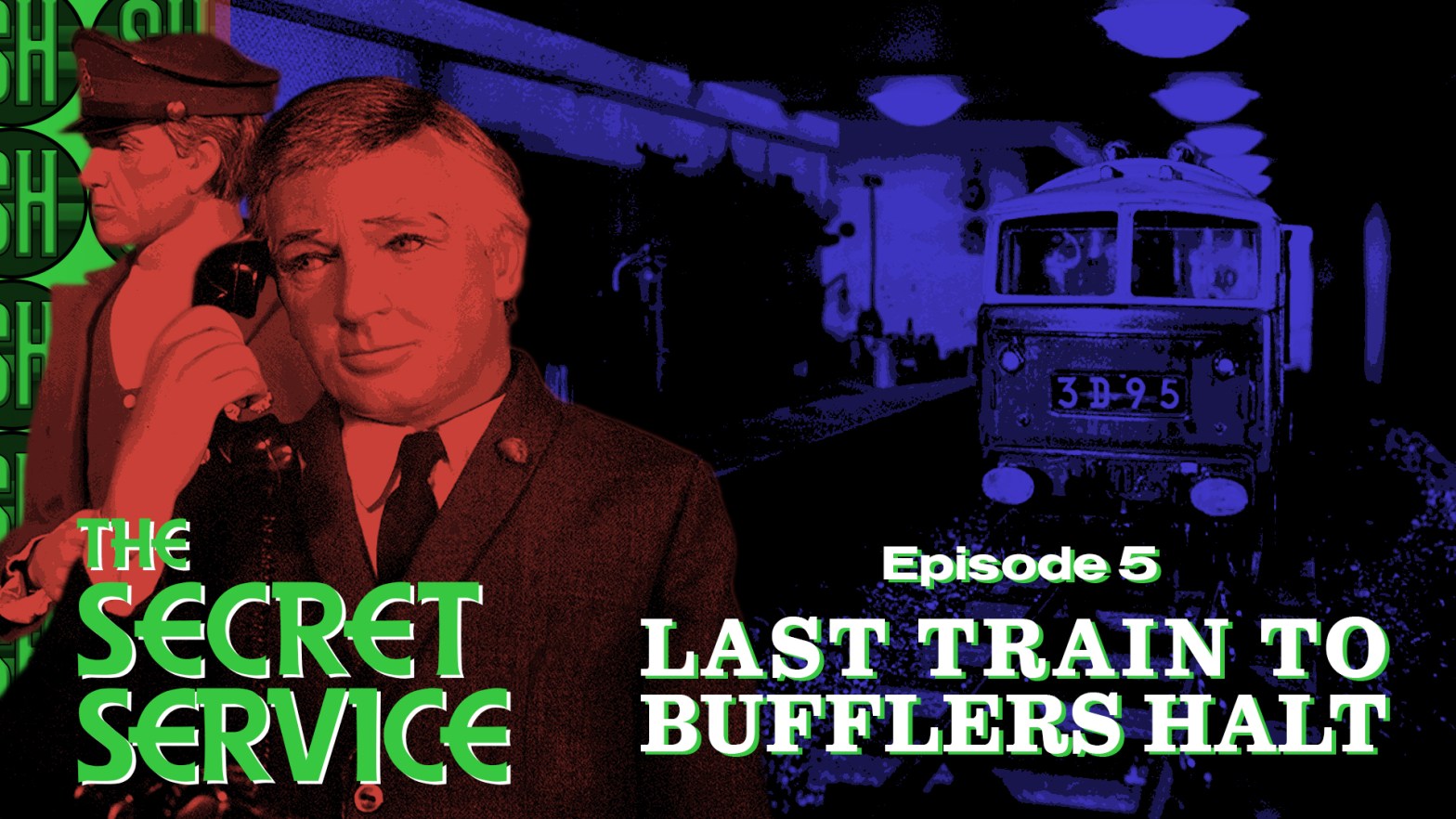
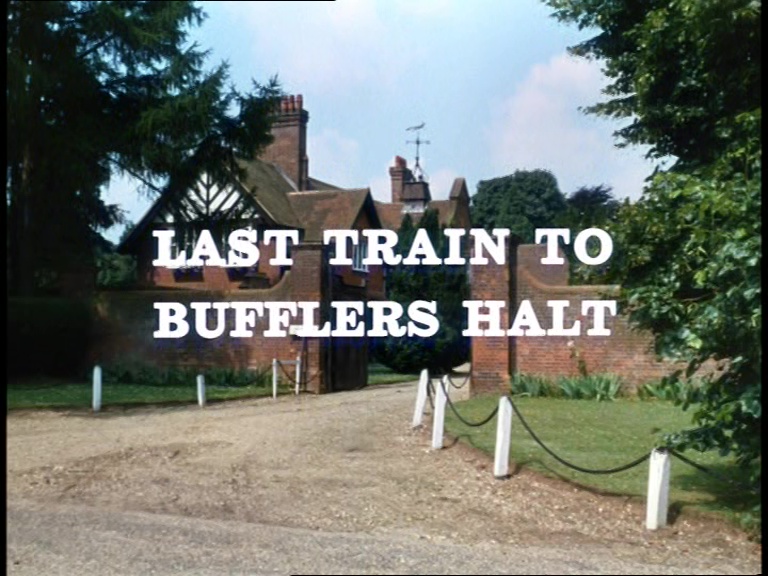
Last Train To Bufflers Halt is “the one with the train.” Pure and simple. I don’t think anyone would contest that. The story embraces all things railway with hearty enthusiasm, and it therefore stands out to me as one of the most memorable, exciting, and entertaining episodes of The Secret Service. A unique mode of transport, a criminal plot wrapped around that, and some loveable characters from the railway thrown in – sounds like a winning formula to me. And is it any surprise that Tony Barwick’s original working title for his script was simply “THE TRAIN”?
Original UK TX:
Sunday, October 19th 1969
5.30pm (ATV Midlands)
Directed by
Alan Perry
Teleplay by
Tony Barwick

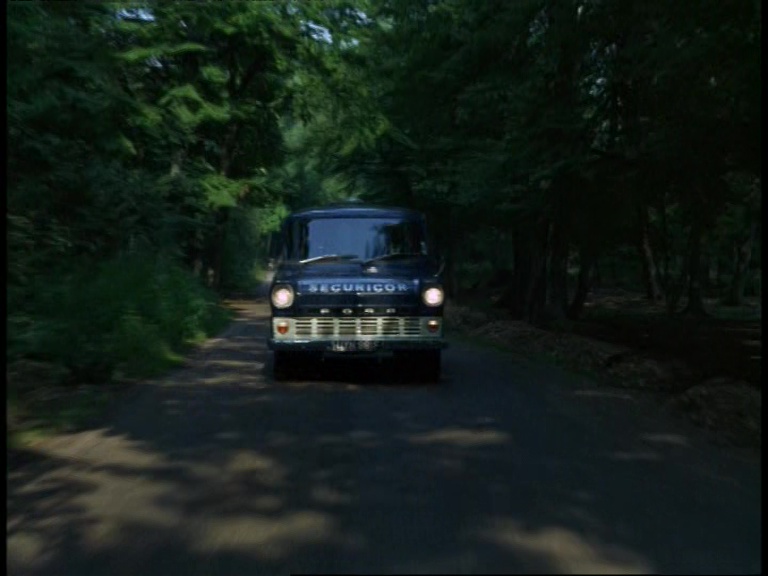
You wouldn’t think it from looking at these shots, but this opening pre-titles scene is supposed to take place at night. Seriously, the day-for-night shooting from the location unit really isn’t fooling anyone. Apart from the van having its headlights on, very little has been done to dodge showing the blue sky or the sunlight streaming through the trees.
That aside, we have a lovely Ford Transit van carrying the Securicor livery. Curiously, Barwick’s script says that it should be “a security vehicle, something like a Securicor Truck” but I guess the location unit decided to take Securicor and run with it by bringing in what appears to be a genuine Securicor vehicle from the United Kingdom security business… either that or its a really good mock-up.
Would it shock you to your core if I said the filming location is Burnham Beeches again? Didn’t think so.
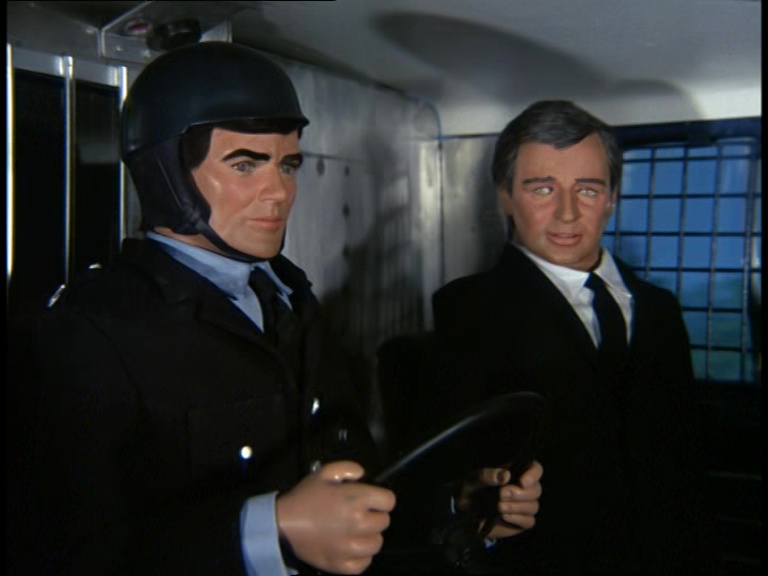
McGrath, our chirpy can-do driver, quickly establishes that this is an important shipment and his boss, Mr Reed, is an important person. In the original script, Reed is named Price… and that’s probably the most noteworthy difference between what was written and the finished episode actually. No secret surprise endings for us this week I’m afraid.
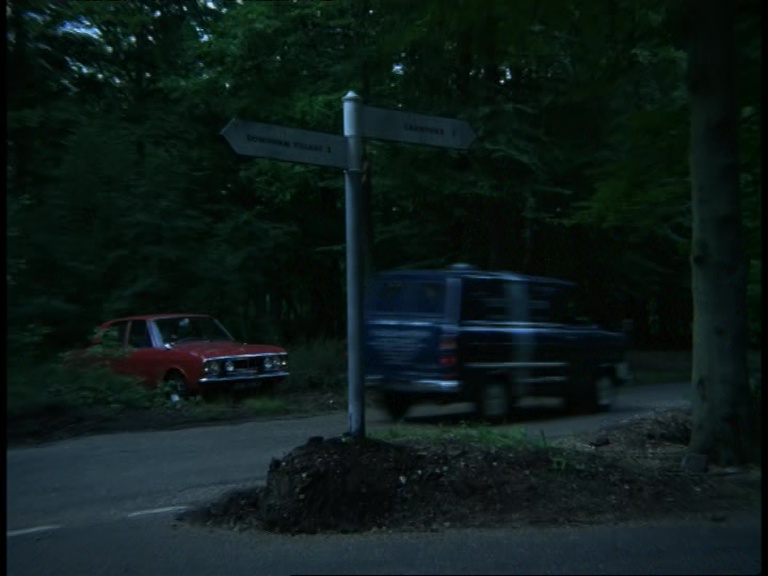
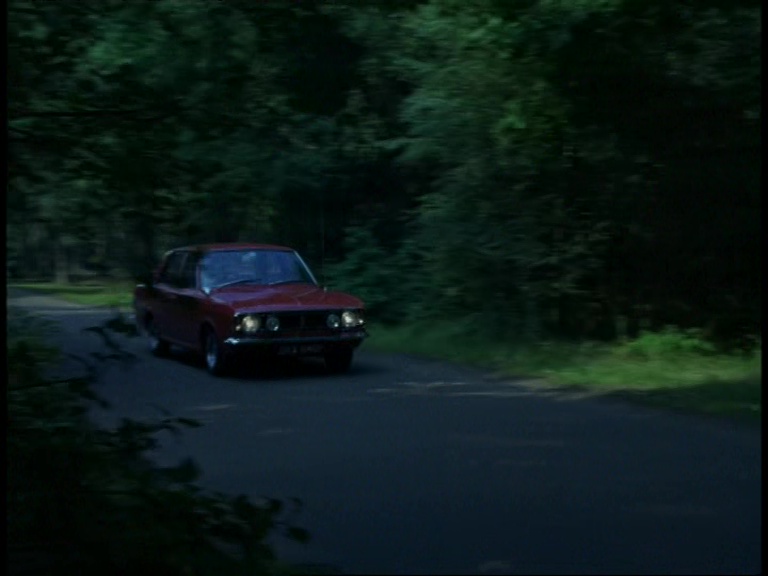
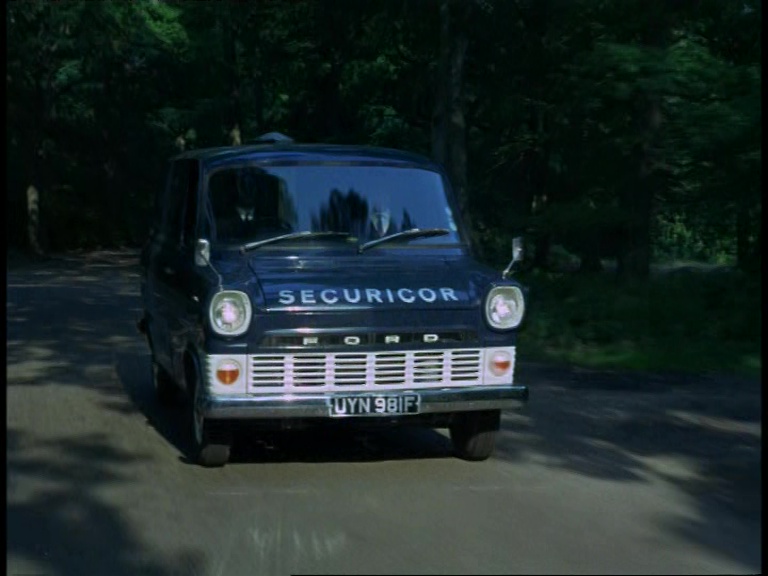
Naturally, Barry Gray is on a roll. Last Train To Bufflers Halt was the fourth and final episode of The Secret Service to receive an original score from Gray, and by thunder does he have fun with it. With great aplomb, the Securicor van whips past a sign towards Cranford which is apparently 3 miles away, coming from the direction of Downham Village which is 2 miles away. Needless to say, this sign post is a load of tosh and we can actually see the manner in which it was unceremoniously plonked at the side of the road by the production team and surrounded by dirt to make it stand up for the purposes of the shot.
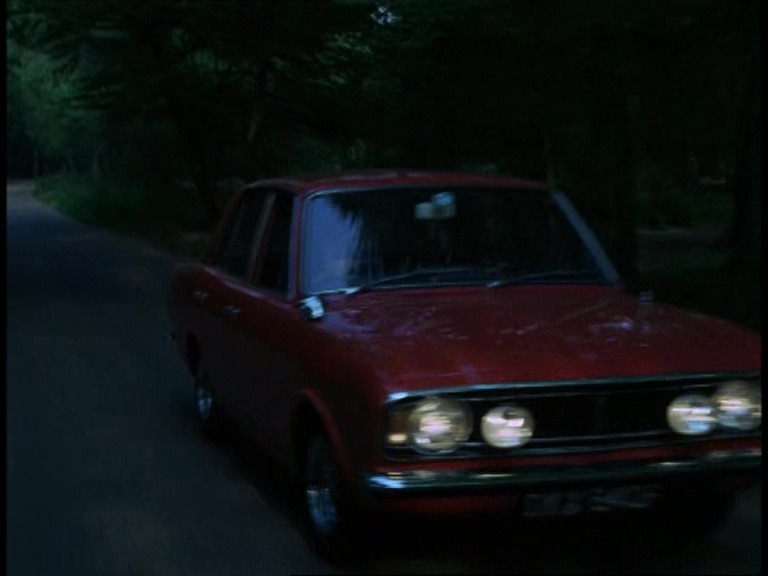
Meanwhile, any of you playing classic car bingo can cross Ford Cortina off your card as one pulls out of a clearing and starts to pursue the Securicor van. Again, very little can be done to disguise the fact this nighttime sequence is being shot in broad daylight.
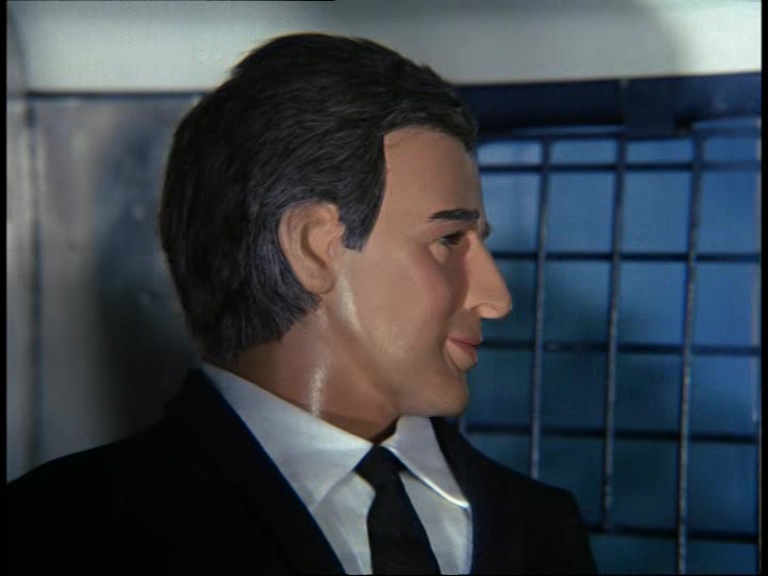
Reed notices their new friend and gives the order for McGrath to do some speeding. Stand by for a damning lecture from Father Unwin… or some words of encouragement… not quite sure where the vicar stands on the matter of dangerous driving these days because it seems to switch depending on the episode.
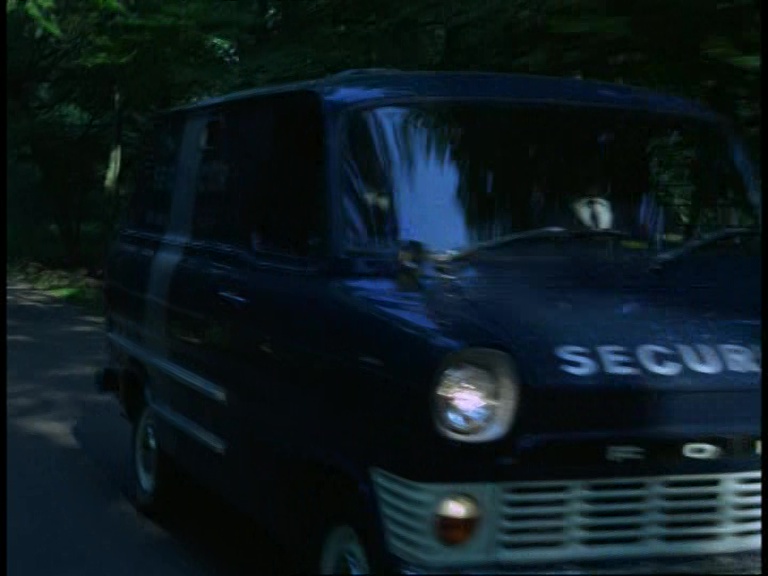
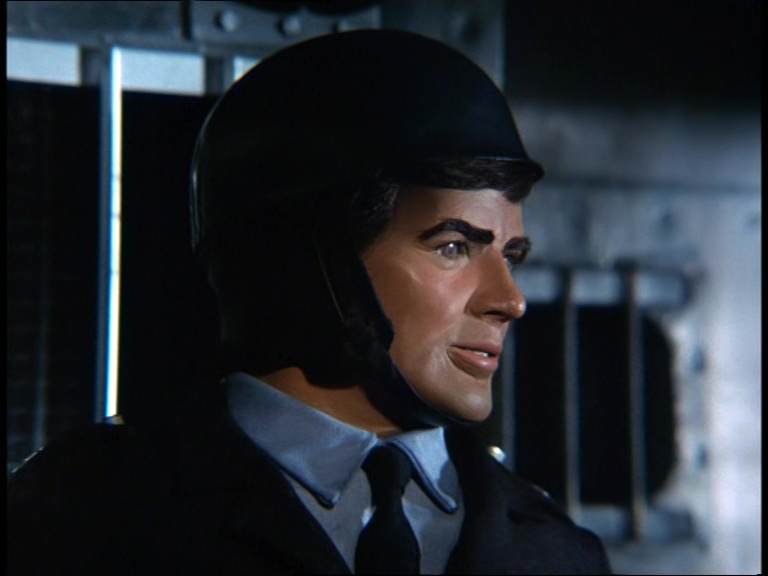
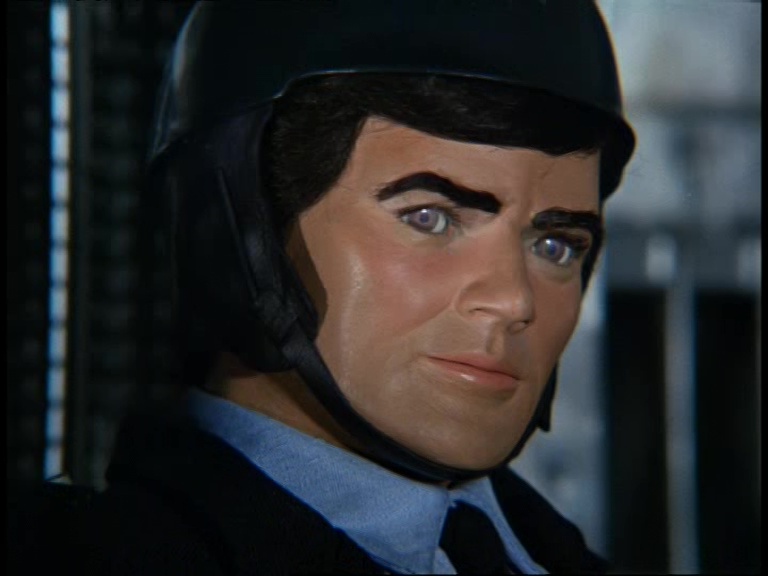
Some effort has gone into making the location footage and puppet material match as we can see a suited man sitting in the passenger seat of the van wearing a black tie, the same as Reed’s puppet. McGrath is keen to ramp up the tension by letting us all know that he cannae go any faster, cap’n because of course he’s Scottish.
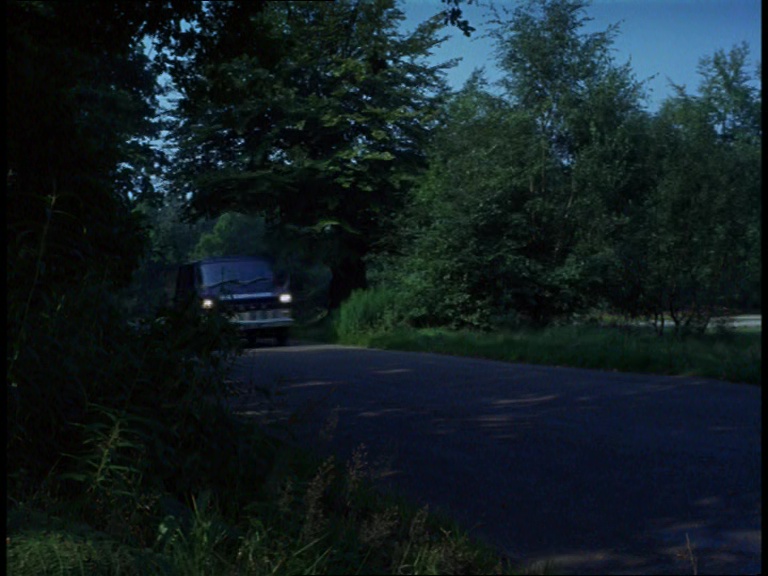
Blue skies, smilin’ at me. Nothin’ but blues skies do I see.
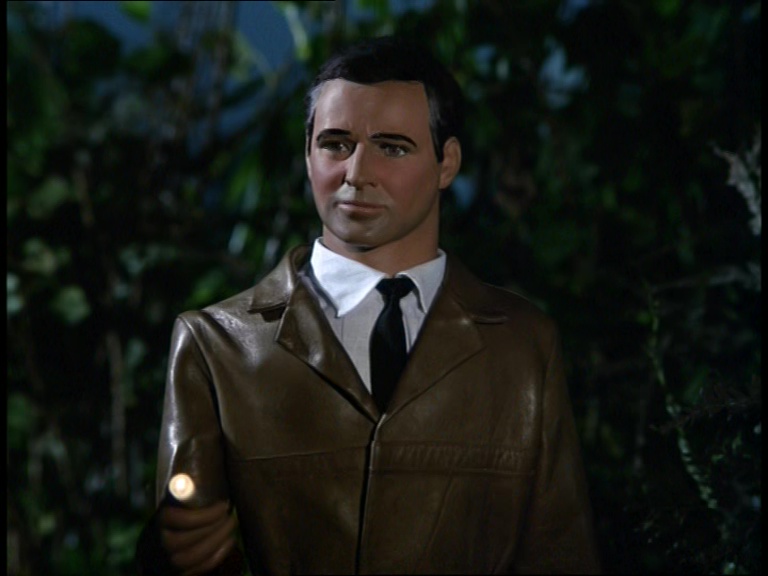
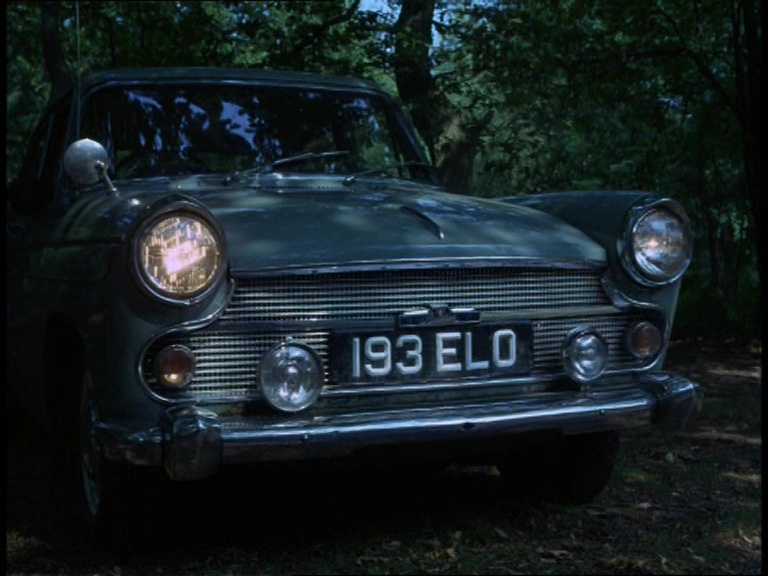
A man in a leather trench coat (and therefore obviously a villain), flashes a signal over to a nearby car – an Austin Cambridge for your bingo cards – which flashes back in acknowledgement. The mix of puppets and live-action is working quite well here. Puppets for any and all human shots, live-action for all the vehicle stuff – it all works together well enough because there are some rules in place.
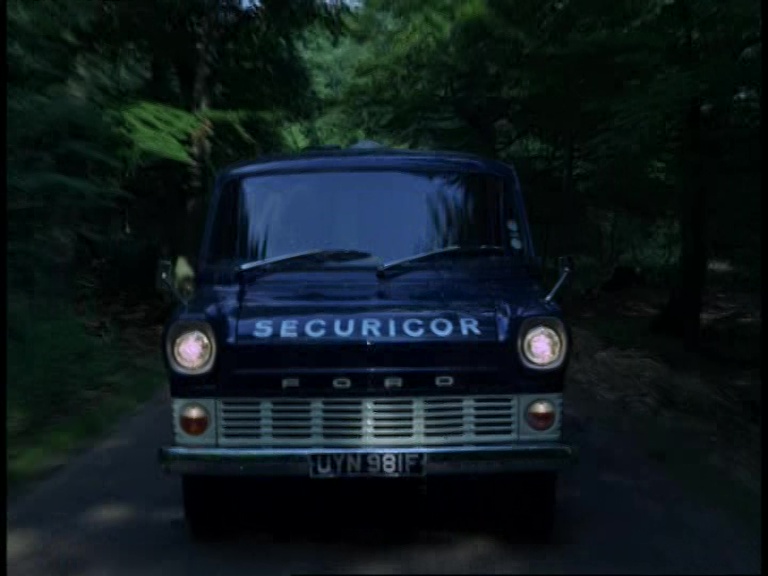
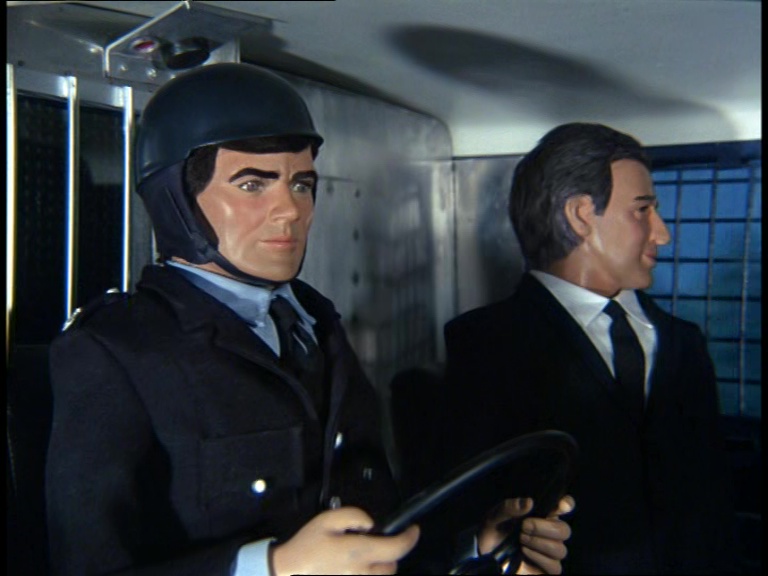
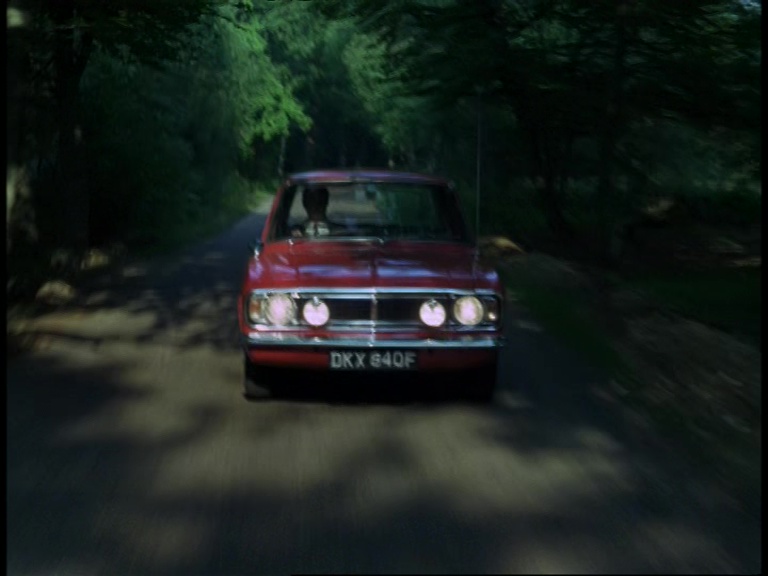
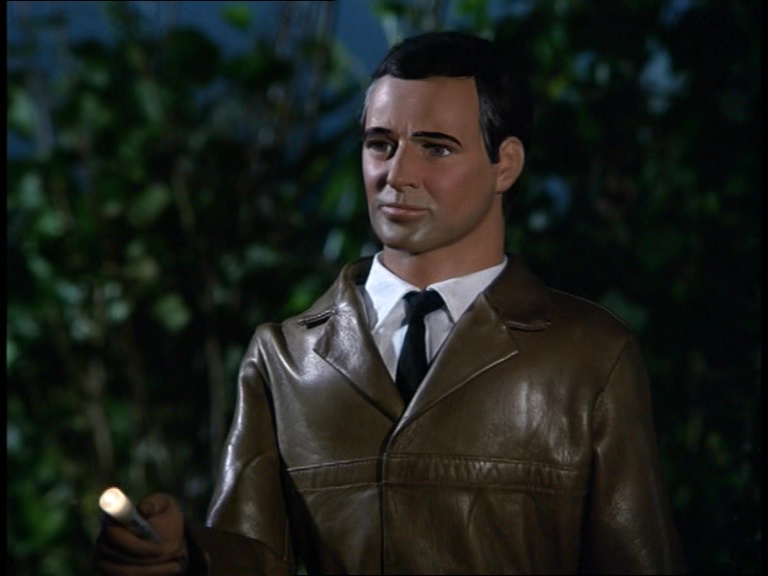
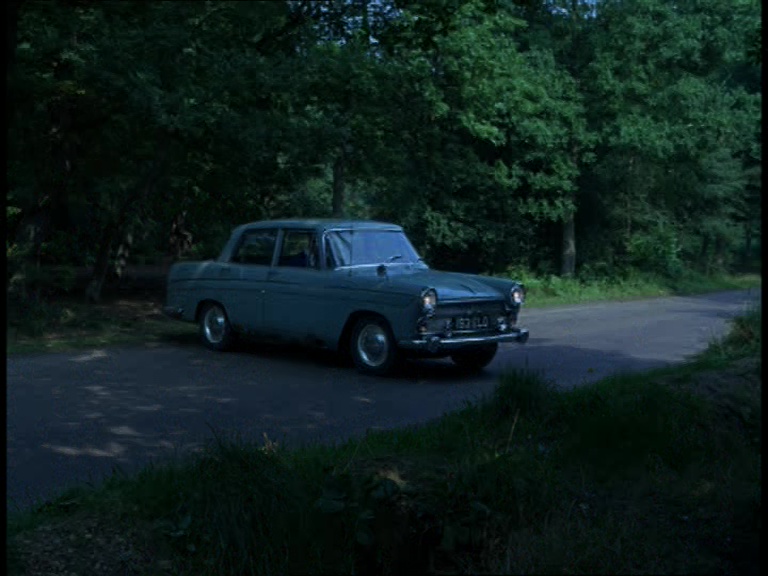
In isolation, the individual shots of classic vehicles driving along country roads inter-cut with puppets doing their thing doesn’t look much like an exciting chase sequence. Yet, somehow, with the music and the magic of editing, it all comes together to make something fairly dramatic. It’s not exactly heart-thumping action, but it does the job.
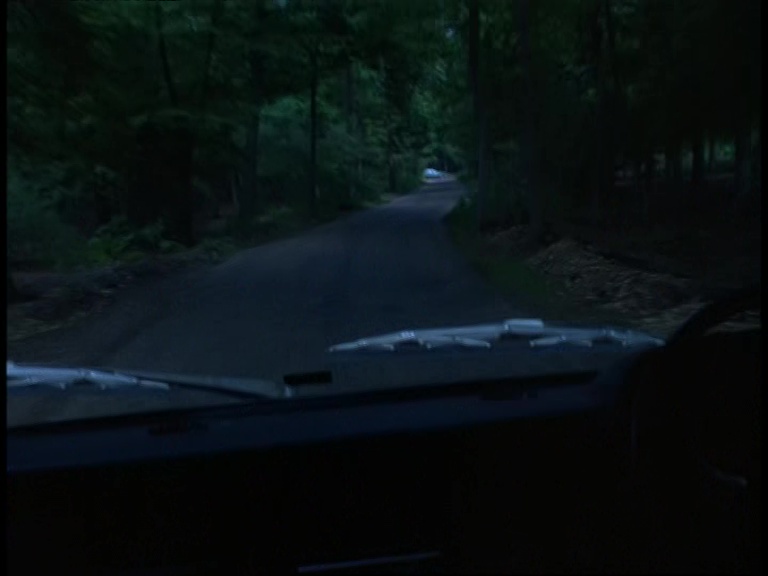
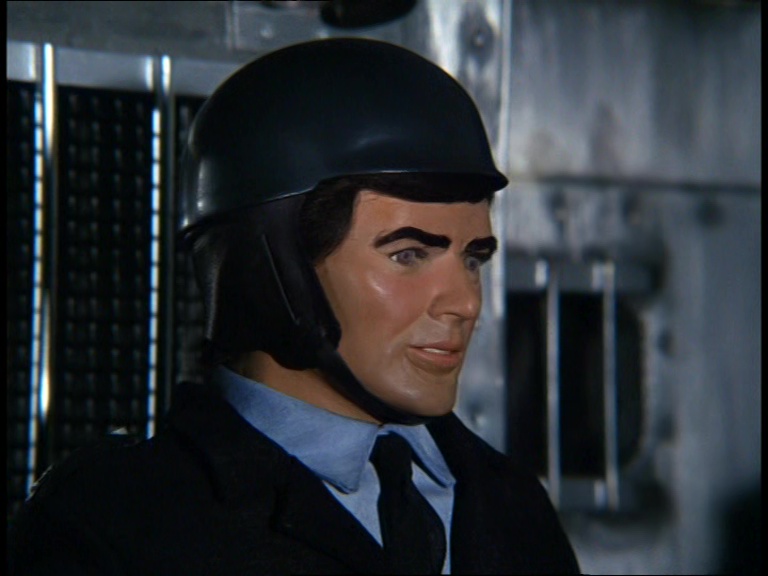
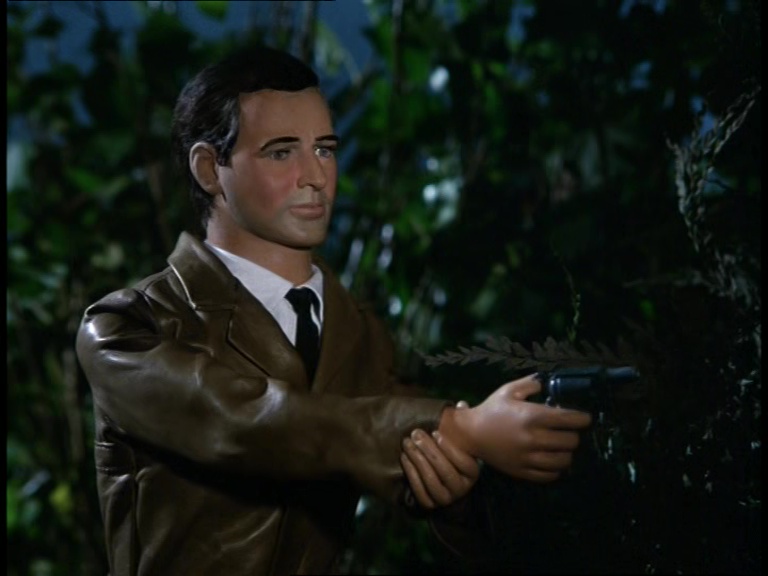
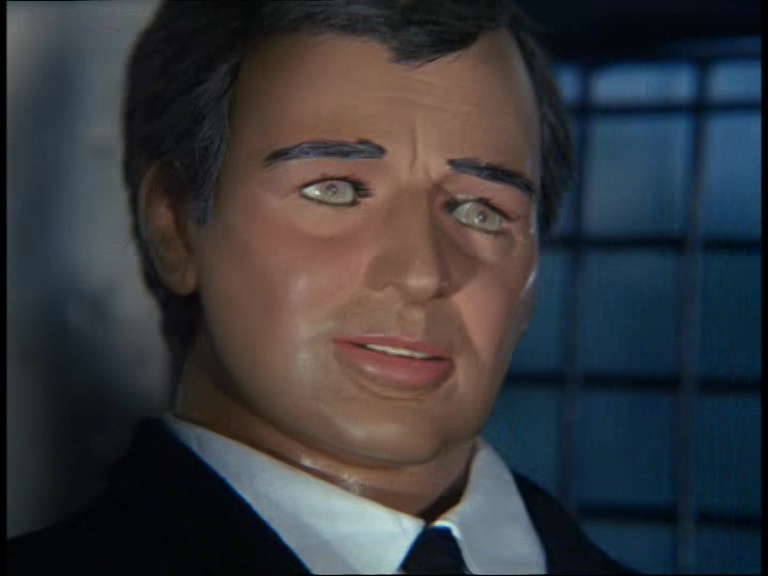
McGrath being the brave man of action isn’t deterred by the possibility of an ambush as they approach the Austin Cambridge parked across the road. Reed, on the other hand, is quite keen on stopping… the wimp.
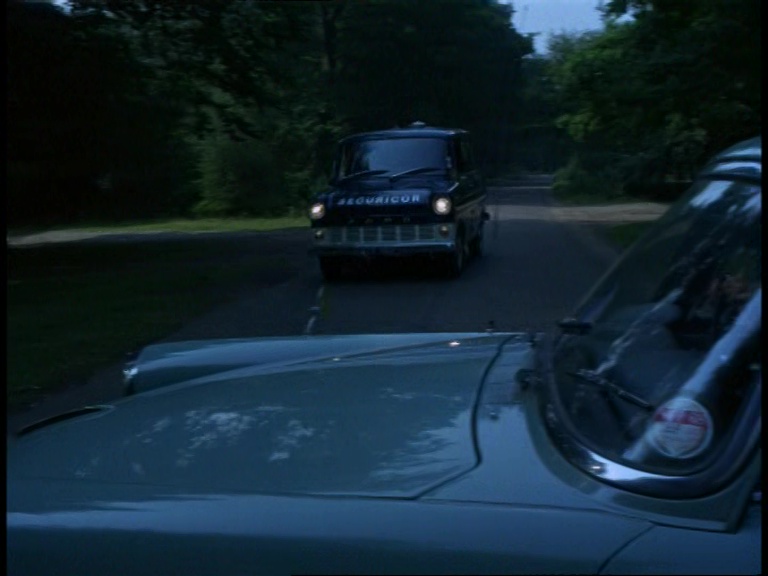
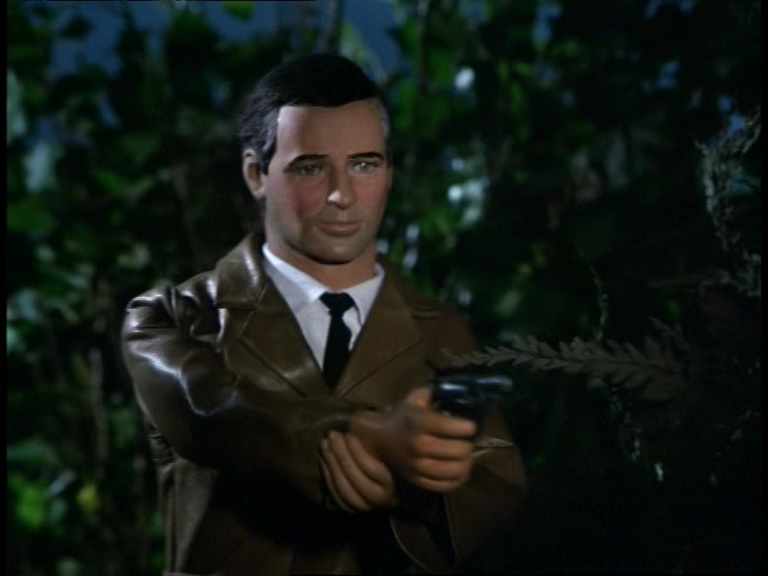
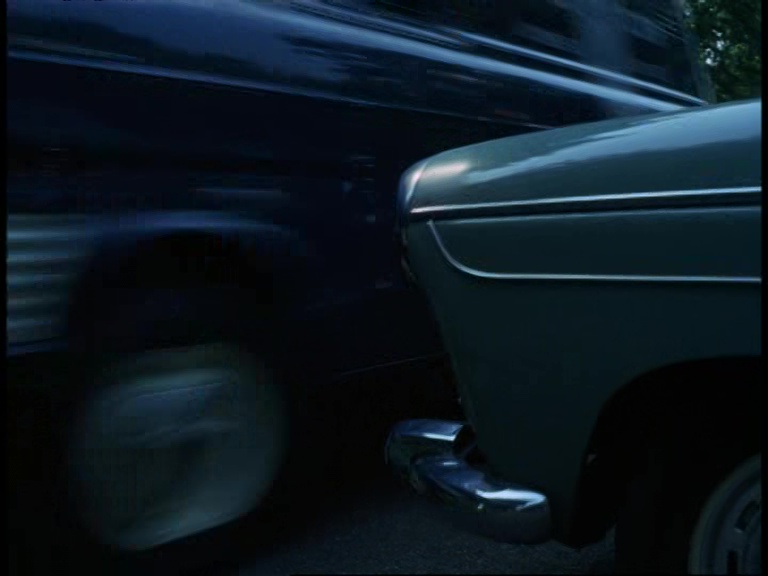
When viewed in context, the climax to this sequence is reasonably thrilling because of how fast everything is cut together. But the illusion is spoiled slightly by a very wide gap to the right of the Securicor van, followed by the car comically wobbling around as the van clearly passes no-where near it. I get it, nobody on the crew wanted to scratch the cars, and the editing is fast enough that it all works regardless of the slight silliness. McGrath looks like an absolute champ for that fantastic display of driving vaguely close to another car.
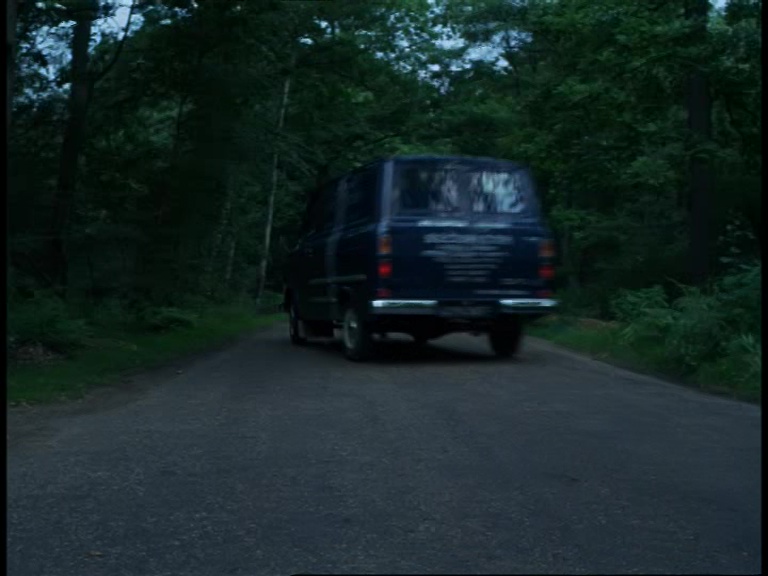
Some of the footage has been sped up which somehow simultaneously makes it more exciting but also more humorous.
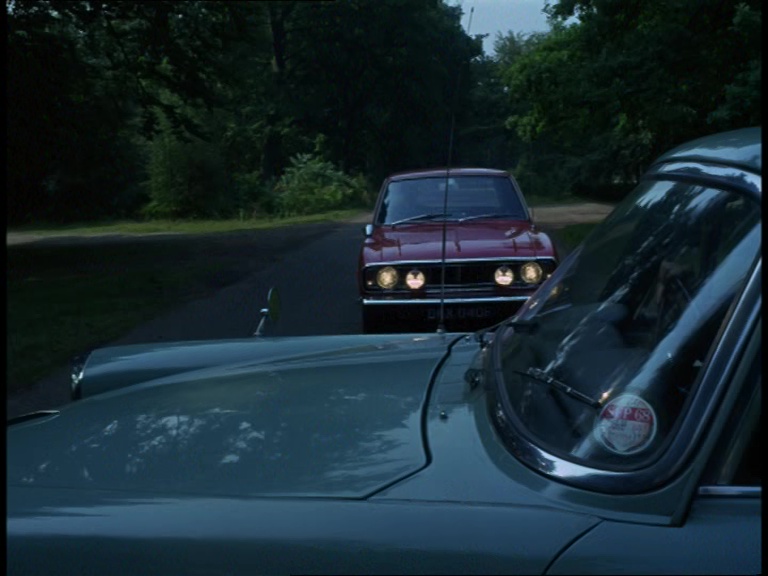
The Cortina can’t possibly drive through the generous gap left in front of the Cambridge so is forced to stop. The tax disc in the windscreen clearly puts us somewhere around September 1968… probably the easiest bit of detective work I’ve ever done. Remember tax discs? I mean what was that all -about?
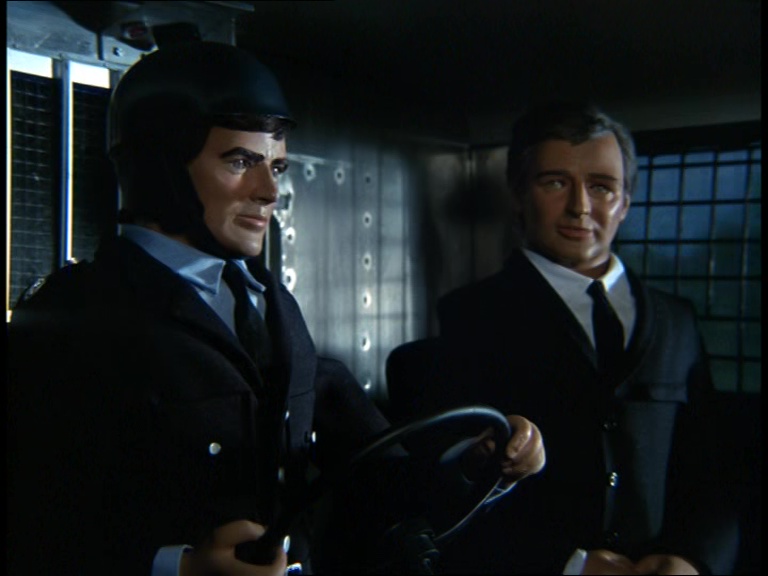
McGrath is pleased as punch. Just wait until the lads in the pub hear about this.
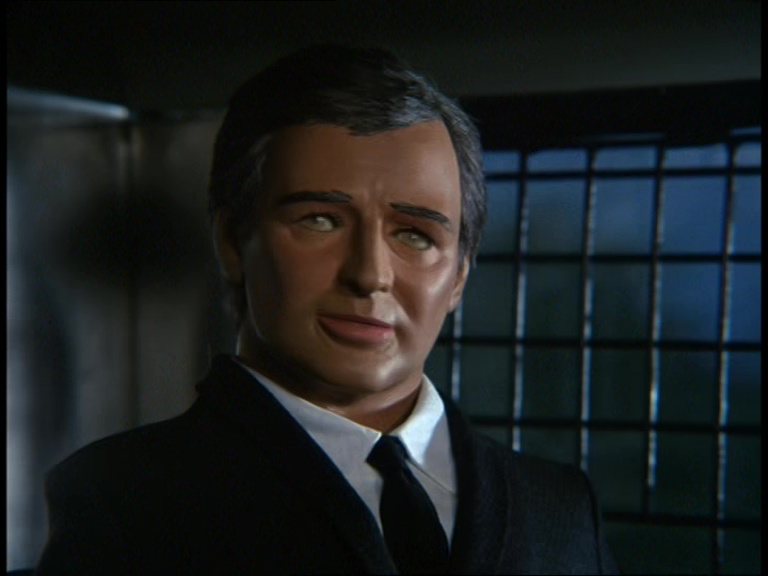
Meanwhile, I think Tony Barwick’s description of Reed says it best: “He can hardly conceal the fact that he is not very pleased about their success.” Yes, Mr Reed is a baddie and Barry Gray is kind enough to spell it out for us with a final musical flourish before we head into the opening titles.
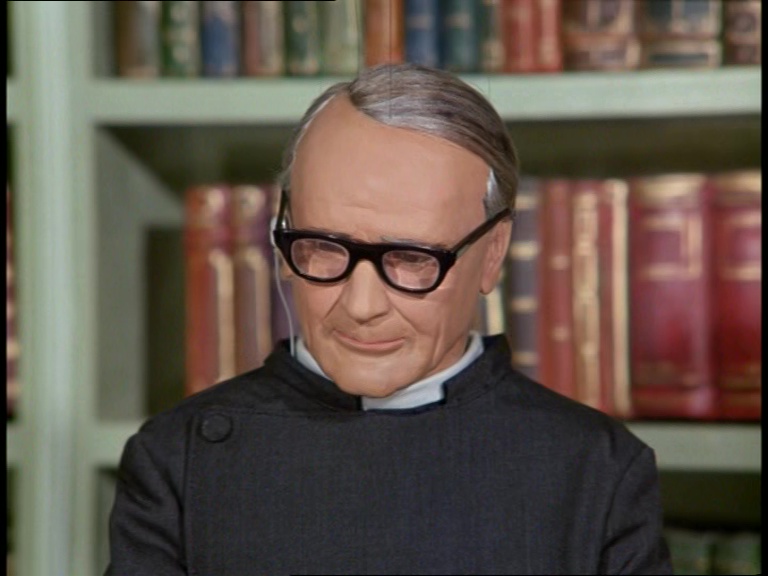
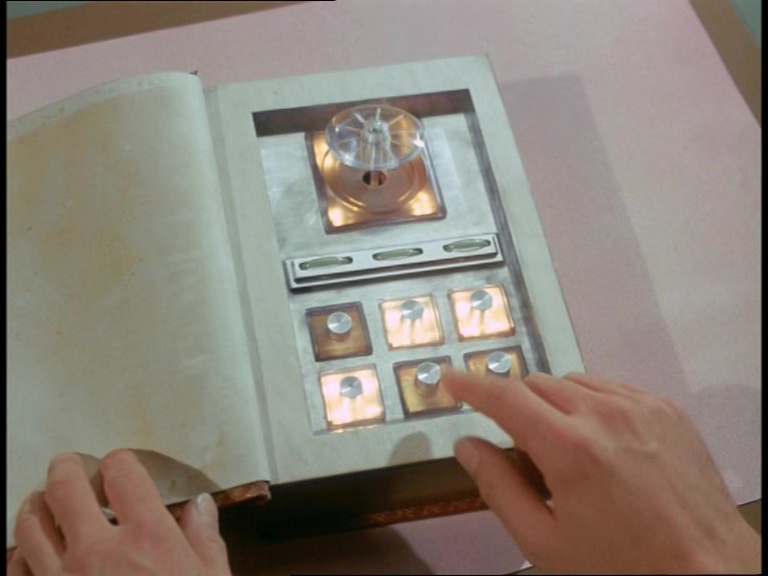
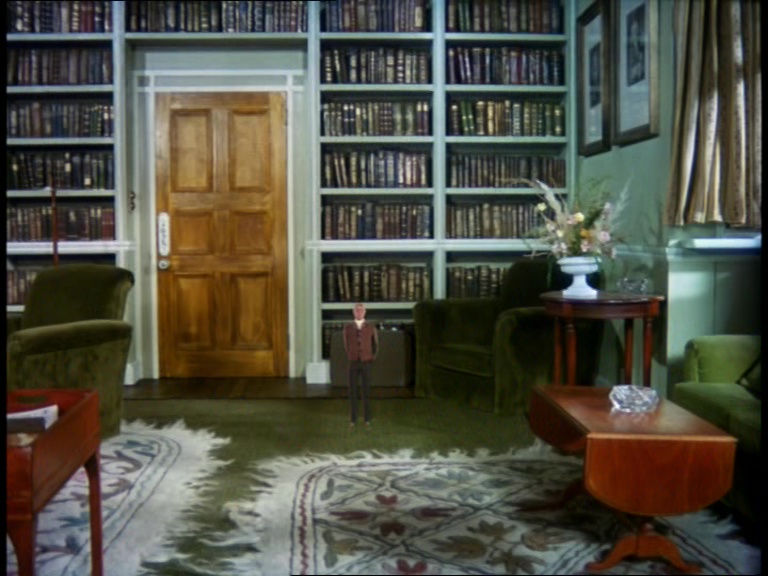
Without an ounce of messing about, we’re immediately into Matthew getting miniaturised in the usual fashion. This scene isn’t actually in the script and mostly borrows material from earlier episodes. It certainly gets us going nice and quickly and makes for a nice change of pace – previous episodes have rather laboured working the story up to the point that Father Unwin and Matthew are called into action.
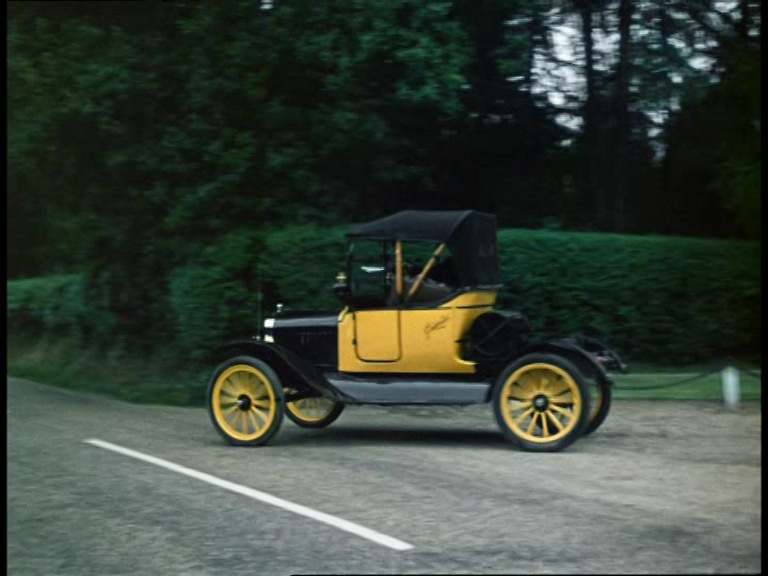
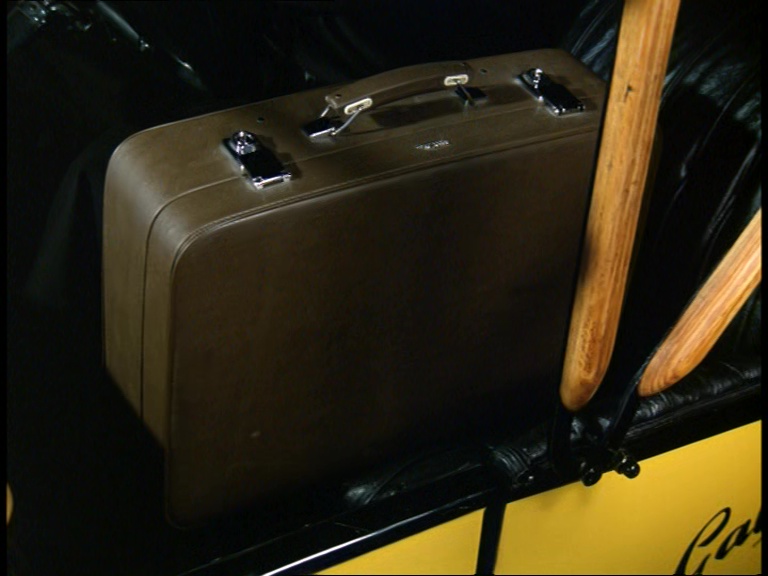
Gabriel blasts off, turning right out of the Vicarage with the roof up and Matthew safely concealed in the case. Our trusty heroes, heading out to fight for justice once again. Now that we’re firmly into the series, there’s a lovely sense of familiarity and excitement we, as viewers, can now associate with these stock sequences which counters the quirky humour that comes along with them.
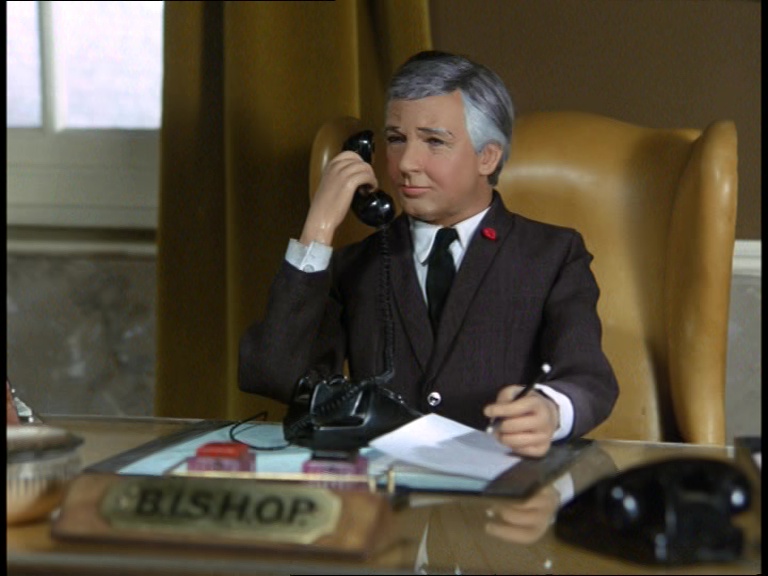
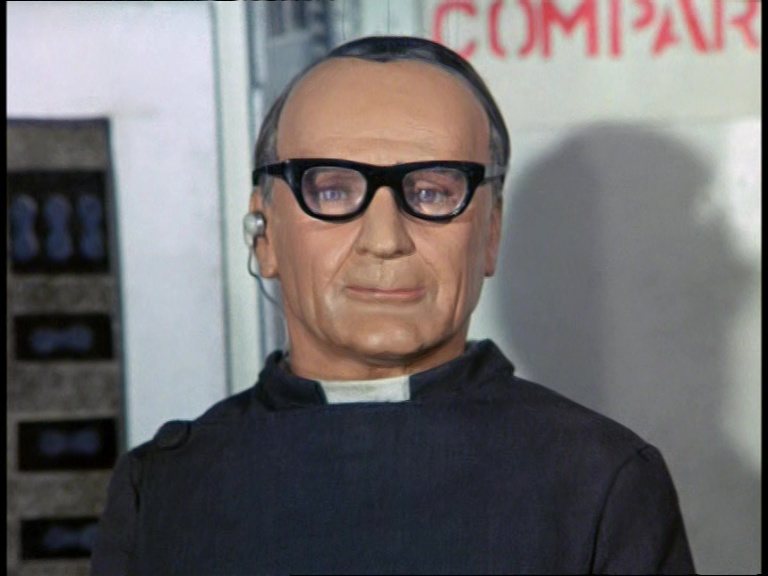
Meanwhile, over at his office in Whitehall, the Bishop is visibly irritated by a phone call, apparently from “a blustering Colonel type” offering up nothing but “UNINTELLIGIBLE BLUSTERING.” It’s a scene that is beautifully played not only by Jeremy Wilkin, but by the puppet operator who manages to capture the physicality of the Bishop’s polite weariness. The little nuances of the puppet’s posture and pen tapping on the desk all deliver an incredible amount of subtext and humour. Without that, this scene wouldn’t sparkle in the way that it does.
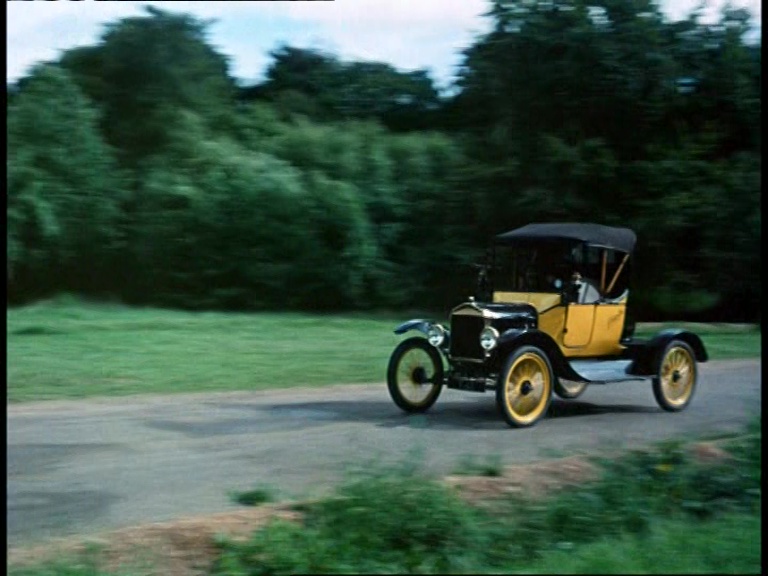
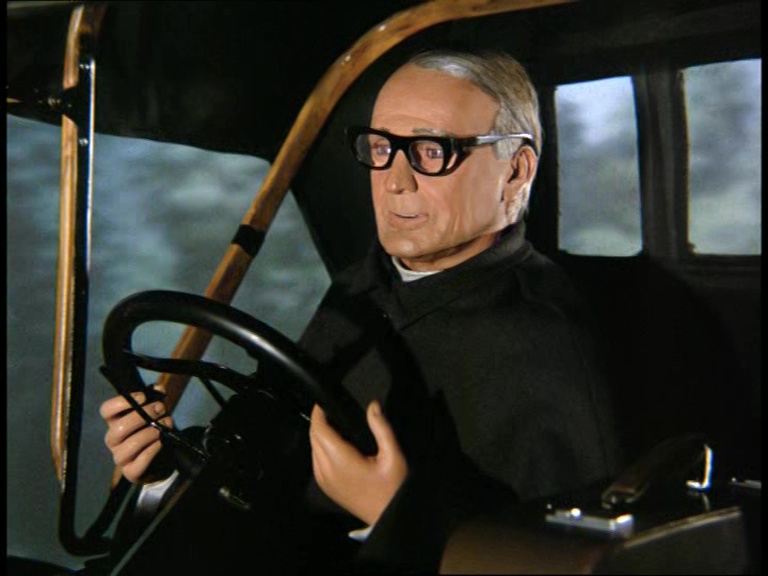
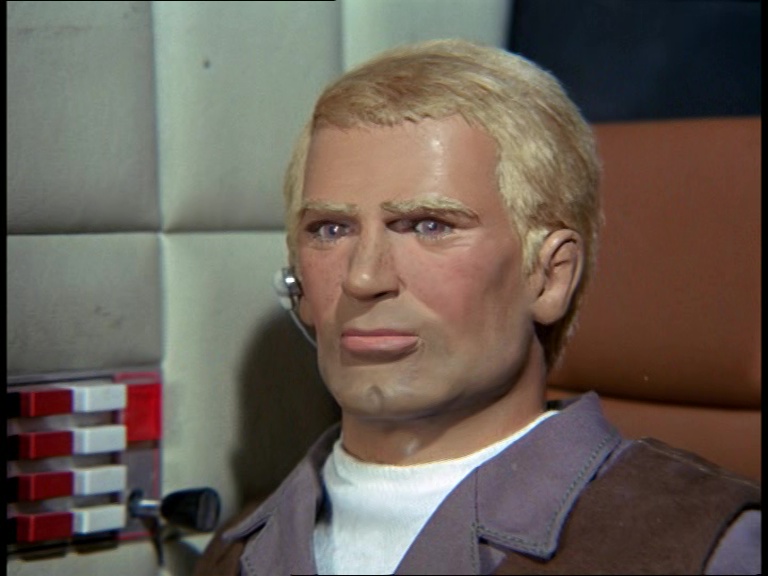
Barwick very intentionally contrasts the Bishop’s “fast as the marvels of modern transportation” line with the next scene of Gabriel dawdling along the road, and Father Unwin yet again struggling with the concept of speed. This is another excellent bit of character work which very subtly also contrasts with the high speed that Unwin experiences in the final moments of the episode. The benefit of Tony Barwick acting as the writer and script editor for the series is that he often displays an incredible knack for tightening his episodes down so that barely a moment goes wasted, and even the most casual moments do something to serve the narrative.
I had a quick look into Father Unwin’s remark about the law that “a motor vehicle be preceded by a man with a red flag” just because it’s the type of thing I’ve heard about but never actually studied in detail. The so-called Red Flag Act known more formally as the Locomotive Act 1865 stated quite firmly:
Firstly, at least three persons shall be employed to drive or conduct such locomotive, and if more than two waggons or carriages he attached thereto, an additional person shall be employed, who shall take charge of such waggons or carriages;
Locomotives Act 1865
Secondly, one of such persons, while any locomotive is in motion, shall precede such locomotive on foot by not less than sixty yards, and shall carry a red flag constantly displayed, and shall warn the riders and drivers of horses of the approach of such locomotives, and shall signal the driver thereof when it shall be necessary to stop, and shall assist horses, and carriages drawn by horses, passing the same.
Remarkably, this incredibly restrictive law was upheld for 31 years before it was finally repealed on November 14th 1896, much to the delight of the British motor industry, and the likes of our friendly speed demon, Father Unwin.
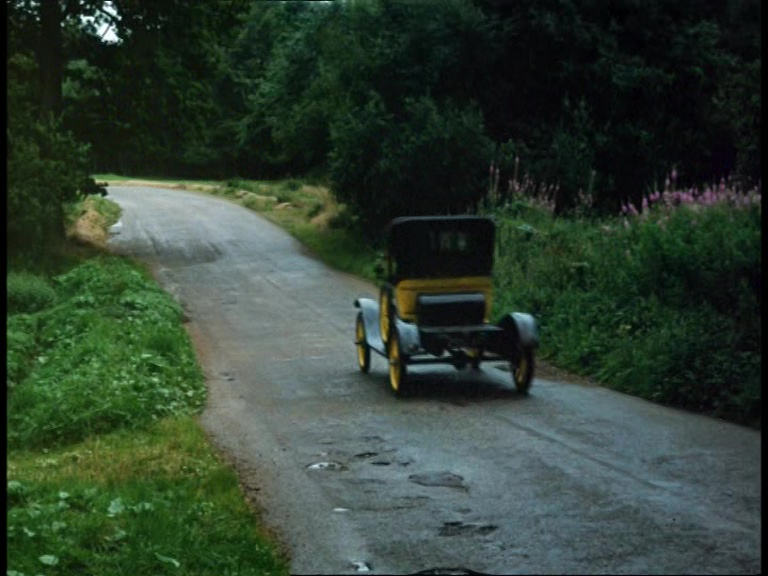
Barwick’s script continues, “The MODEL T continues on its merry way.” You can tell that everyone at Century 21 seems a little more at ease with the quaint charm of The Secret Service now because of cute little descriptions like that turning up in the scripts.
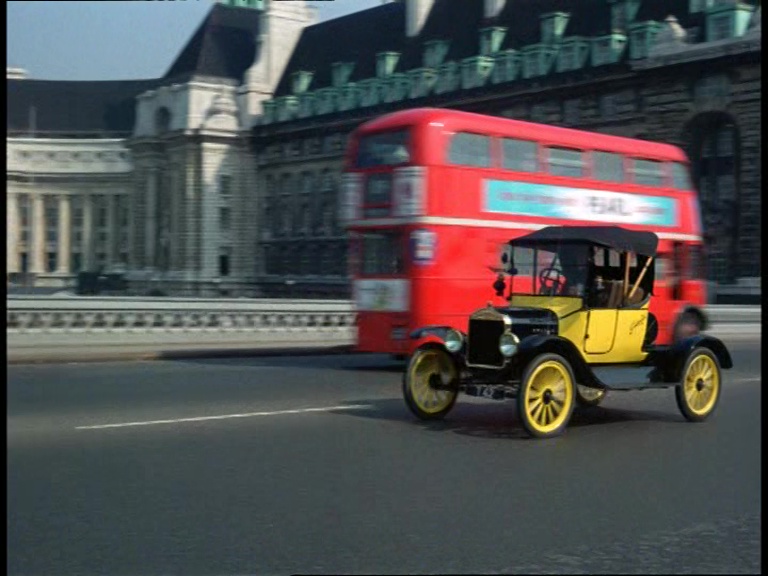
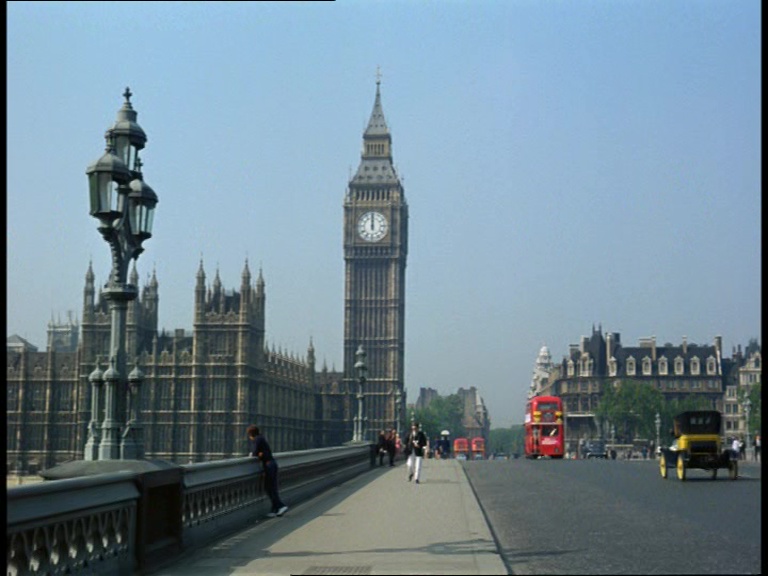
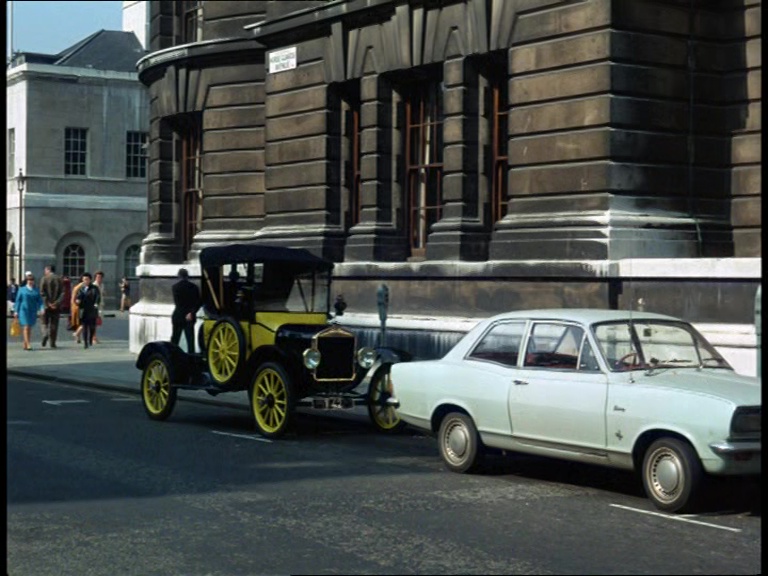
In case you were in any doubt about Britishness being a key selling point of The Secret Service, here’s Gabriel crossing Westminster bridge, passing a Routemaster bus and heading towards the Houses of Parliament, before parking opposite House Guards behind a Vauxhall Viva. If the Andersons had any intention of selling The Secret Service to the US when they dreamt up this format, it was on the basis that Americans might be intrigued by the British setting and characters, because they sure won’t deceive anyone into thinking its an American show as they attempted to do with Stingray and Thunderbirds.
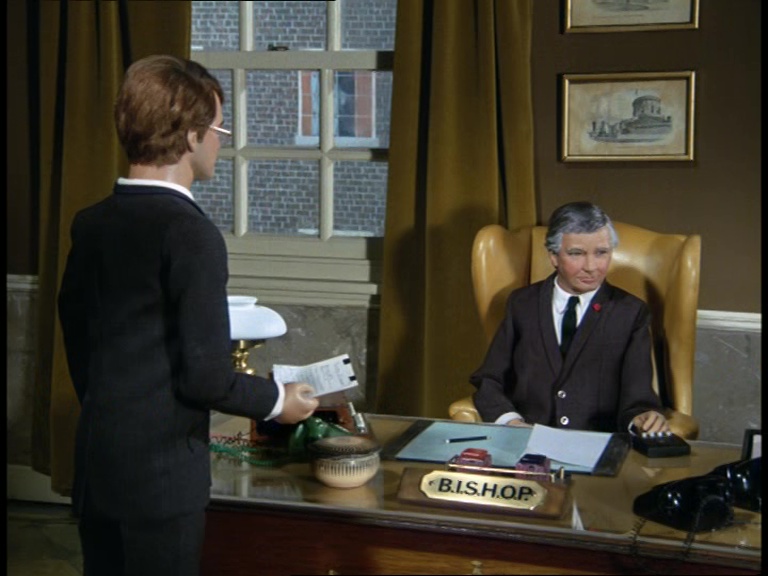
Agent Blake is hastily dismissed from the Bishop’s office with promises to have a report ready in the morning. The script refers not to Blake, who was otherwise an unnamed agent in the earlier script for A Question of Miracles, but to an entirely different character known as Carstairs. This evidence suggests that the production originally had no intention of making Agent Blake (Captain Scarlet in disguise) into a recurring character until some time after a few scripts had been delivered for the series. In some ways it’s a pity that the BISHOP organisation isn’t expanded with additional characters like Carstairs, but on the other hand, a smaller team unit of familiar faces seems more appropriate for the quaintness of the series.
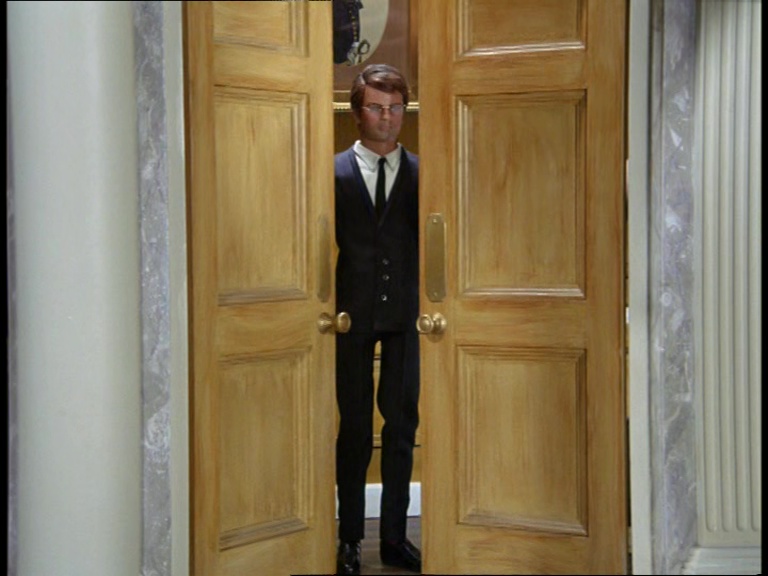
Apparently Blake still isn’t allowed to know anything about Unwin and Matthew working for BISHOP, so he’s forced to go upstairs without supper and think about what he’s done.
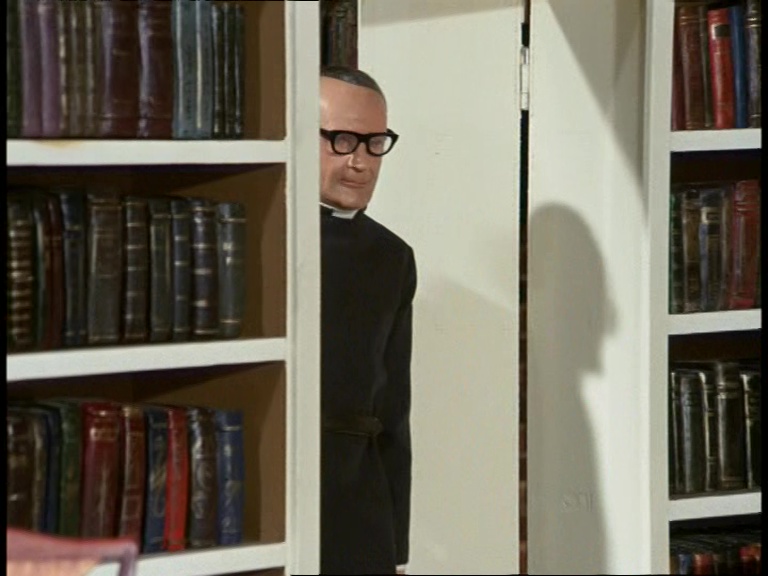
Father Unwin is admitted inside the Bishop’s office for the first time in the series via a secret door hidden in the bookcase. A note in the script says, “The secret entrance (ref: Keith Wilson) slides back to show FATHER UNWIN carrying the case.” The fact that Barwick isn’t too specific about the nature of the doorway in his script suggests he was very much leaving it up to Keith Wilson and the art department to figure out how best to integrate a secret passage into the existing set. The bookcase serving as a hidden door is something of a classic so I can’t blame Wilson for taking the obvious route with his design.
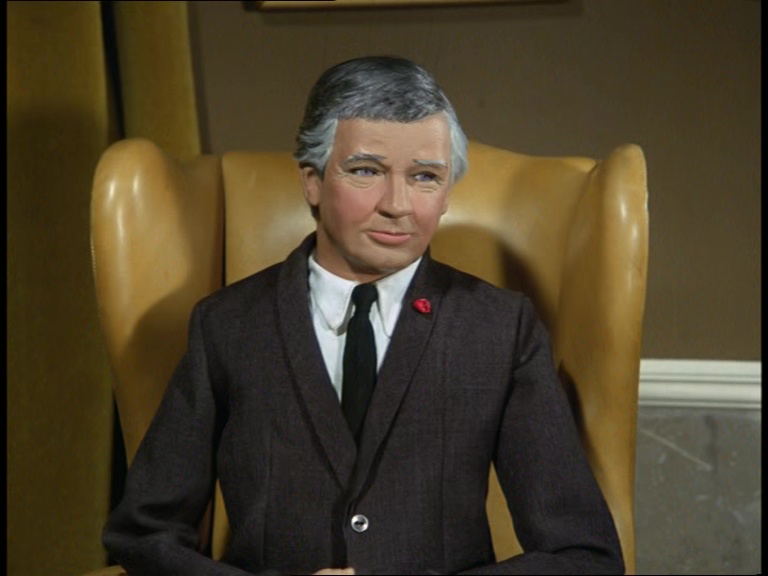
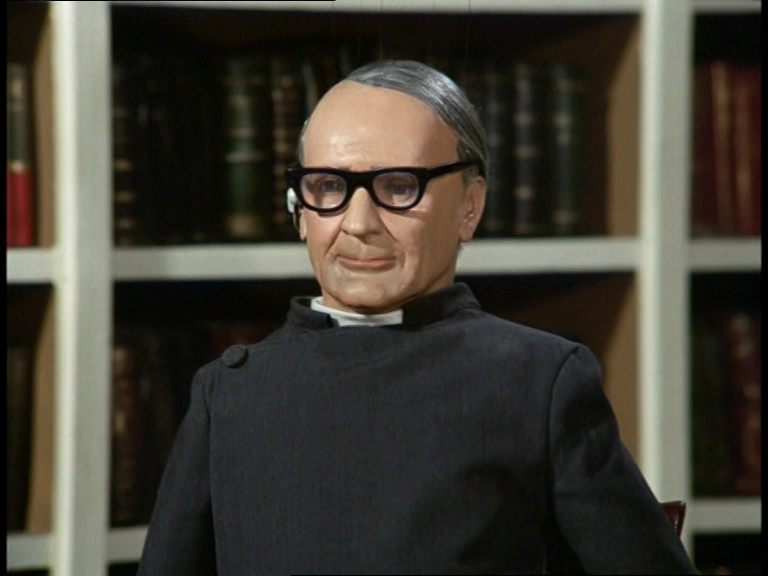
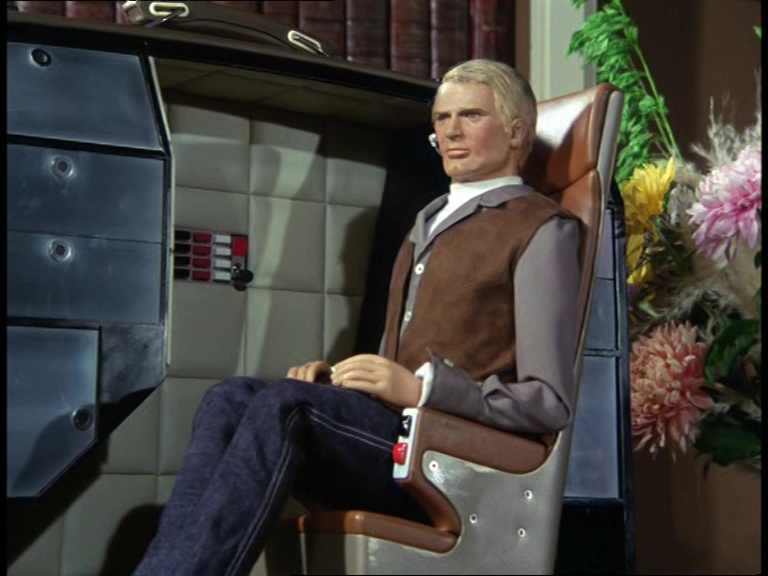
This scene is noteworthy as the first time that we’ve actually seen Father Unwin and Matthew meet with their superior on-screen. Previously, all communications have taken place via the hearing aid radios. There are some interesting details about the relationship to note in the dialogue –
The Bishop is audibly taken aback by Matthew being hidden away and it takes a slight hesitation for him to feel comfortable addressing the case directly. It suggests that while the Bishop is familiar with Matthew’s unique setup, he perhaps hasn’t seen it for himself all that often.
This is borne out in the next line referring to this as an “all too infrequent visit” which confirms that the Bishop rarely meets with these particular operatives in-person. Presumably, all communications and briefings are handled remotely in order to better maintain Unwin and Matthew’s cover, and also to avoid the practical limitations of Gabriel having to drive into London every week. It also suggests that the Bishop thinks of them fondly, and perhaps wishes they were able to see each other more often. After all, we have no idea how Unwin and Matthew came to be involved with BISHOP, and can therefore only infer from this dialogue that maybe, possibly, they were friends or colleagues prior to the events of the series beginning – if we believe the possibility that A Case For The Bishop was their first assignment which, again, we don’t know for sure.
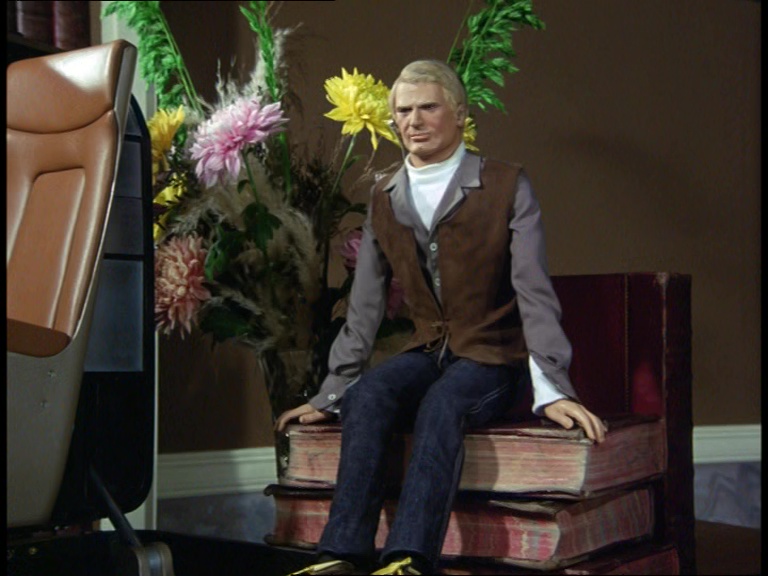
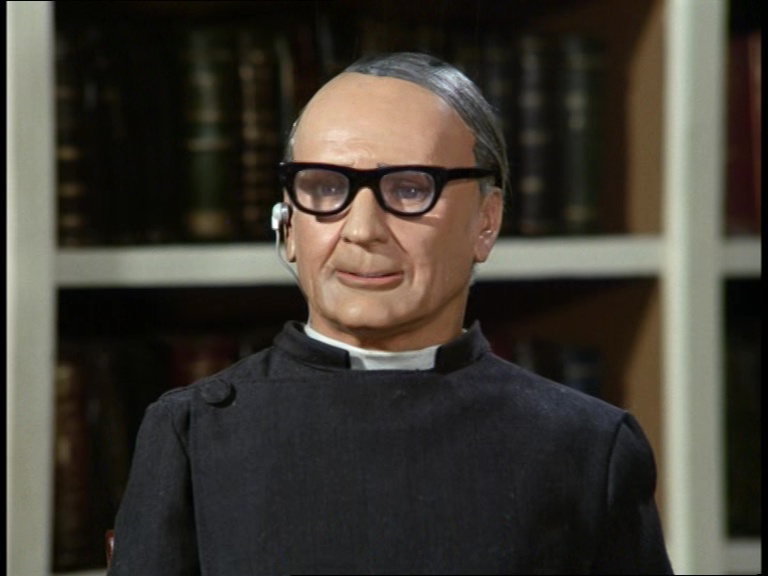
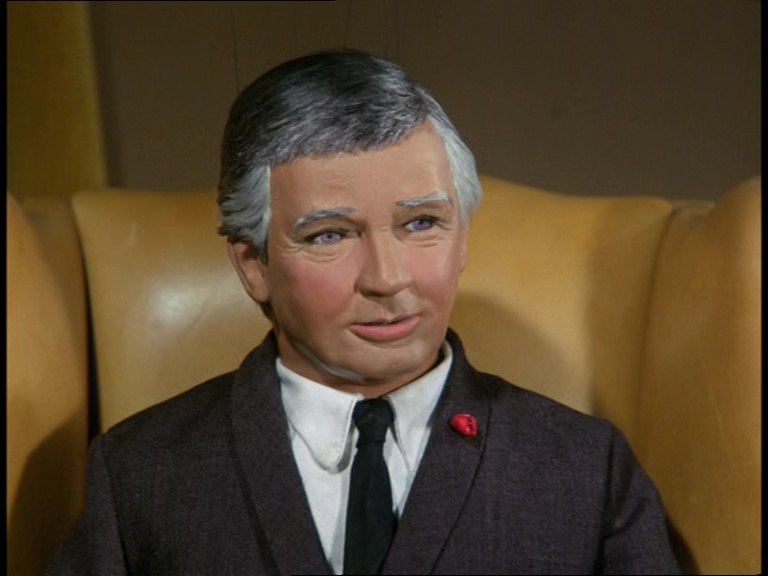
We don’t have long to speculate further about the relationship between Unwin, Matthew and the Bishop though because it’s time to get to the plot. Presumably, Barwick wrote this scene as an in-person briefing just so we could have a change of scenery and a change of pace from the way previous episodes have done things. The mission itself, doesn’t actually sound that much more important than any of the previous ones.
We learn that the Securicor truck from the pre-titles sequence was carrying “nearly a million pounds worth of used bank notes.” This is an alteration of the original script which instead states the more enticing, “five million pounds worth of gold bullion.” Why the change from bullion to bank notes at less than a fifth of the original value? We don’t know for sure, but it probably has something to do with the fact that £5,000,000 of gold bullion probably would have weighed somewhere in the region of several tons – the exact math gets a bit complicated when dealing with dollars vs. pounds so give me a break. Either way, £1,000,000 in paper bank notes sounds a lot more practical to cart about on the back of a Ford Transit or a train.
Anyway, all that aside, the Bishop wants to prevent another hijacking and so plans to plant Unwin and little Matthew aboard the next shipment, which is moving from the Cranford vault to London tomorrow by rail, rather than by road. Well, that’s the plot all nice and neatly set up for us!
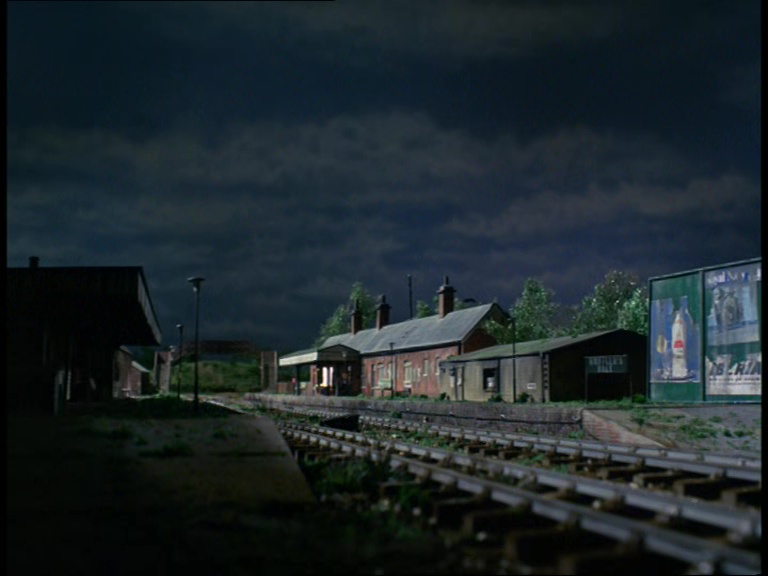
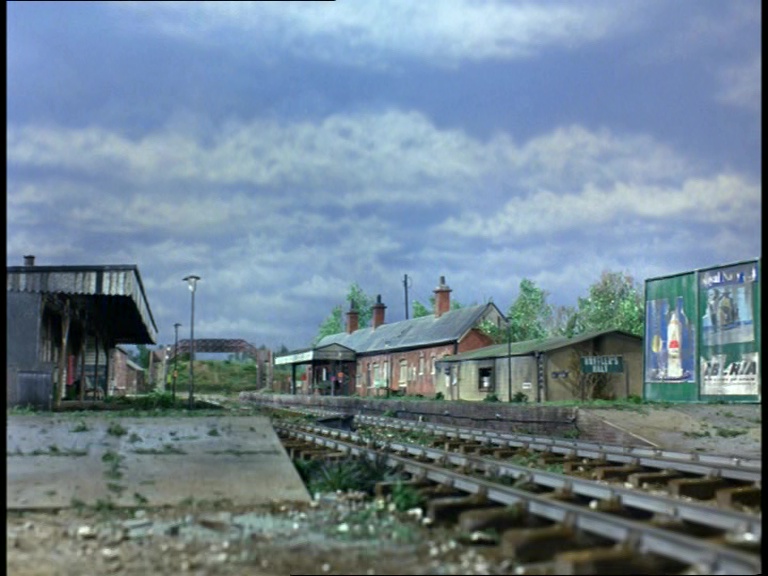
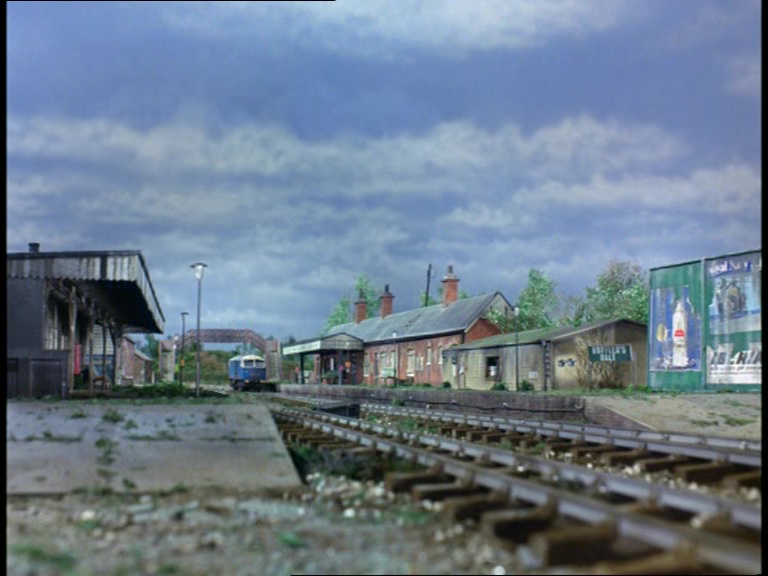
The first of many model shots for this episode shows a rundown and overgrown train station with a single light on inside the building. Presumably to aid with continuity it was decided to use a model set rather than a real location to represent Buffler’s Halt.
Abandoned railway stations weren’t exactly in short supply in 1968. The infamous Beeching Report issued on March 27th 1963 identified 2,363 stations (55% of the network) and 5,000 miles of railway line (30% of route miles) for closure in order to curtail the losses suffered by British Rail and to achieve Prime Minister Harold Macmillan’s brief to achieve “the premise that railways should be run as a profitable business.” I wouldn’t dare to share my opinions on the absolutely ghastly, abhorrent, puke-inducing notion of essential public services being run purely for profit, so let’s just say that the closure of rural stations and the resulting waste of valuable railway infrastructure and 67,700 trained British rail personnel, probably had an influence on Tony Barwick’s vision for Buffler’s Halt.
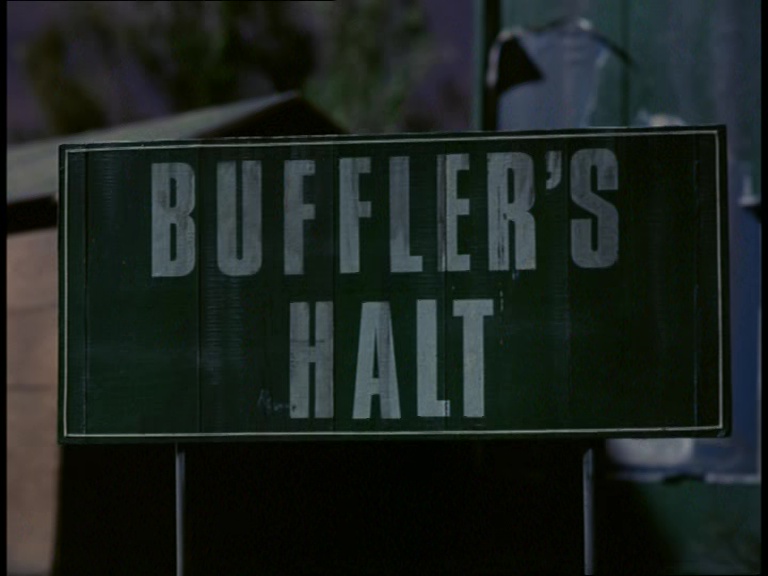
Both the script and the signage refer to “Buffler’s Halt” with an apostrophe, but the episode title caption doesn’t use an apostrophe, so it’s basically up to you which version you prefer to use. Presumably Buffler is the last name of a person or family, so the halt could have belonged to them once upon a time. I doubt that it has anything to do with the defintions of “buffler” offered up by Urban Dictionary which I will now share for my own amusement:
“Strategic use of toilet paper pressed firmly on your butt crack to muffle fart sounds while peeing in a quiet place.”
OR
“A totally rad dude who works as a Butler. Is usually buff as well but is not required.”
OR
“The type of bro who gets buff in Butler Library at Columbia University.”
I don’t think any of those concepts have a place here unless the Beeching Report is the toilet paper in question.
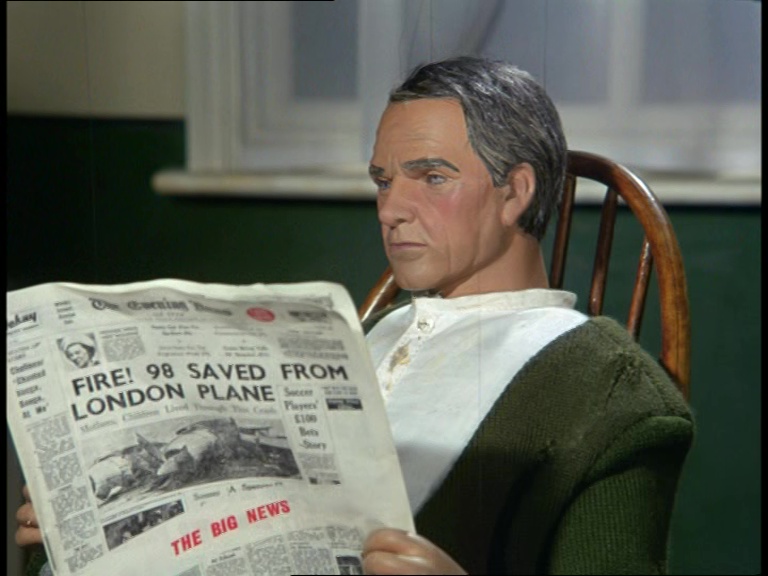
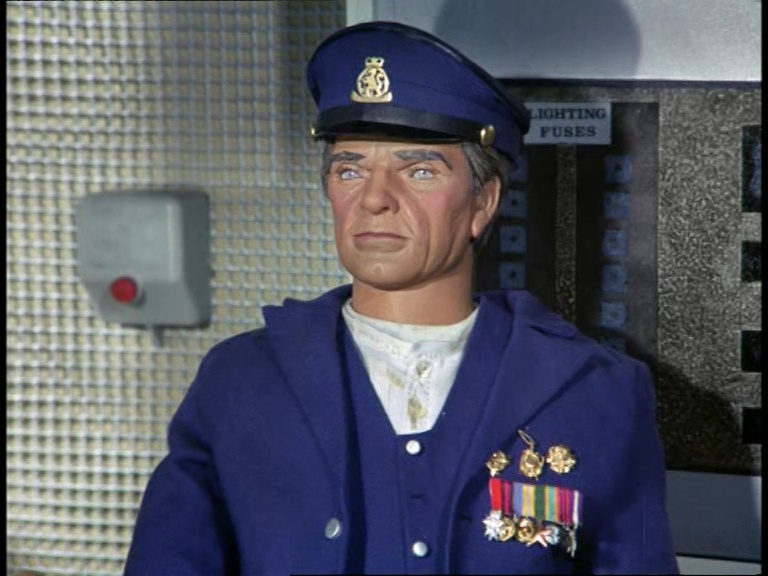
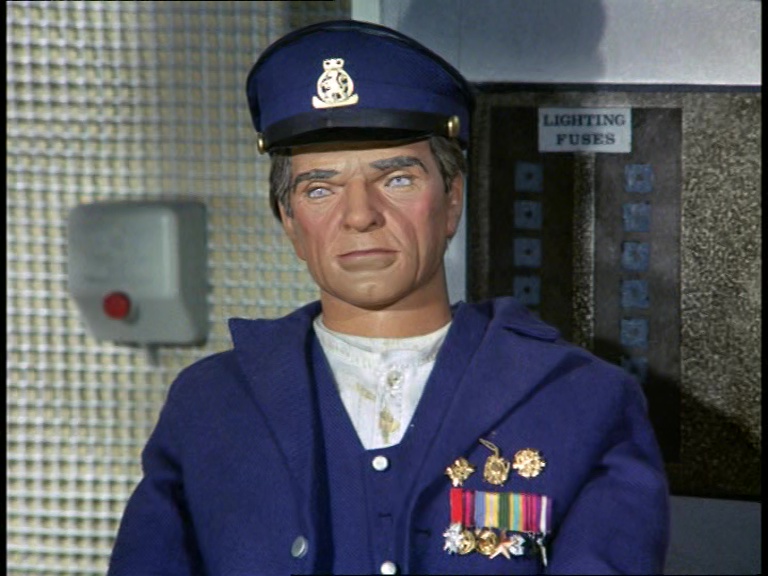
Retired railway worker, Albert Hobson, is enjoying a quiet evening putting the world to rights with his newspaper. As per Barwick’s script, he is now living in the station having worked there for all of his life. This “I don’t know, what a mess” moment isn’t scripted as Albert mumbles away quietly, and I can imagine voice artist Gary Files might have even improvised this dialogue. Hobson is a very memorable guest character for the series. There’s a few eccentric-type characters sprinkled through The Secret Service and they fit very neatly into the incredibly British world of grumpy old working class heroes paired with upper-class twits – more on that when we get to More Haste, Less Speed, of course!
For the second week in a row, we have a familiar newspaper prop to examine. A remarkably similar scene to this one from the Thunderbirds episode, Brink of Disaster features Parker putting his feet up and reading the paper just before businessman Warren Grafton comes to the door – it was a scene added to the episode to extend the show from half an hour to a full hour, and therefore might have been provided by none other than Tony Barwick who was responsible for a lot of that extra material. Anyway, the newspaper that Parker was reading featured the same headline, “FIRE! 98 SAVED FROM LONDON PLANE.” However, for its appearance here, a red caption declaring “THE BIG NEWS” has been printed across the front… just in case a plane crash wasn’t big enough news for Albert.
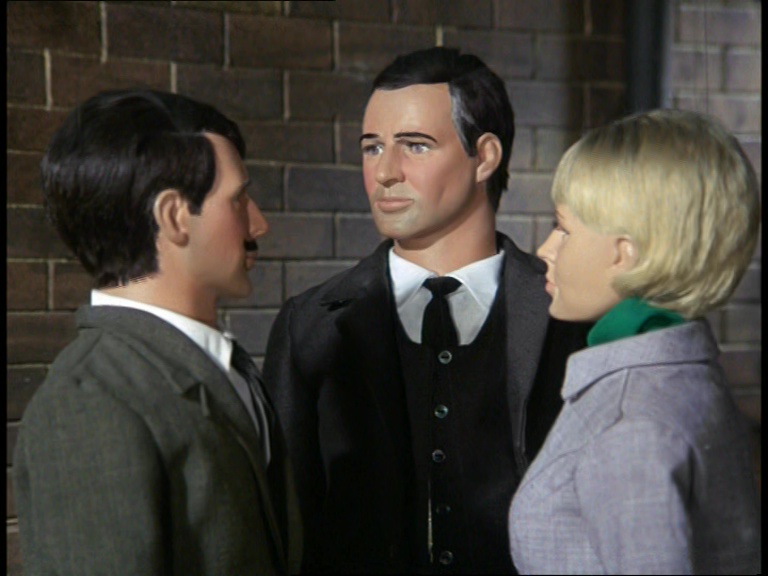
Three posh twerps have arrived outside, Calow, Mason, and Jackie. Mason was the chap in the leather trench coat shooting at the van earlier so we know he’s a wrong’un. In the original script, it was meant to be Calow who shot at the van but for whatever reason the roles were switched up. Jackie is noteworthy for being the first female character other than Mrs Appleby to appear in the series… although Mrs Appleby doesn’t appear at all in this particular episode, and Jackie only gets one scene of dialogue, so it actually means Sylvia Anderson has even less to do than usual! Barwick makes sure to describe Jackie in the script as a “young attractive woman” just so we’re all clear that her purpose for being there is primarily to be looked at…
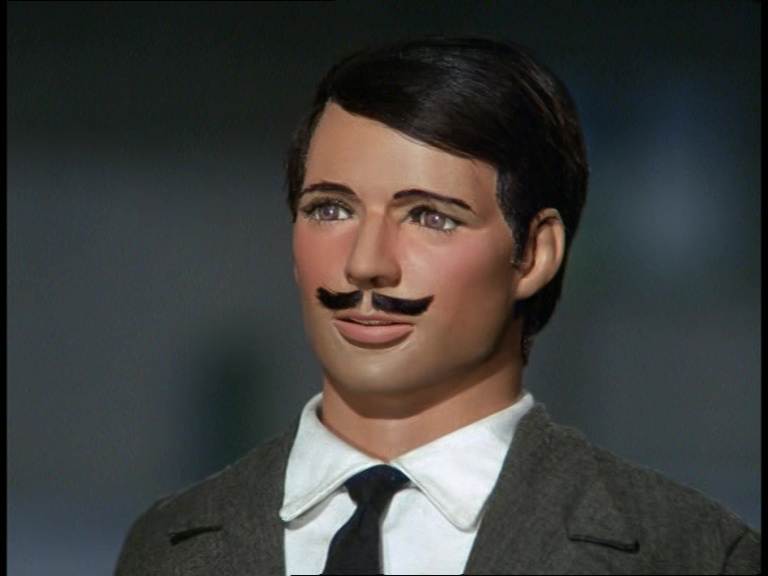
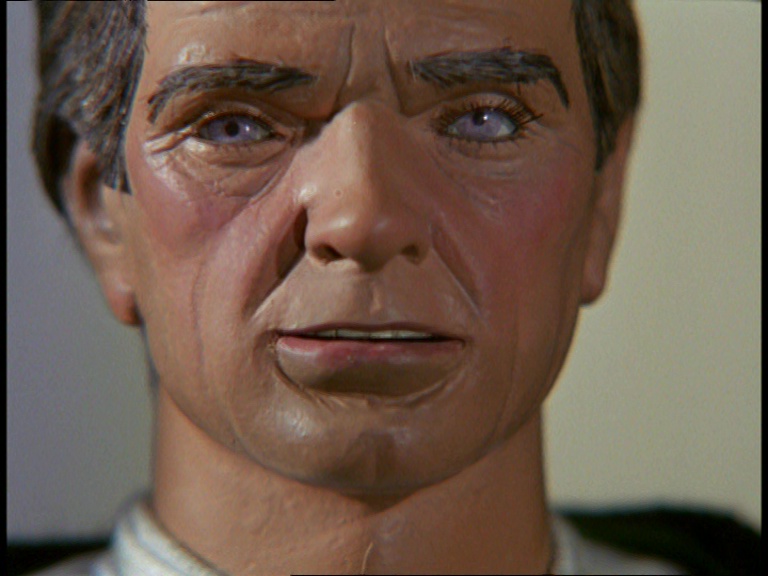
Calow claims to be from the Railways Board and gives Hobson the news that Buffler’s Halt is due to be re-opened! Albert can barely contain his excitement as director Alan Perry crashes in for a dramatic close-up of the happy chap. Little touches like this all serve to make the character that bit more memorable and engaging. The villains are playing on Hobson’s ego and pride and so Alan Perry has to sell that for all it’s worth to establish that dear Albert isn’t a crook like the others, but a loveable fool with, dare I say it, ideas above his station… get it?
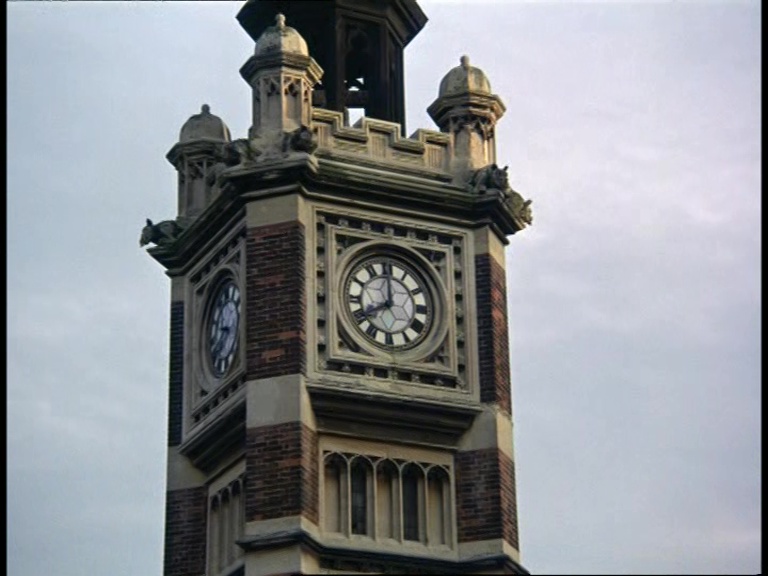
The Secret Service sure enjoys giving us establishing shots of clocks. This one is the Jubilee Clock Tower constructed in Maidenhead to commemorate Queen Victoria’s Diamond Jubilee in 1897. It’s not a train station as the script suggests, but frankly I doubt that many viewers would have been intimately familiar with Maidenhead landmarks to know whether it was a real train station clock or not.
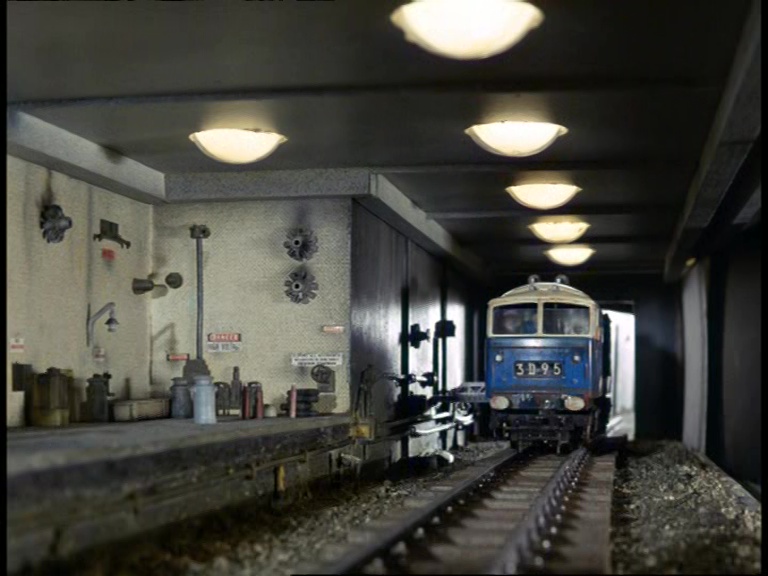
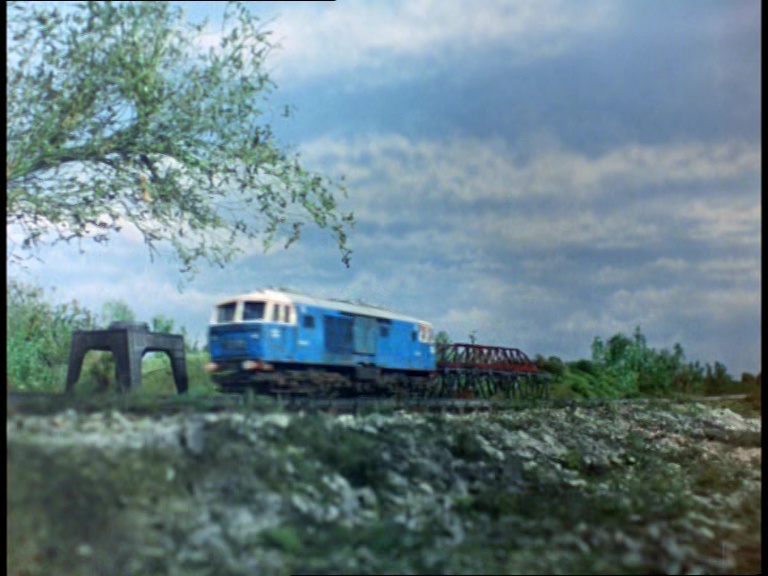
Okay train fans, here’s what you’ve all been waiting for, our first glimpse at diesel locomotive ‘3D95’ – the star vehicle of this particular episode. Here’s Tony Barwick description from the script: “The train is a ‘special’ just one top security carriage, and the deisel [sic] engine.” In a diversion from this description, the special effects department have opted for a model of a single British Rail Class 35 diesel locomotive, specifically using the Blue Flyer toy from the O gauge Big Big Passenger Train set by Triang, still carrying its original number, but dirtied down considerably for realism. It’s a lovely thing and it’s surprising really what a novelty it is to see a model train set put to work in a Supermarionation production – only rarely are everyday railway locomotives seen in the more futuristic series due to the prevalence of monorail systems in the Andersons’ world of tomorrow. No such glamour here.
Both the train and the model set itself are beautifully detailed. Again, one assumes that the logistics involved with shooting a real live-action Class 35 would have been too expensive or time-consuming for Century 21, so instead the special effects team have been called upon to make all the railway material for this episode looks as realistic as possible. We’ll see how they do with that challenge!
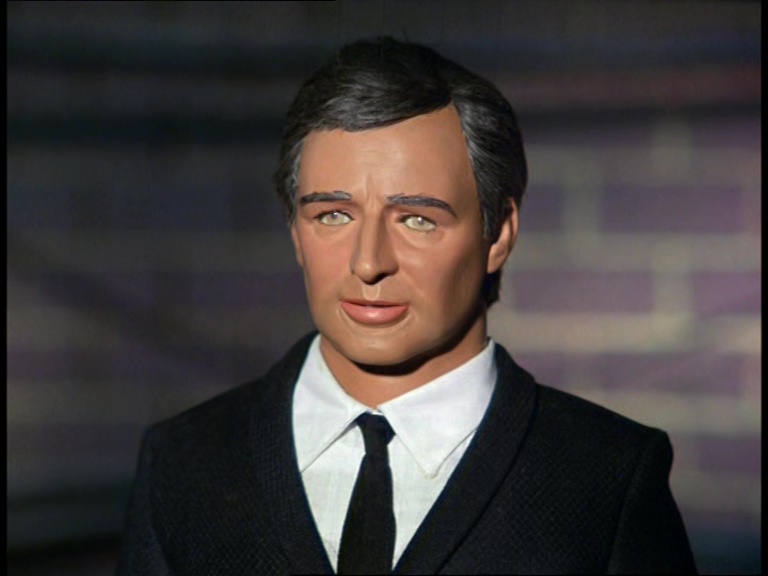
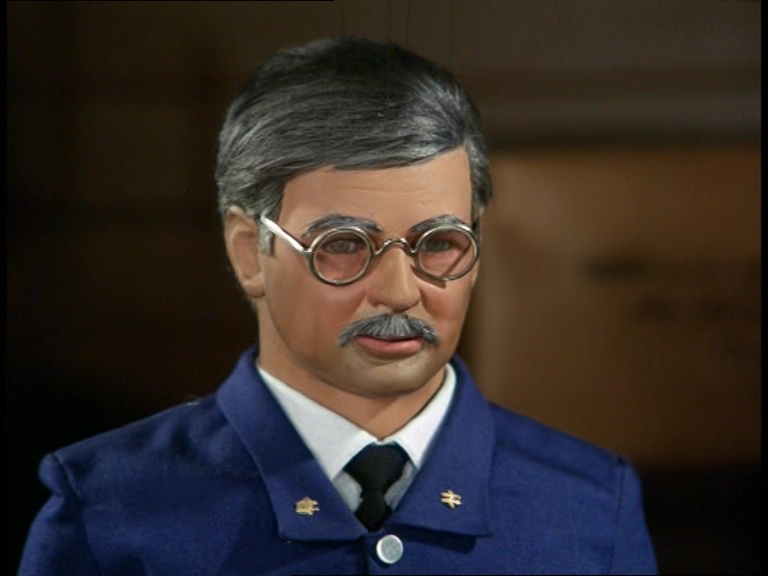
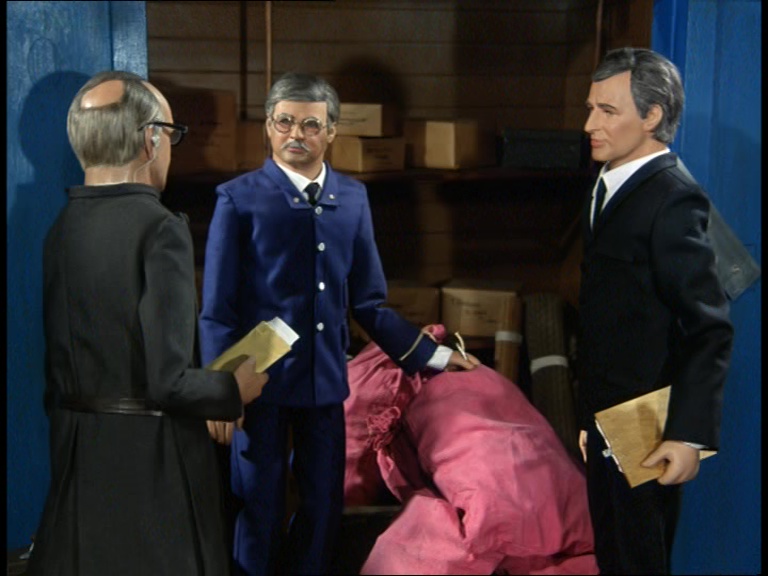
Reed and the guard are loading up the bank notes. Of course, a Class 35 locomotive wouldn’t have actually had its own spacious cargo compartment built-in and, as per the script, should have been pulling a carriage for carrying the shipment and passengers. We’ll have to assume that this is, in some way, a very special diesel railcar rather than a standard Class 35. All the train nerds reading this are up in arms while all the non-train nerds reading this are bored to tears.
Instead of “six crates” of gold bullion as the script originally specified, we learn that the bank notes are being carried in six sealed mail bags which have been unceremoniously tossed on the floor. For the mathematically inclined among you, that’s an incredibly infuriating number because £1,000,000 in bank notes isn’t perfectly divisible by six so there’s different amounts of money in each bag. That said, the Bishop did say earlier that it was “nearly a million pounds” so hopefully it was actually an amount which is divisible by six. Of course, whether you’d actually need six mail bags to transport £1,000,000 in bank notes is up for some debate. It would depend on how neatly the notes are stashed inside, and whether we’re working with £50s, £20s, or something else. Just to bring all this to a close before the maths nerds and the train nerds rise up into a hoard of supernerds, let’s assume that all the numbers work out perfectly and move on with our lives.
Father Unwin, carrying his case, turns up unannounced and asks to board the train. How he made his way into the tunnel, we don’t know. In the script, it wasn’t supposed to be a tunnel but a large warehouse.
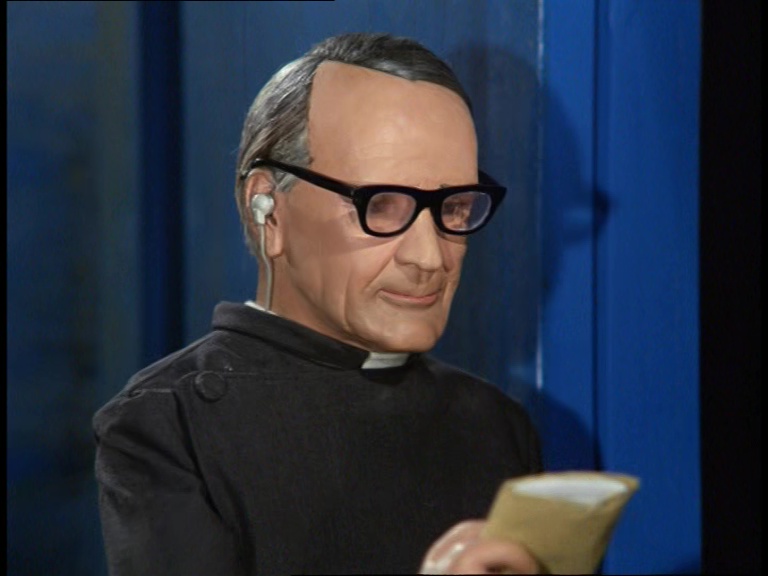
Unwin claims to have authorisation, provided by the Bishop, which has been signed by the Prime Minister himself – who at the time would have been Harold Wilson if that’s an image you need.
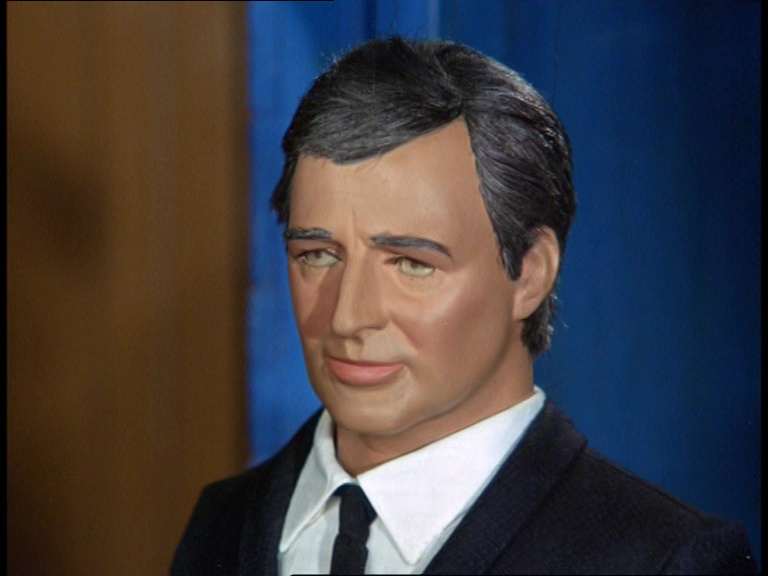
So, despite the very likely possibility that the authorisation has been faked, and Reed probably wouldn’t know what official documents from the Prime Minister would look like anyway, he allows Unwin aboard the security shipment. Now, the subtext here is obviously supposed to be that because Unwin’s a priest, he’s unlikely to be of any danger to Reed’s plan for hijacking the train. Bizarrely, Reed wishes him a “good luck,” which rather comes out of left field. The script helps to clarify that Reed “gives a look to UNWIN and says as if he expects they are going to need it – Good luck!” I don’t quite think the malevolent undertones of the line come across in the finished scene. It sounds more like Reed is genuinely wishing Unwin luck with whatever he’s been assigned to do by the PM… which doesn’t make much sense seeing as Reed’s trying to commit a train robbery and would probably rather not have the PM involved! Maybe I’m reading too much into it… but then again you could say that about this entire blog and I don’t have time for an existential crisis right now.
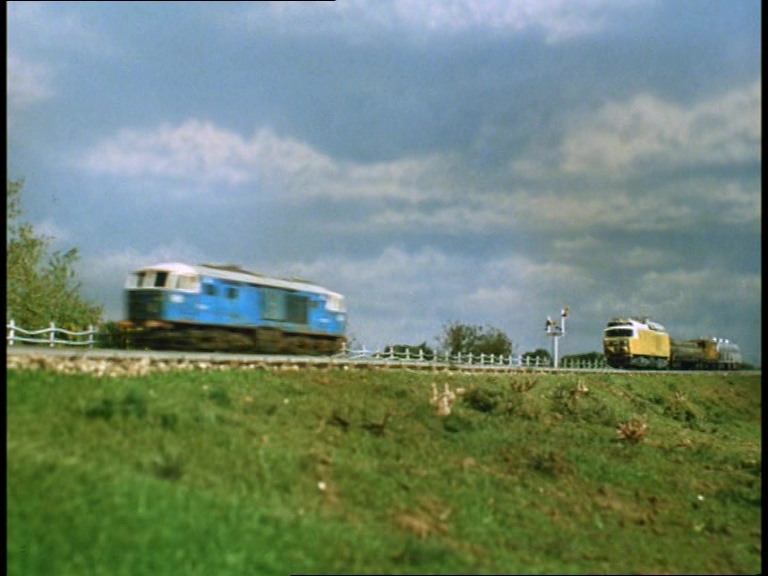
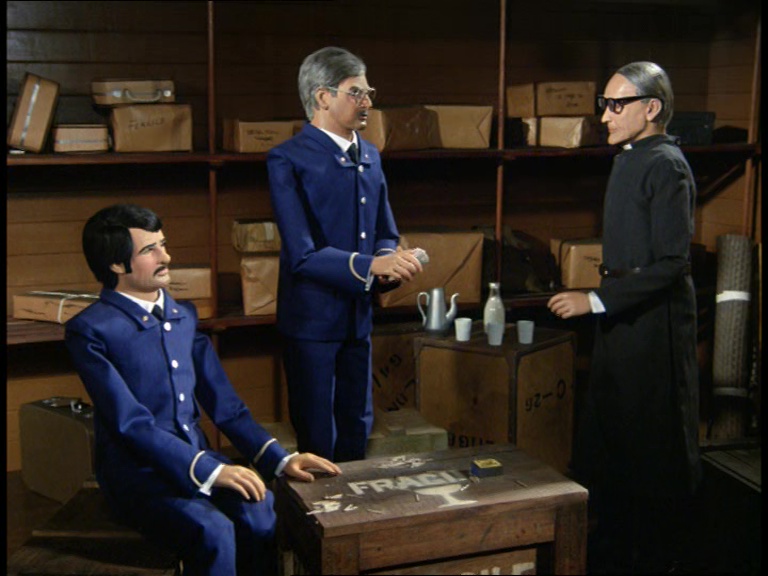
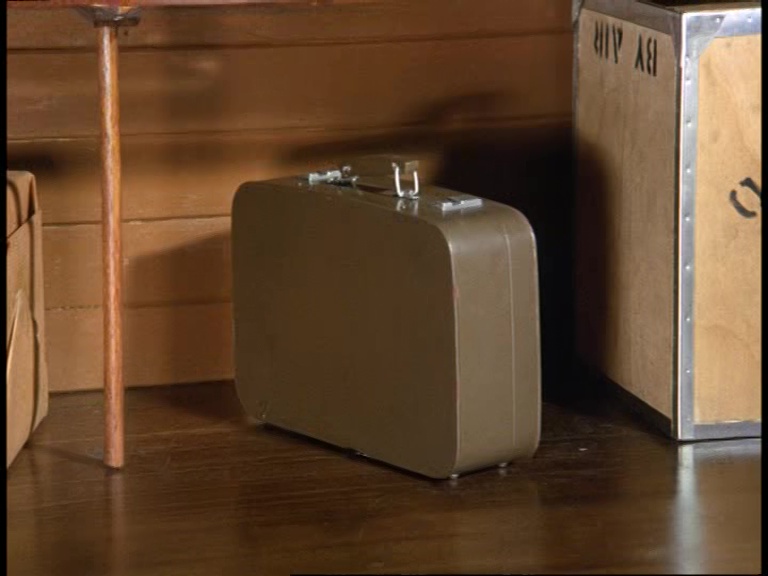
Time for one of many lovely shots of the locomotive thundering down the line. It’s tricky to pass judgement on the special effects team’s efforts here. On the one hand, it’s a lovely, thoroughly detailed model and landscape. It could be considered realistic if it weren’t for the fact that, yet again, the models are being filmed from a great distance with half the composition taken up by empty sky, and with very little of that lovely detail actually visible on camera. We’d gotten away from this rather dull approach to miniature filming last week with To Catch A Spy, but we seem to have gone right back to it again here. The train is being filmed from so far away that it can’t help but look like a tiny toy rather than a big, powerful diesel locomotive.
Inside the train, Father Unwin is initially hesitant to take part in the guards’ card game and insists upon moderate stakes – a reminder that he is a man of morality first and foremost. Meanwhile’s Matthew is tucked away quite happily in his case…
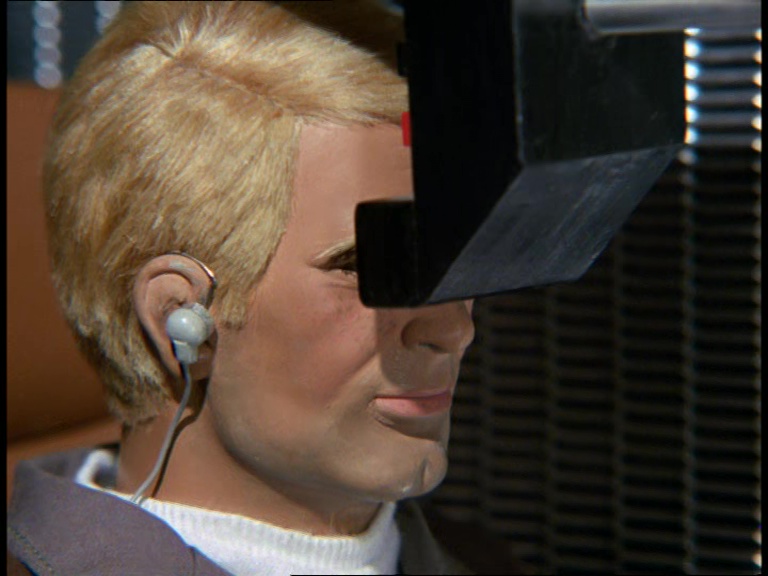
Compared to previous episodes, Matthew doesn’t actually have a whole lot to do in Last Train To Bufflers Halt. There’s no submarine torpedoes for him to ride or dogs to chase him around a garden or aircraft that he needs to cling on to. He’s just sort of there as backup for the moment.
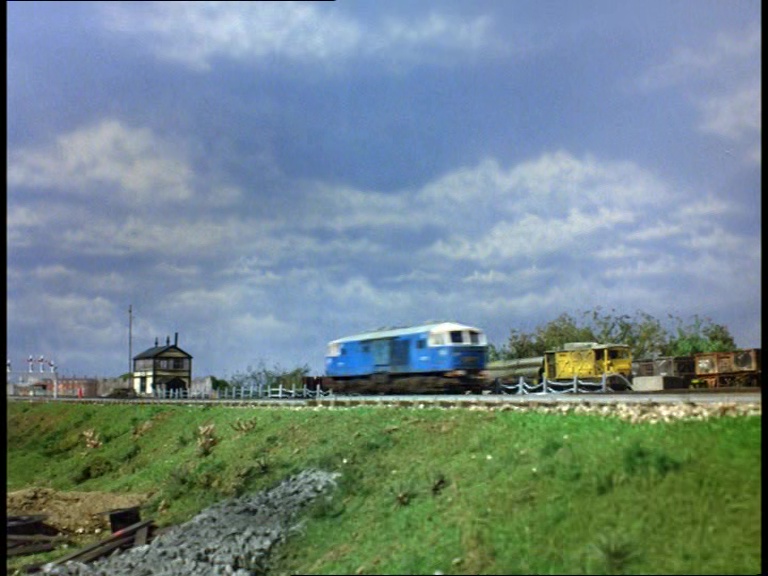
Lots of lovely details of the railway are just about visible, which have all been made to look suitably tired and worn out. Again, the sky-to-landscape ratio is a touch infuriating. The low-angle of the camera should be making things look big and imposing but we’re so far away it has the opposite effect.
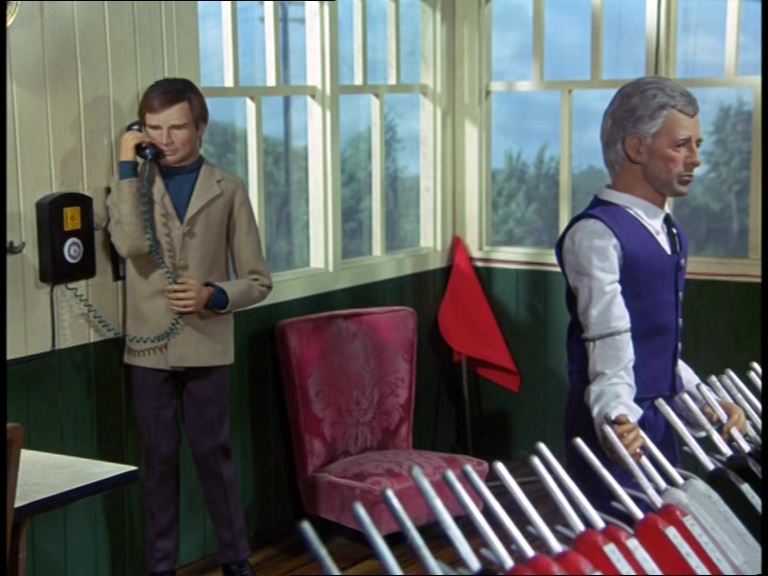
In the signal box, Captain Ochre pops up for yet another guest appearance, this time as a trusty BISHOP agent providing checkpoint support.
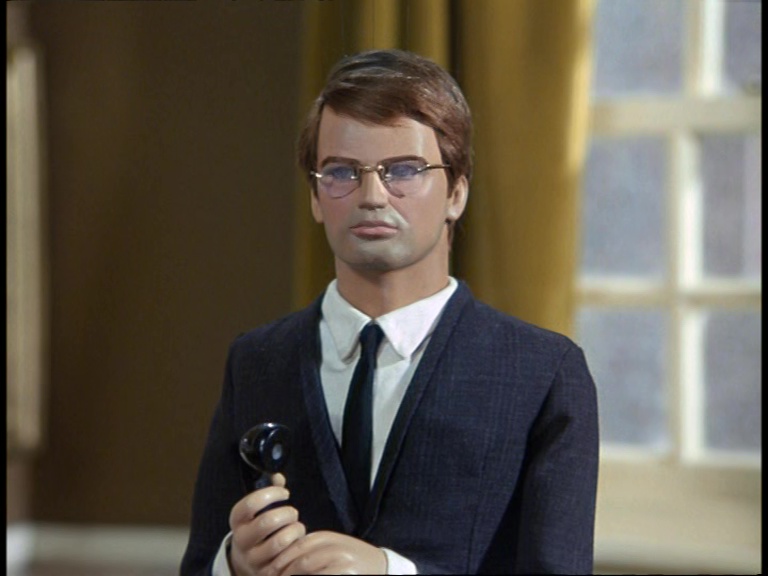
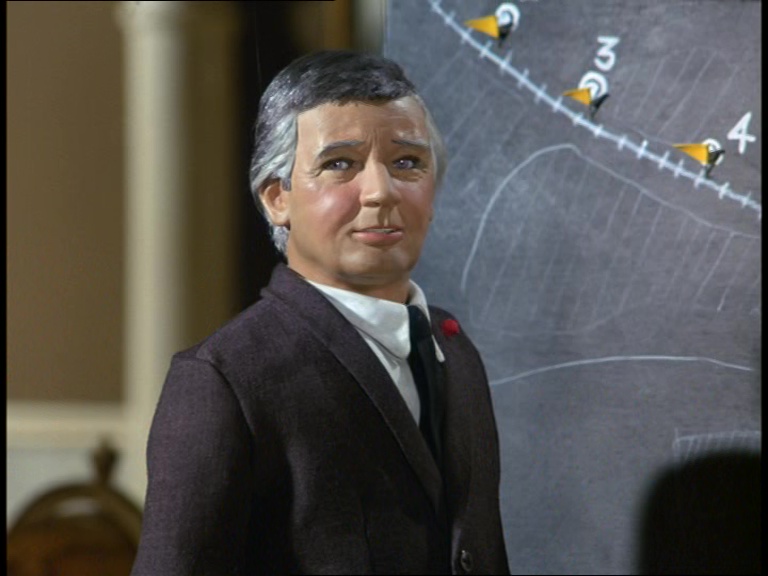
Using a telephone, a chalkboard, and some little flags, Blake and the Bishop have a total grasp on the operation. They have checkpoints positioned along the line at ten mile intervals to ensure the shipment’s safety. How beautifully organised.
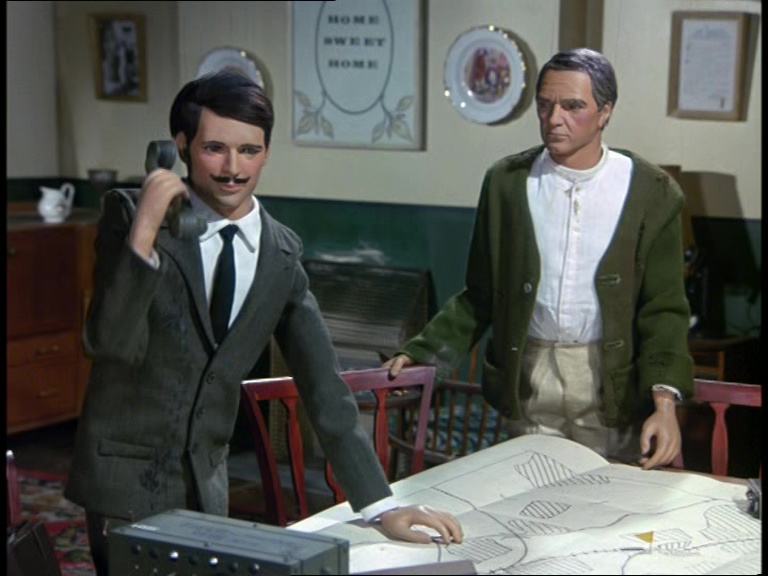
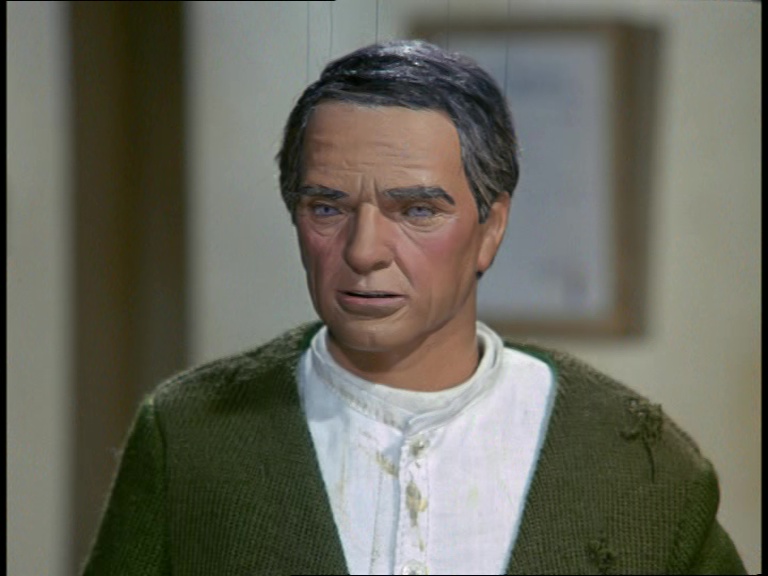
Back at Buffler’s Halt, Albert is beginning to question Calow’s credentials from the Railway Board and the official status of the station re-opening so suddenly. Gawd bless that man, he’s so wonderfully intuitive. And he keeps a piece of art declaring “Home Sweet Home” on the wall which is so charming seeing as the place is an absolute dump and the man has a suspicious-looking stain down his front.
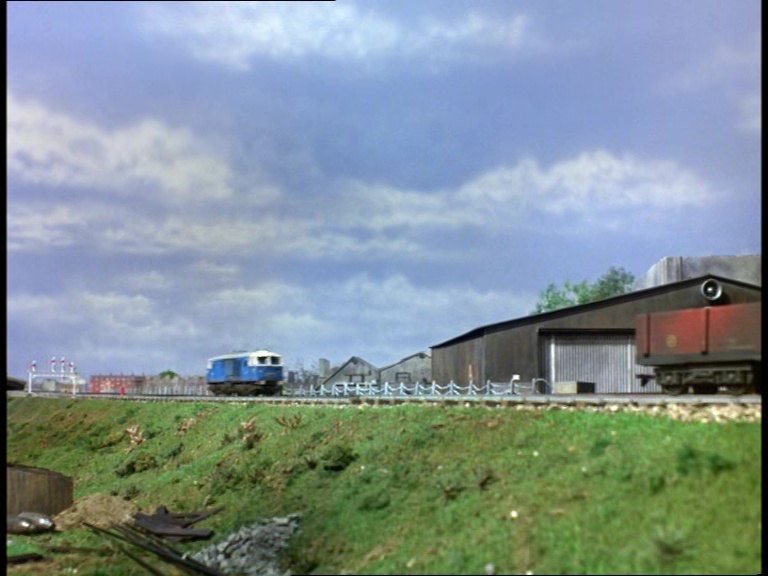
The same model set of the train line is being re-dressed repeatedly in order to look like the next section of track. This wouldn’t be a problem if a) the camera was placed in a different position each time, and b) the background details that have actually been changed weren’t just tiny specks on the screen.
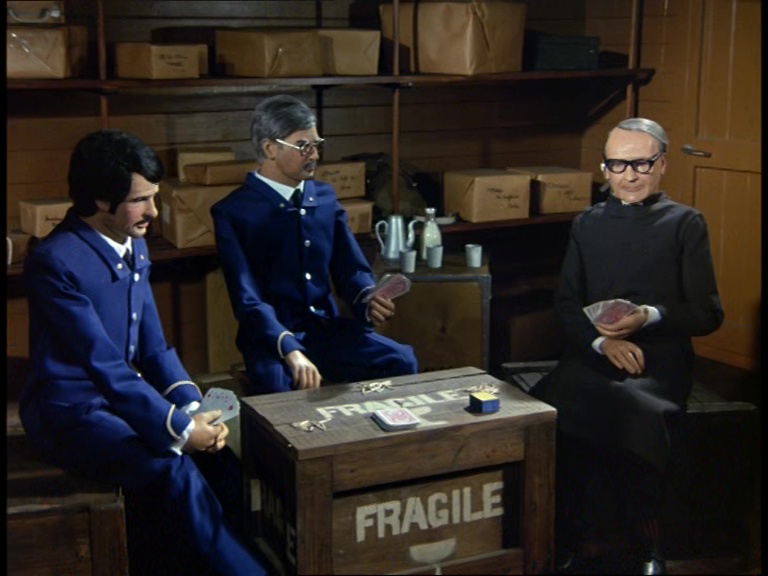
Just a bunch of lads kicking back and enjoying themselves.
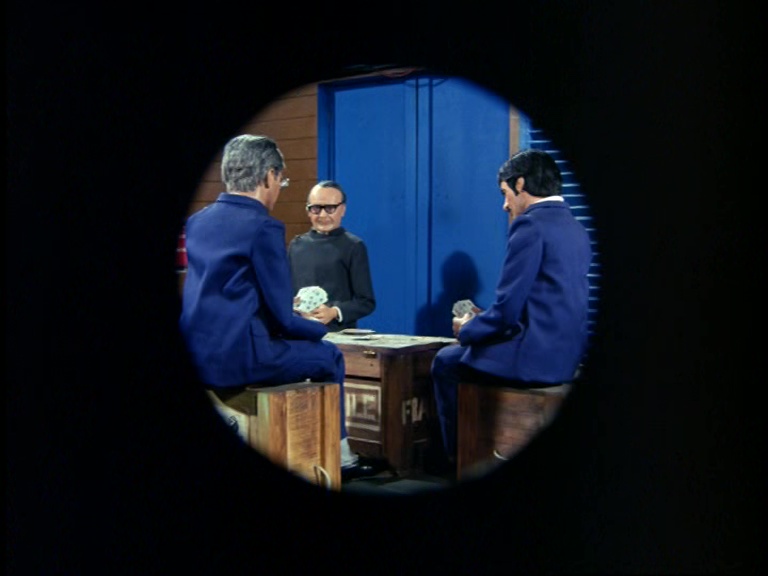

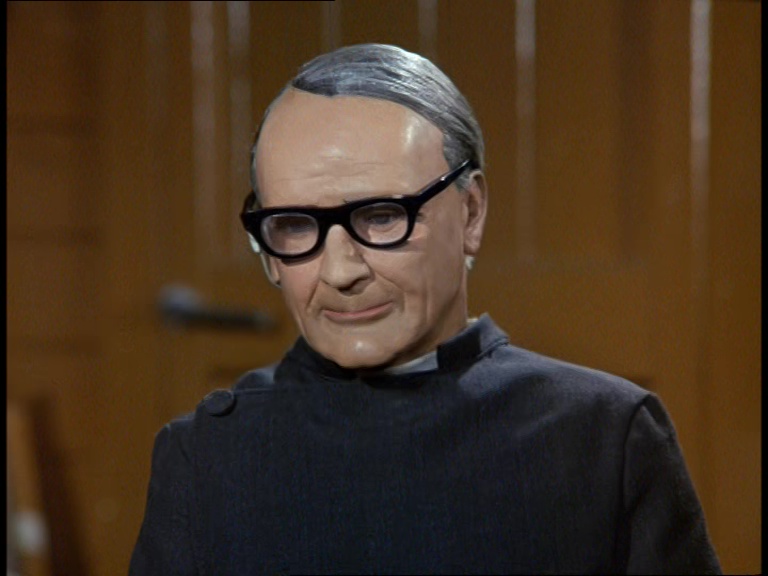
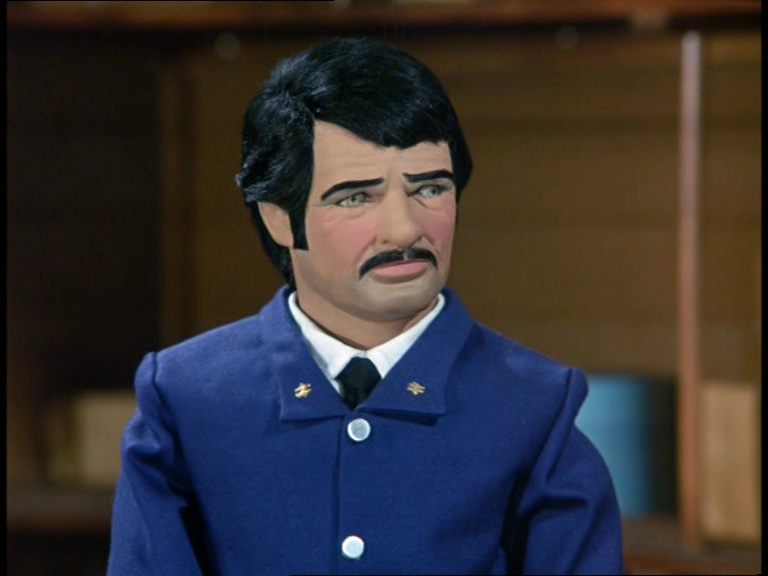
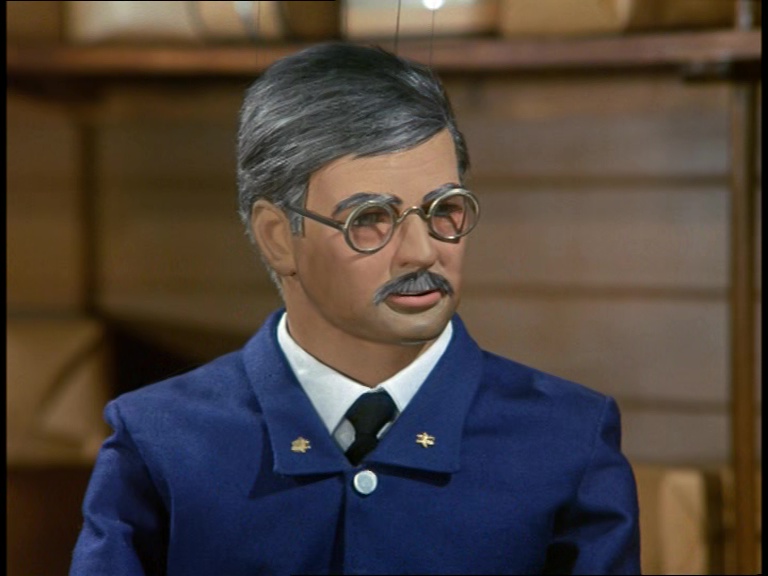
Matthew, probably bored stiff by the lack of excitement, decides to help Father Unwin out by looking at the guards’ cards and radioing tips to the vicar. The swine. Unwin is most put out by this and gives Matthew a thorough telling-off in Unwinese so as not to arouse suspicion, and instead just look like he’s lost his mind. The amusing implication, of course, is that Unwin once again has assistance from a higher power. Father Unwin, being a man of integrity, insists they start again without Matthew’s intervention. What a stand-up bloke.
In Tony Barwick’s script, the Unwinese dialogue is written out in plain English with a stage direction encouraging Stanley Unwin to translate it himself, rather than the previous format of the scriptwriter attempting to write in Unwinese with varying degrees of success. For some reason, only the first guard is given dialogue in the episode which means the dark-haired chap sits in permanent silence looking baffled, while the wonderfully Welsh bloke has plenty to say. In fact, the unnamed first guard is another of my favourite Secret Service guest characters specifically because of his regional accent from Jeremy Wilkin. Regional accents have always been avoided in previous Supermarionation series because of the fear of Americans not understanding them. Presumably, the change of course allowing them to creep into The Secret Service was a deliberate choice.
Another detail I just have to admire are the British Rail uniforms that the guards wear, complete with lapel pins. It’s a reasonably accurate take on the real-life uniforms worn by railway staff at the time, although quite a bit more colourful.
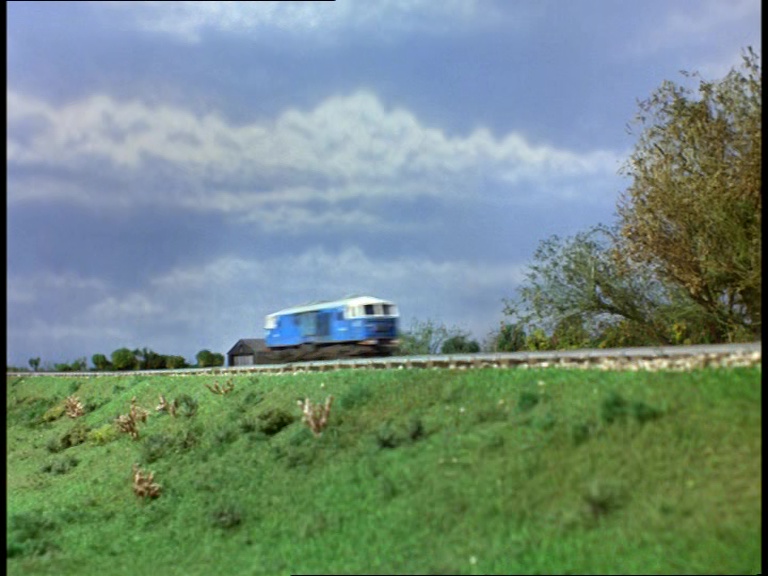
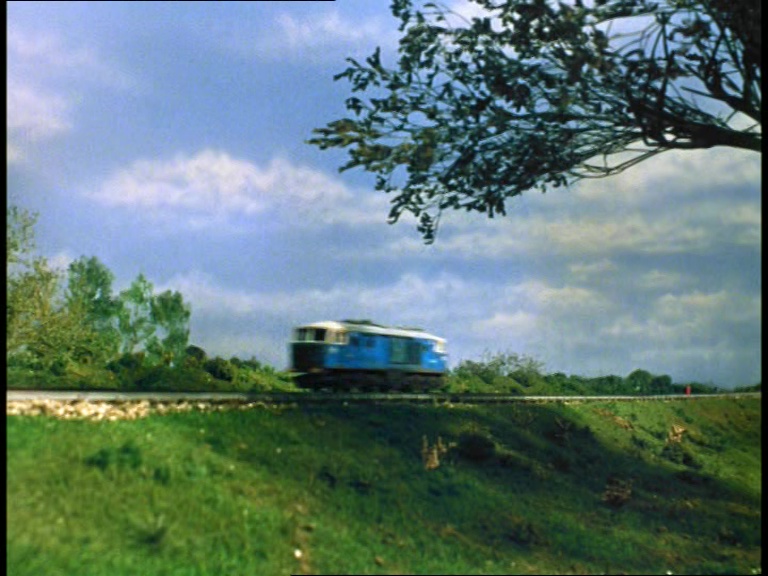
Again, the same angles of the train are taken with the scenery shifted around. At least the tree in the foreground of that second shot fills the sky a bit more. Don’t get me wrong, I think all this model work is nice and adds a touch of variety to the series – it’s just a pity it couldn’t have been executed with a little more creativity.
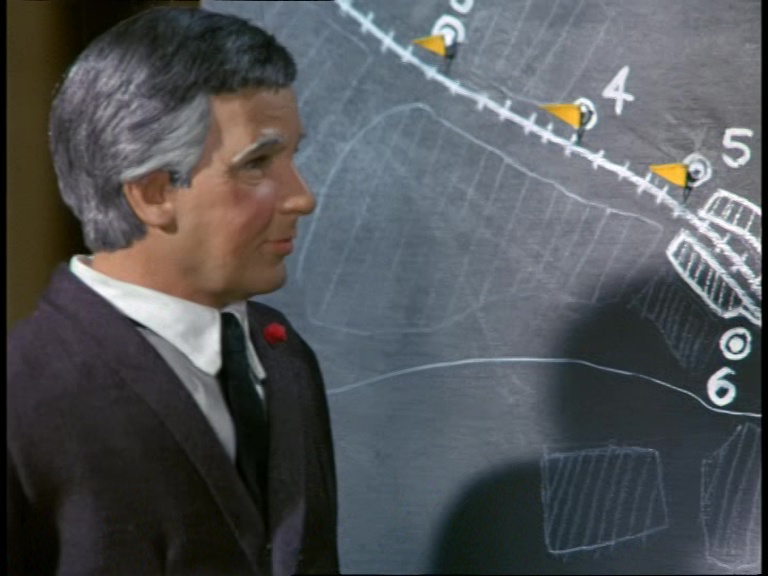
The Bishop lets us know that the sixth checkpoint has been cleared. Hopefully Blake remembered to bring along enough of the little yellow flags.
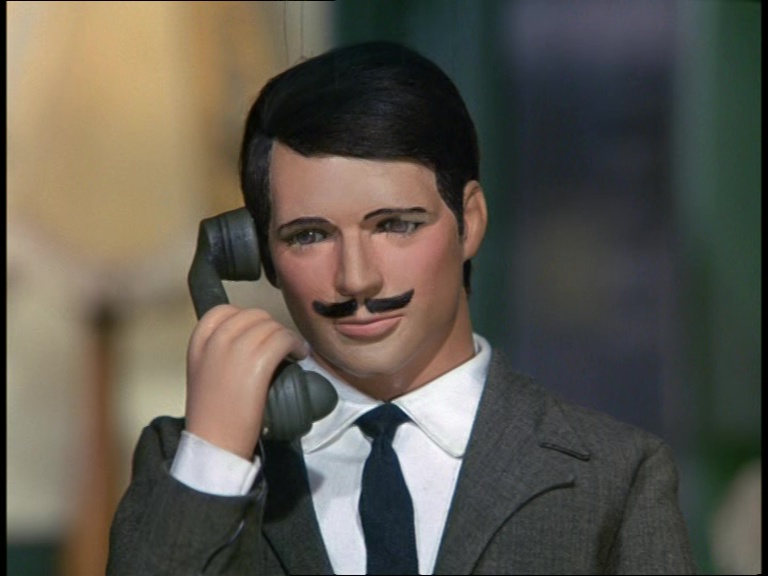
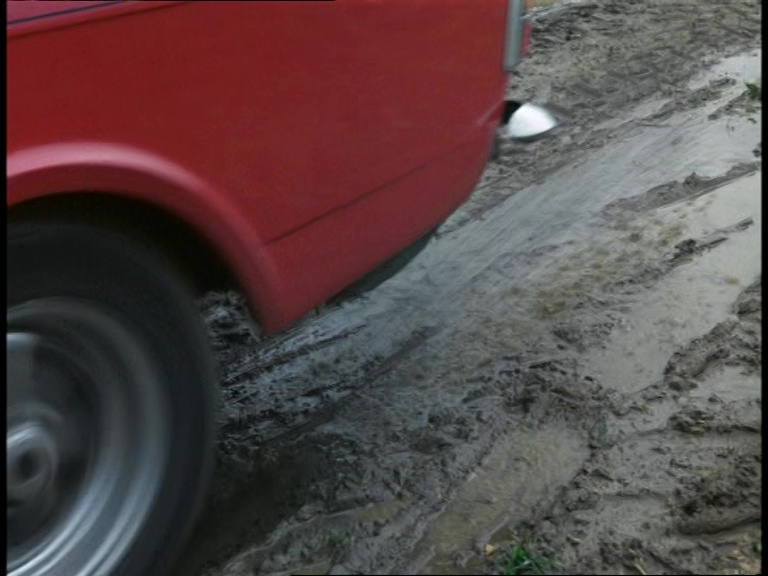
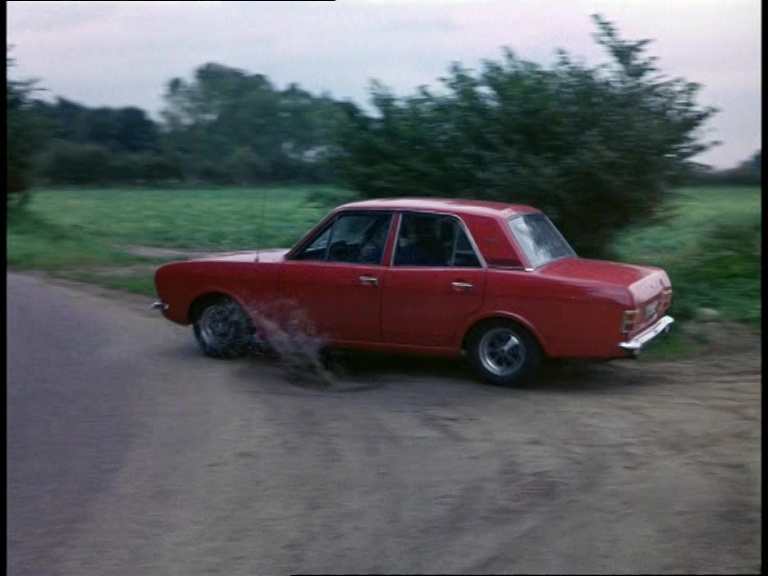
But at 8:42, Calow puts his scheme into operation and sends the red Ford Cortina on its way to do… something… not entirely sure what… but the wheelspin in the mud looks terribly impressive. Actually, the script makes it clear exactly what’s happening in a deleted scene featuring Jackie inside the car asking her colleague, Mason, to drop her off “a couple of hundred yards from the signal box.” With that moment removed, however, we don’t actually know who’s in the car right now.
Also, Century 21 (or perhaps just Tony Barwick himself) clearly had a fondness for calling their villains, Mason. See Clem Mason in Barwick’s Joe 90 episode, The Unorthodox Shepherd, also Clem Mason in Barwick’s UFO episode, The Pyschobombs, the Mysteronised mechanic from Barwick’s Captain Scarlet episode, Special Assignment who ran the garage, Mason’s Autos, and the air steward Mason in the Thunderbirds episode, Alias Mr. Hackenbacker… which was actually written by Alan Pattillo… but maybe script edited by Tony Barwick… it’s not entirely clear who was acting as script editor on Thunderbirds‘ second season. Anyway, I think the message is clear – anyone called Mason is not to be trusted.
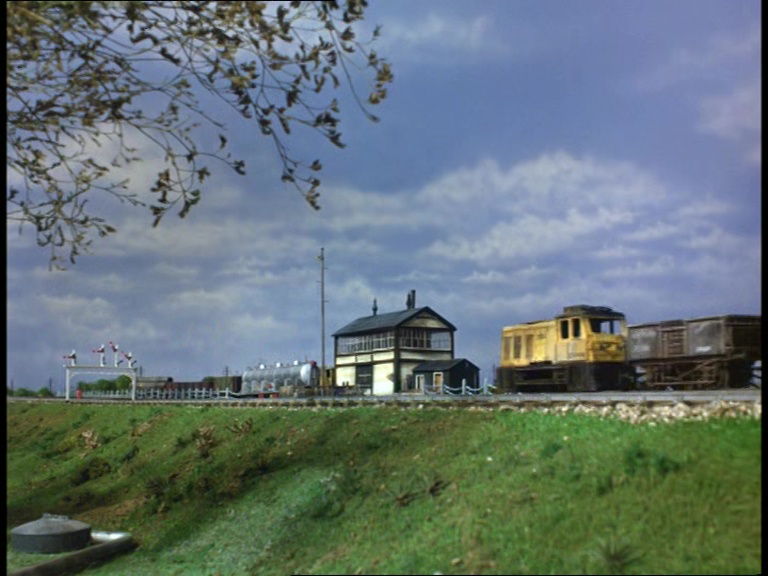
Same ruddy camera angle, but a different locomotive. This little yellow 0-4-0 shunter is a diesel model once again borrowed from Triang’s range of Big Big Trains, but the cab has been replaced by the model makers. The trucks being pushed along are also from Big Big Trains.
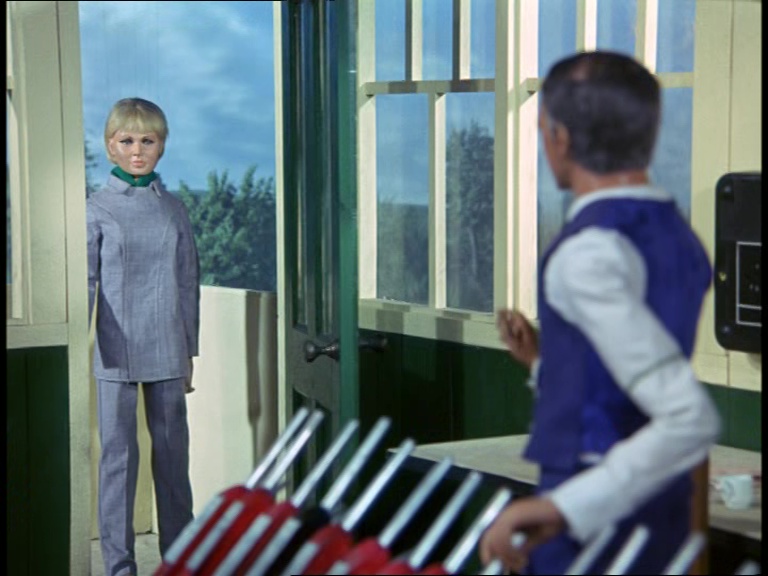
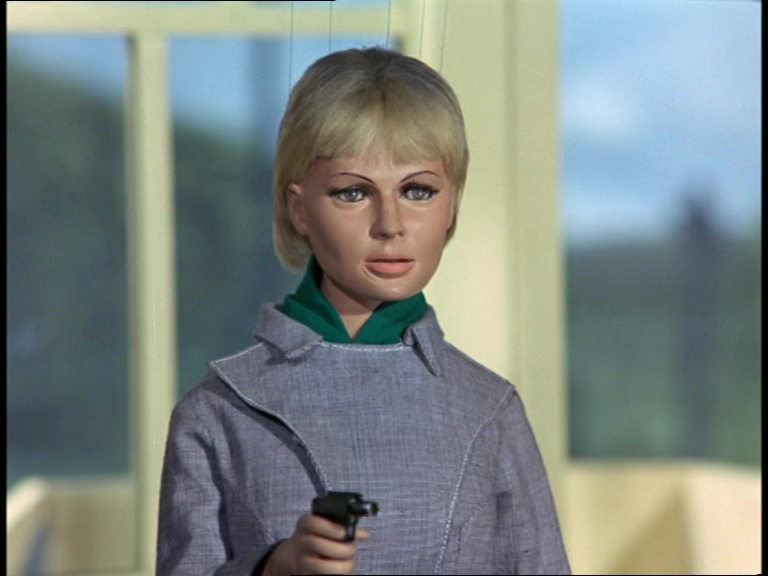
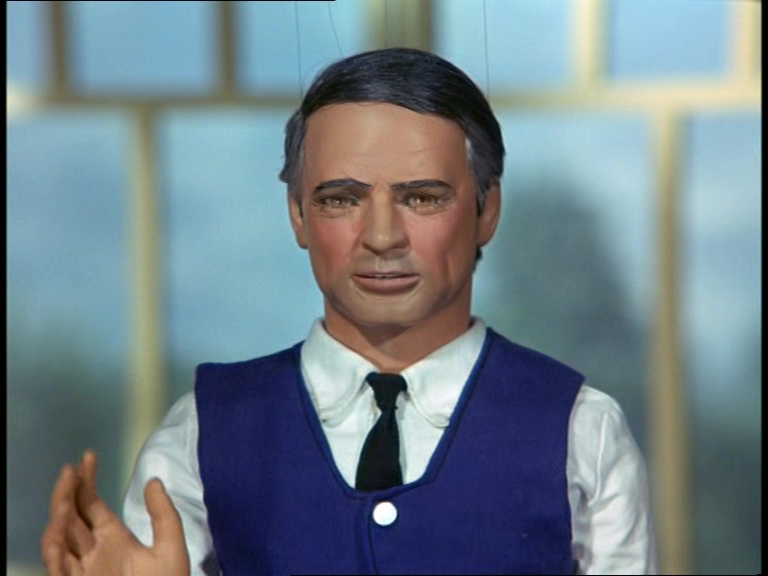
Jackie, sporting Sylvia Anderson’s reliably European-sounding villain accent arrives to threaten the signalman. He is ordered to divert Unwin’s train into the Blackmore Tunnel…
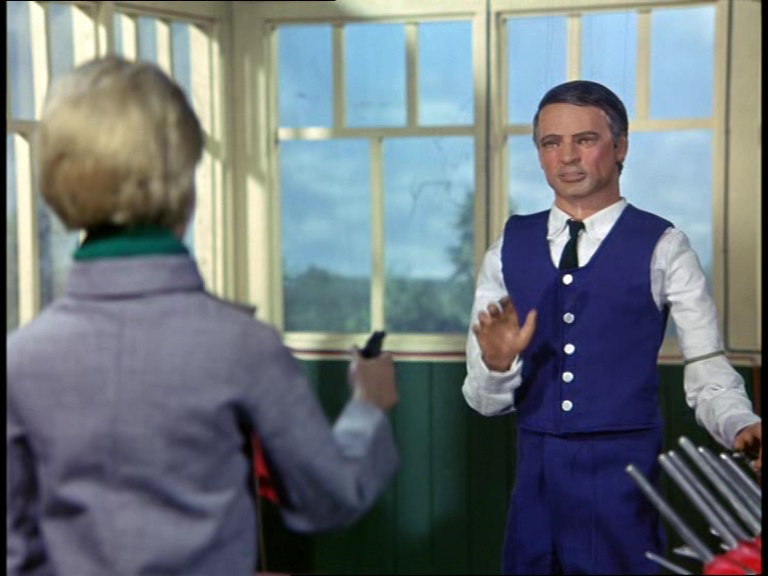
Or have his head blown off. Since British Rail don’t pay as well as they used to, the signalman decides he’d rather get sacked than have his brains turned into jam.
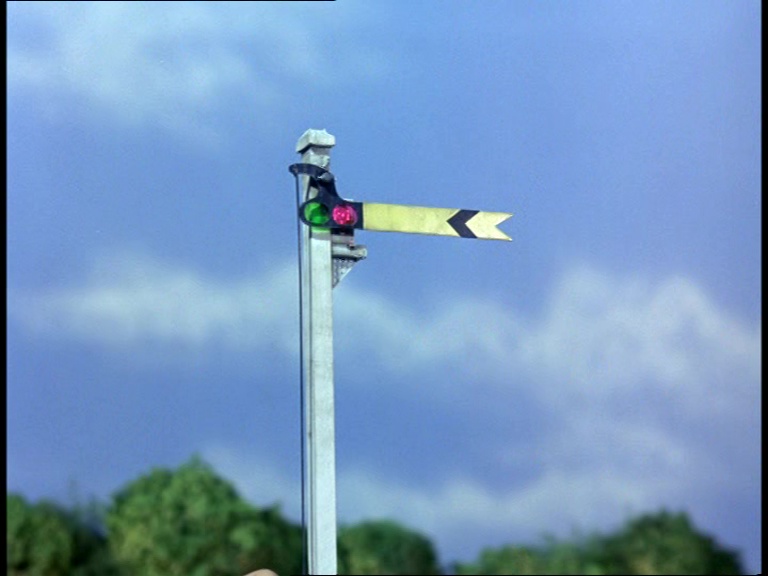
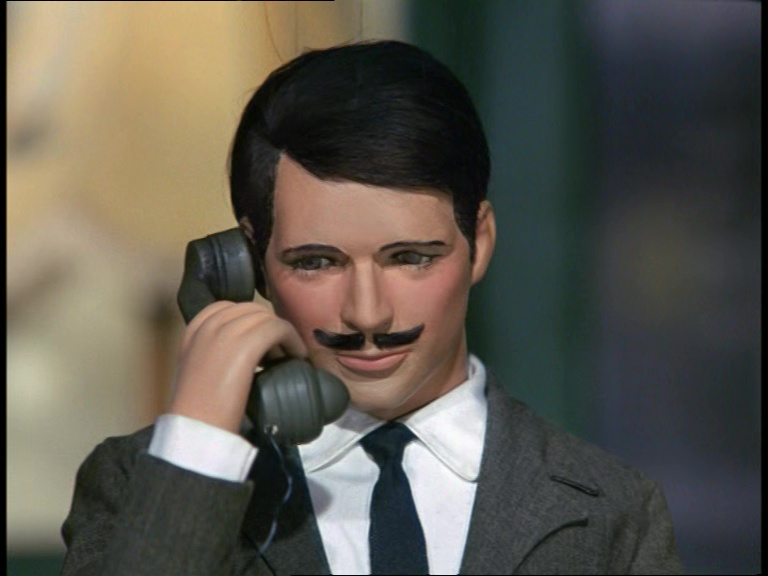
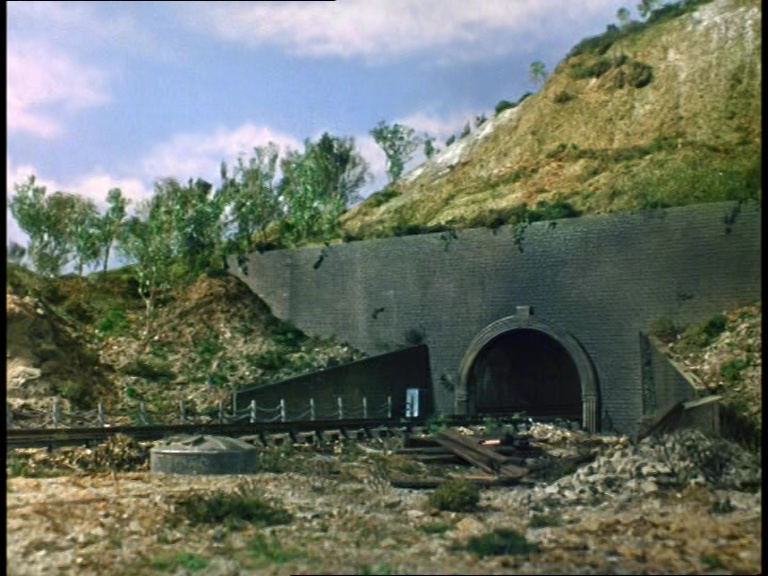
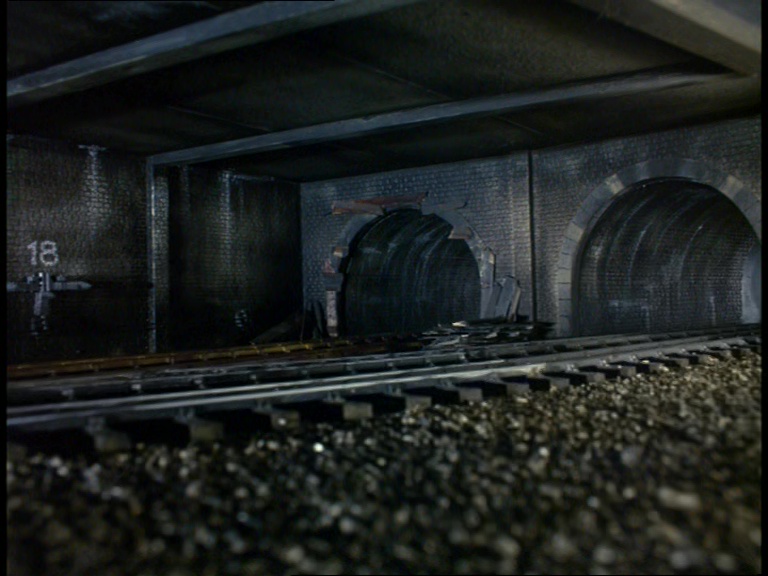
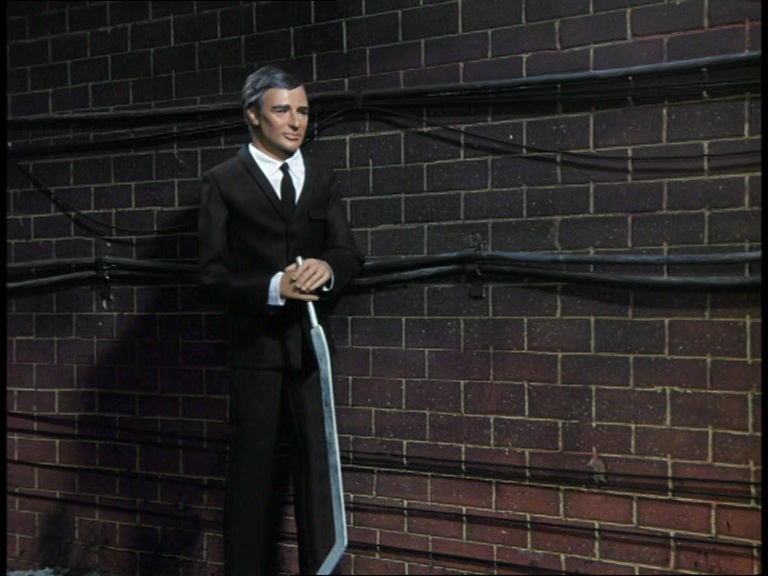
With the signal changed successfully, Calow contacts his leader in the Blackmore Tunnel, who turns out to be none other than that lovely, shifty character, Mr Reed. He’s standing in there ready to operate the points and intercept the train.
Incidentally, the Blackmore Tunnel is an entirely made-up location by Tony Barwick so you can’t pay it a visit. In the script, he highlights that “we see the spur line leading off to the left. It was boarded up but the boards have been removed.” It’s not entirely clear on screen, but the detail of the removed boards is there if you look really hard.
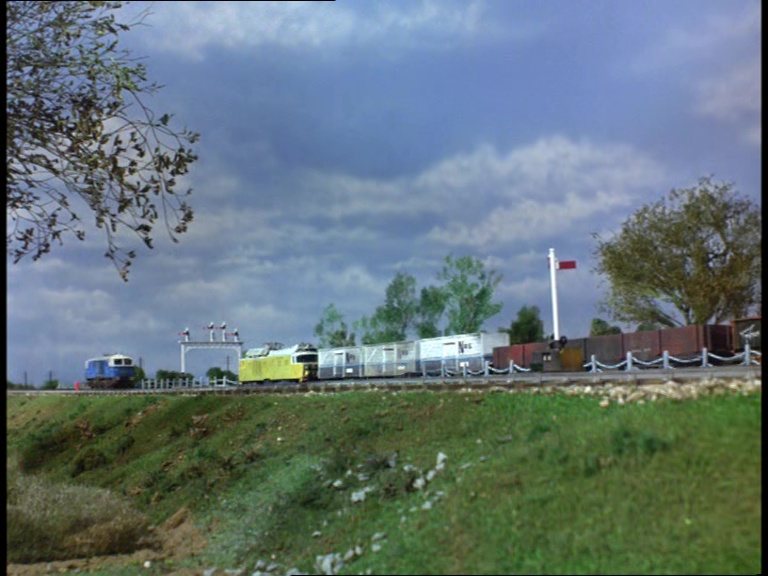
Unwin’s train zips past yet more modified Triang Big Big Train models. These train sets were probably ideal for the effects team because they’re relatively simple, low-detailed models that could therefore be modified for different purposes. They were also battery-powered which likely allowed the model makers more freedom to modify the track since it wouldn’t be providing electrical pickup to power the locomotives. Again, I can only apologise to the non-train nerds who just came here for Secret Service trivia.
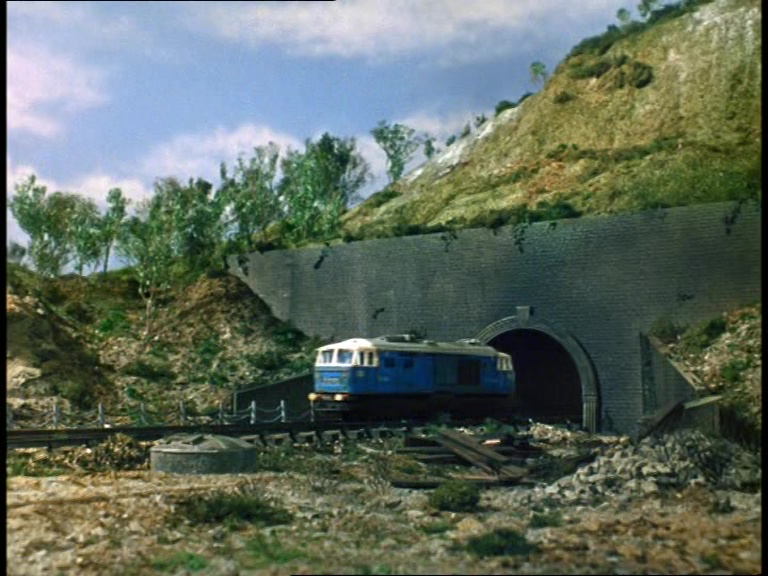
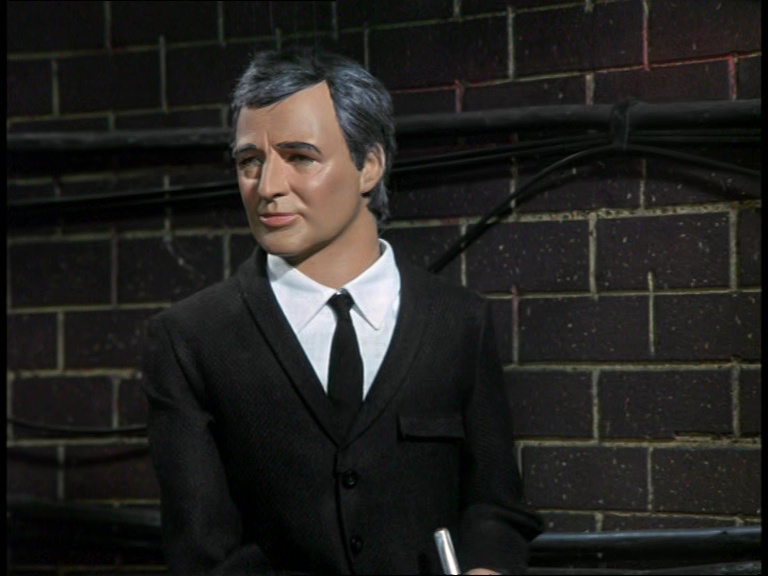
And so, we reach the commercial break with Reed watching the train enter the tunnel and slowing down to a stop. His evil scheme is working out just swimmingly.
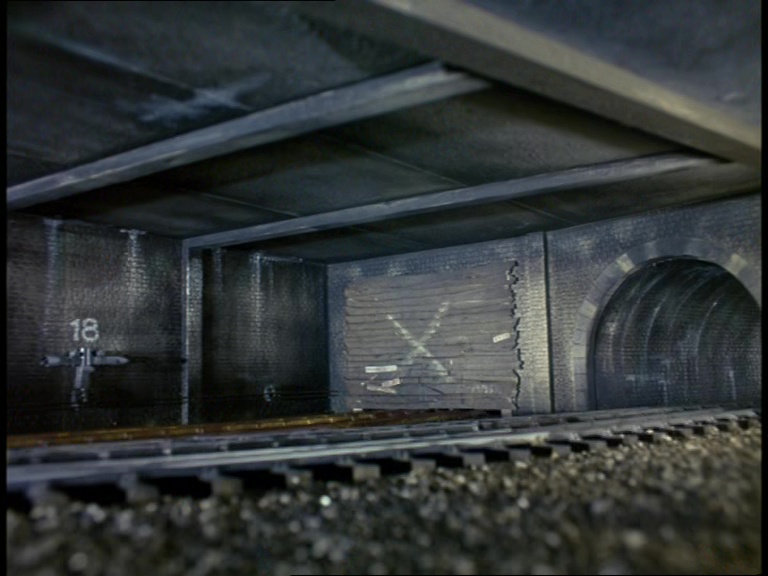
At some point during the commercial break, the tunnel on the left has been boarded up by Reed. At first I thought this was a continuity error but the script is helping me to understand the geography of this episode much better than the actual episode, and those boards were removed and then put back up in order to signify that the line to Buffler’s Halt was closed, and they’re now on that line without anyone knowing. If the model shots were a little more distinct from one another this might have been easier work out just from watching the show… either that or I’m a bit thick.
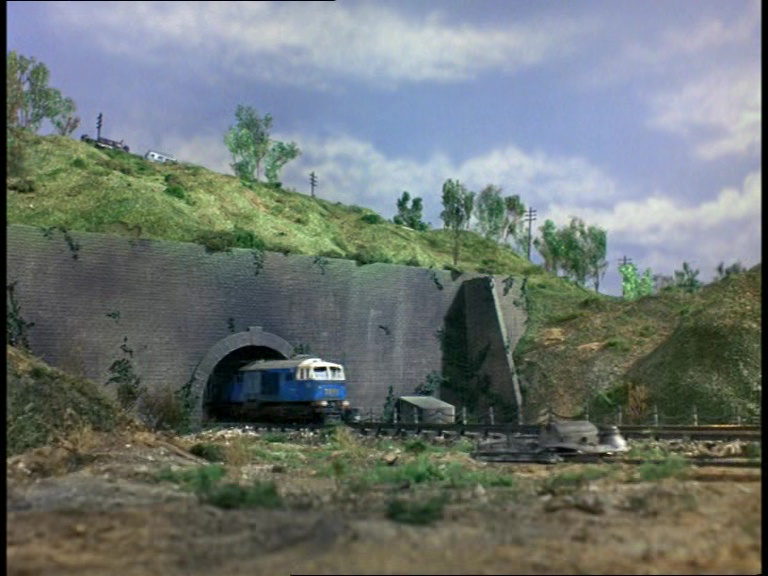
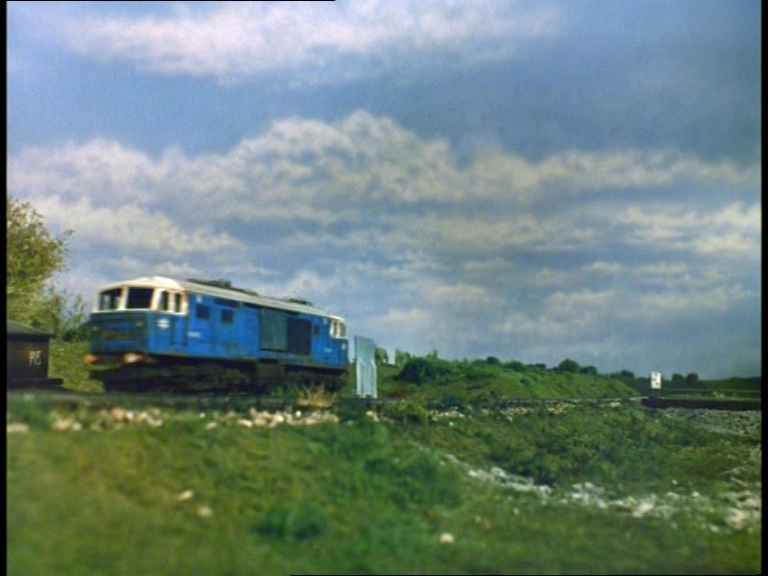
Meanwhile, Thomas the Bank Engine (see what I did there?) carries its precious monetary cargo out of the other end of the tunnel. One detail you might have missed is the tiny little bus which can be spotted driving along on top of the tunnel. Isn’t that neat?
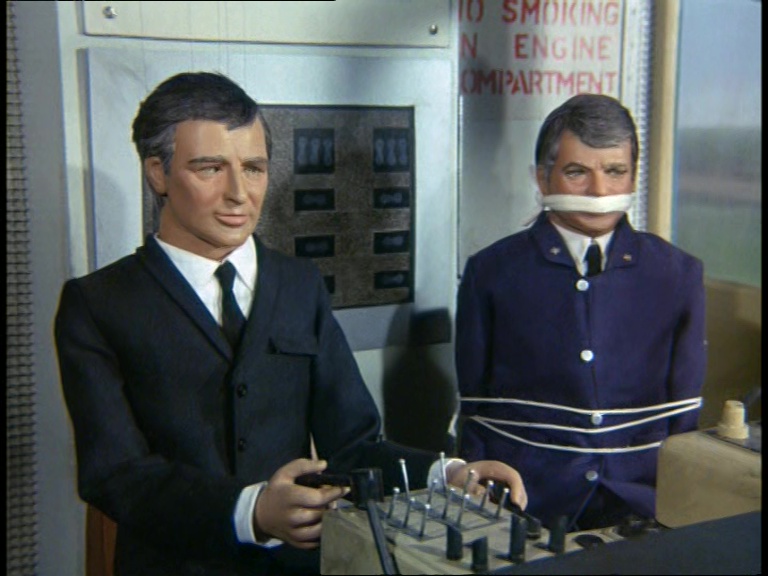
The lucky, lucky driver gets the privilege of watching Reed take over control of the train. Somehow I doubt this is his worst day on the job as a British Rail employee.
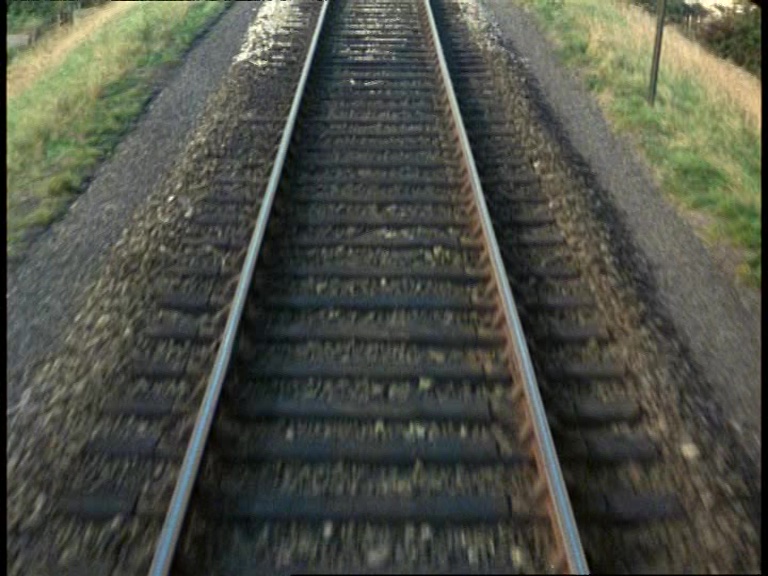
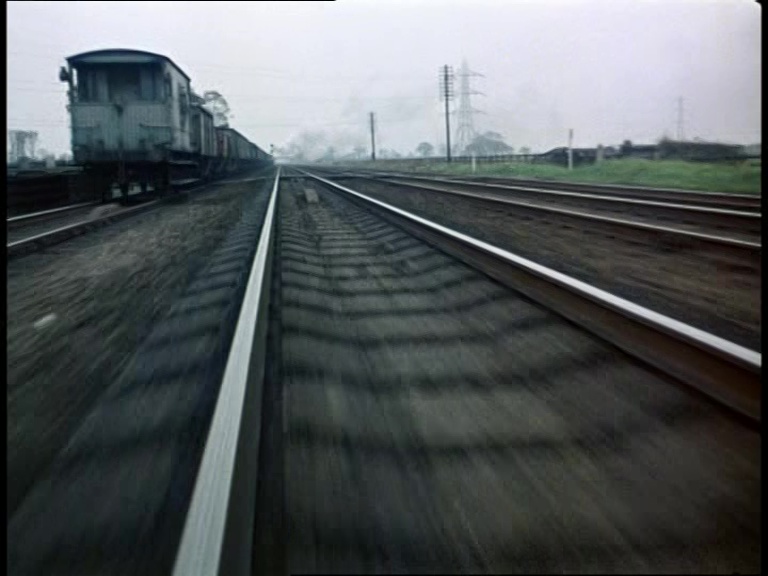
Time for a live-action shot of the railway line to drum up the tension. It’s a welcome addition seeing as the model effects unit aren’t doing much to vary their own shots of the locomotive speeding along.
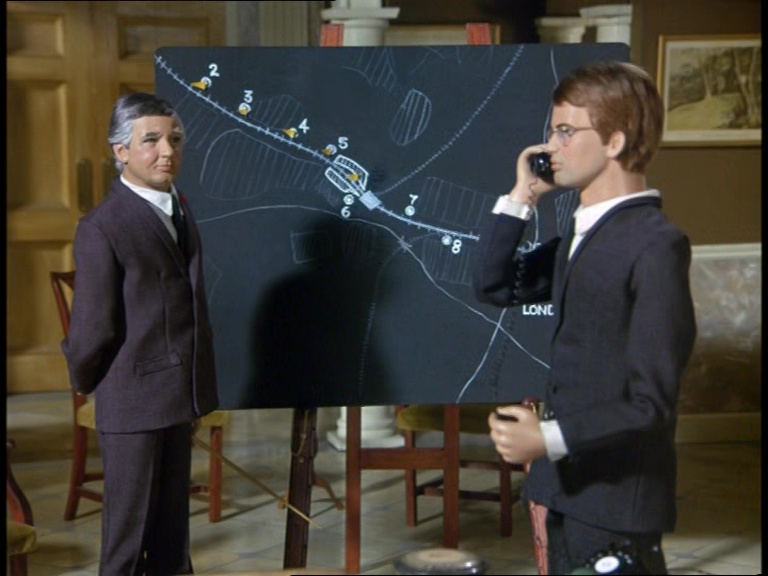
The bad news has reached the Bishop’s office. No more yellow flags today lads. The sequence of events has been shifted around ever so slightly compared to the original script which places this scene before the shots of the engine driver tied up in the cab by Reed that we just saw.
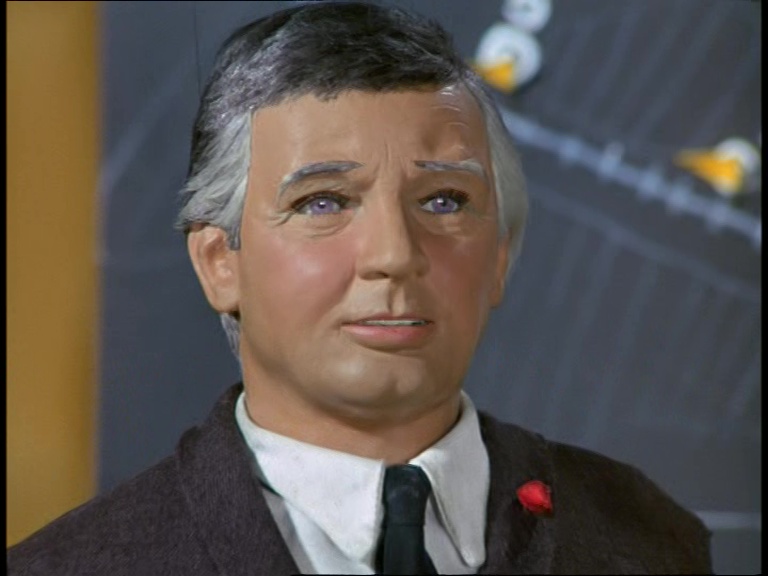
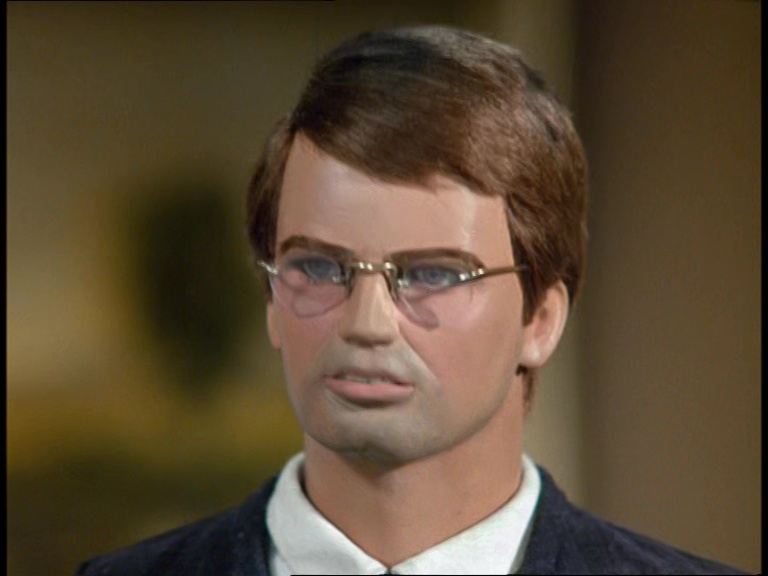
The exchange between Blake and the Bishop is delightful. Poor young Blake is terrified of his superior losing his temper, despite the fact the Bishop has clearly never lost his temper with anyone ever. It just adds to the character’s mysterious, twinkly charm that Blake views him with this air of authority even though the Bishop is obviously a pretty easy going guy.
Also, there’s something satisfying about watching Captain Scarlet behave like a cowardy, cowardy custard…
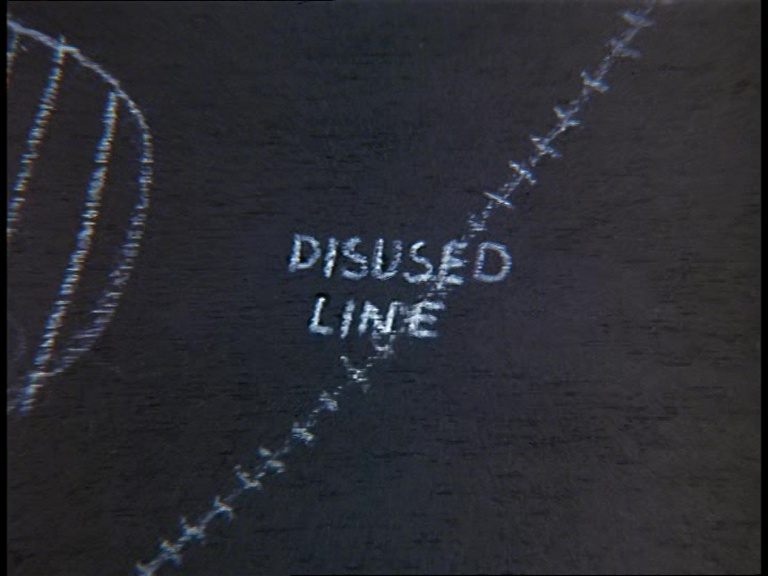
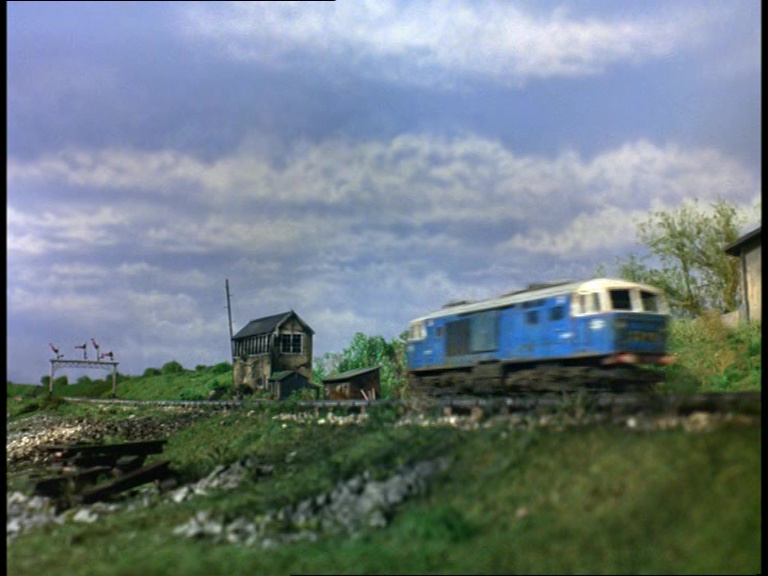
For maximum drama, we pan across the blackboard to the clearly marked “DISUSED LINE” which Blake probably only drew on there to add a touch of artistic flair. Unfortunately, the disused line is difficult to distinguish from the main line because its shot in exactly the same way as all the other train material we’ve seen so far, and just happens to feature a rundown signal box way off in the background.
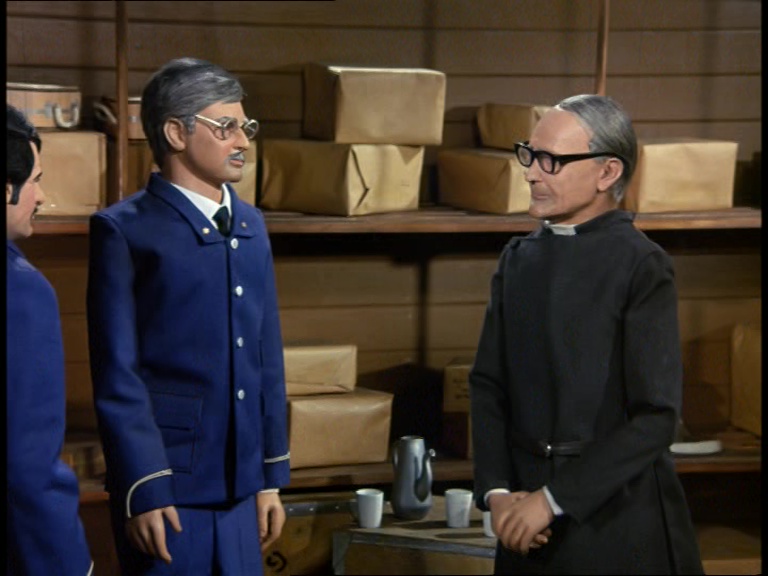
Father Unwin passes on the news from the Bishop that the train has been hijacked in the same manner as a waiter informing their customers that the chef’s run out of Turnip Surprise. There’s no hysterical shock or surprise from the guard either – he knew from the sound of the rails that something wasn’t right… the sad git.
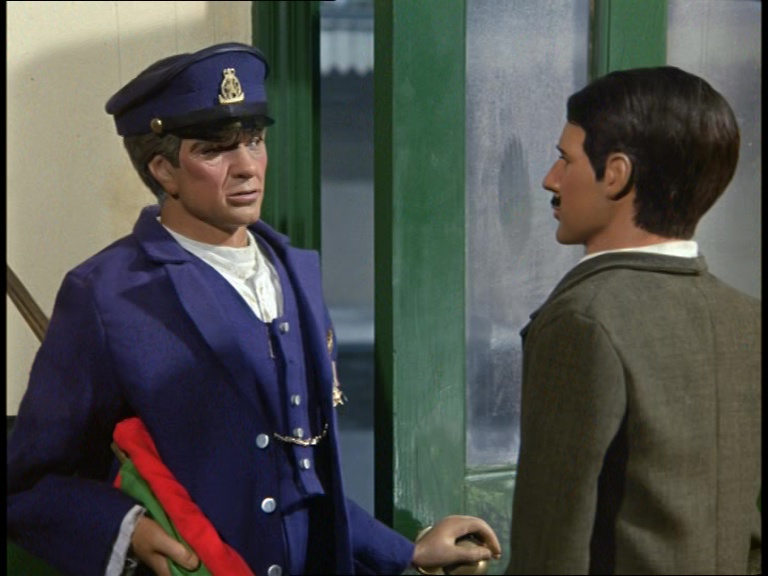
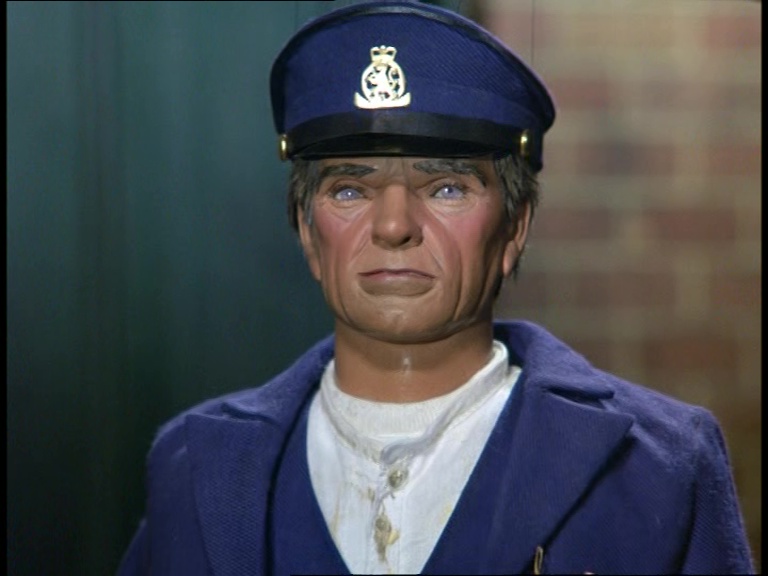
Dear Albert is ready to greet the train with all his uniform looking spick and span despite going unused for four years. Shame he’s still wearing the shirt with the suspicious stain on it though.
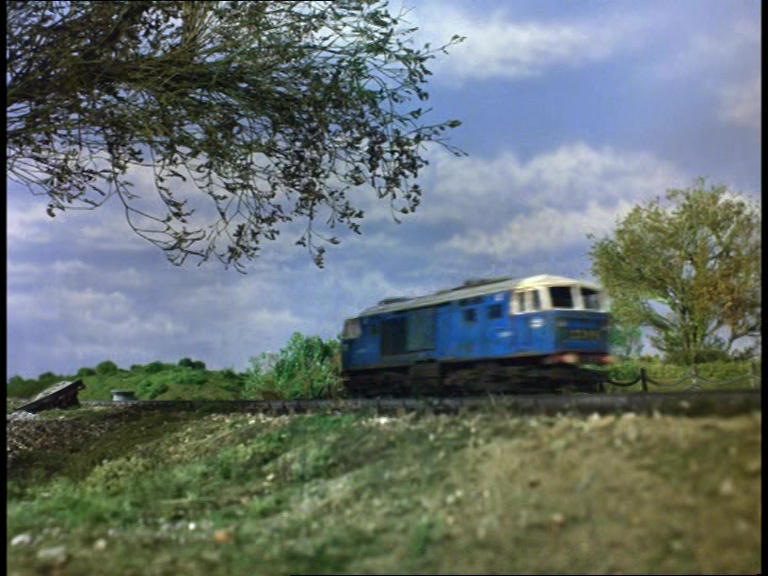
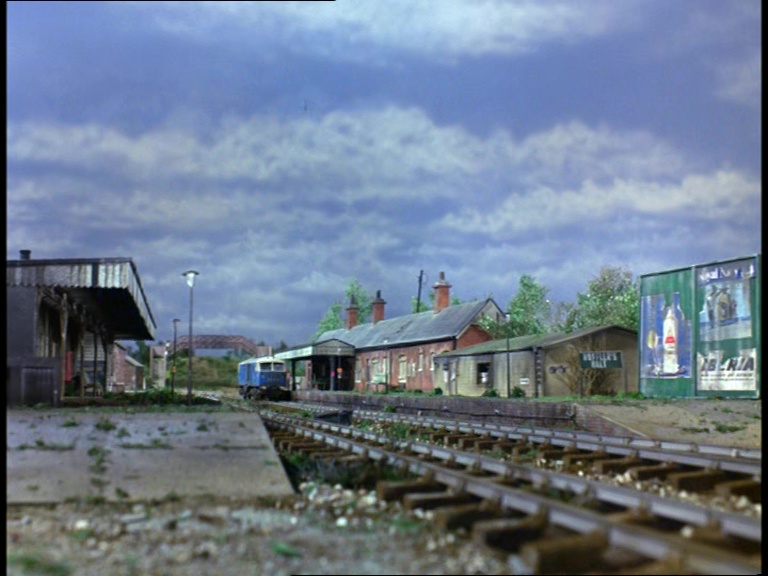
As the train pulls in to Buffler’s Halt at last, I love the fact that we can recognise the musical motifs that Barry Gray often uses in train-based episodes of the Supermarionation shows. Oblivious to everything else, Hobson yells the station name at the top of his lungs like a gorilla who’s just learned to speak.
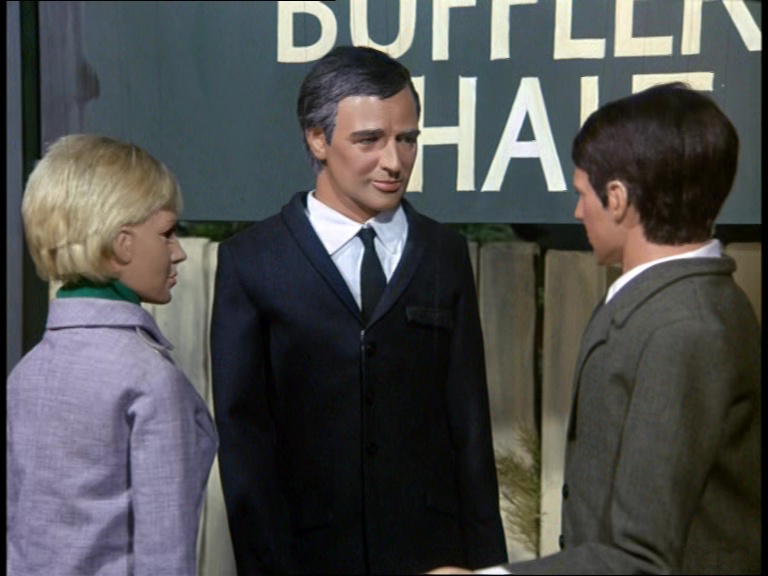
The villains have a truck standing by to make a getaway with the cash. Of course, the train didn’t actually have to stop at a station to make the robbery. Calow probably didn’t need to go to all the effort of working with Albert to reopen Buffler’s Halt and deal with all his nonsense. They could (and probably should) have just stopped the train in the middle of no-where and driven the truck out to meet it. But hey, who am I to spoil a perfectly good little heist?
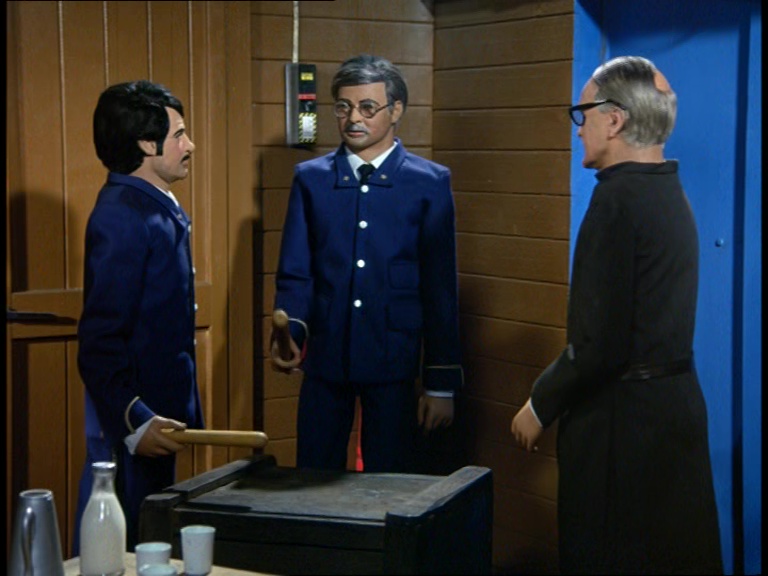
Father Unwin is horrified by the guard’s suggestion of clobbering the crooks over the head with conveniently available wooden truncheons. Seriously, did all British Rail guards have those stashed away?
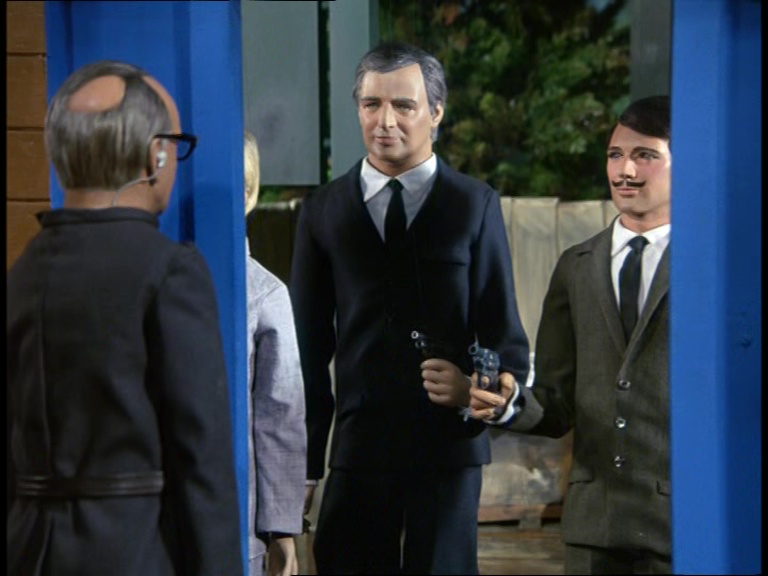
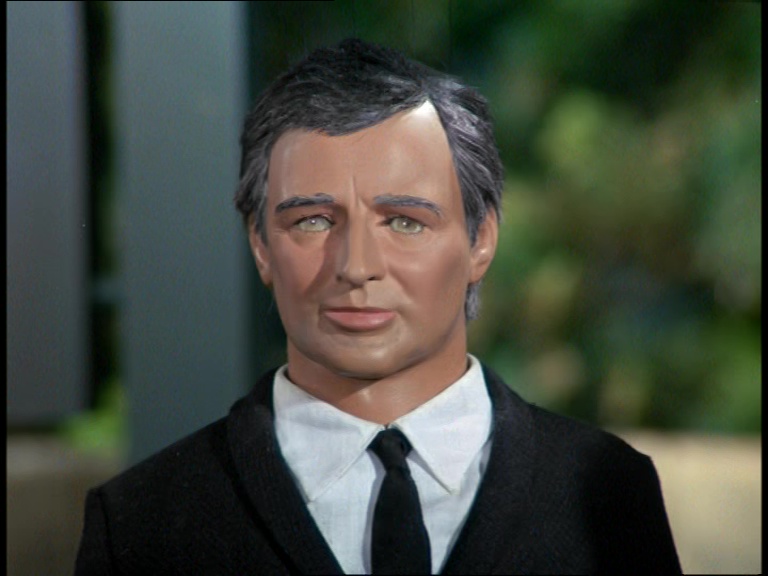
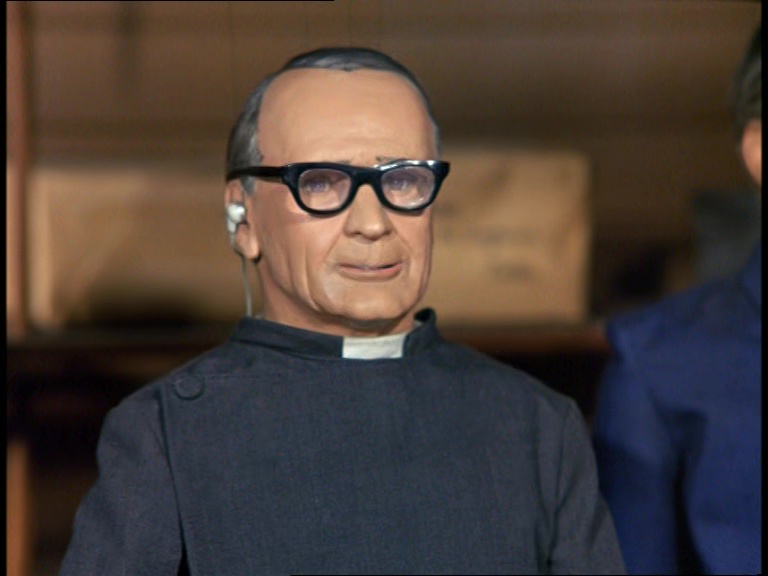
When the door opens, Reed is genuinely surprised to find Father Unwin standing on the other side. Yes, he forgot about the eccentric priest who came into his life barely an hour ago with a note in his hand from the Prime Minister of all people. Father Unwin’s plausible deniability can only stretch so far for the benefit of the plot, and I think characters completely forgetting about him during a heist is probably a bit unrealistic.
Unwin is keen to test Reed’s conscience with a guilt-trip but it doesn’t get him very far, as he’s escorted into the station building at gunpoint along with the guards and Mr. Hobson. Don’t expect Albert to go quietly mind you.
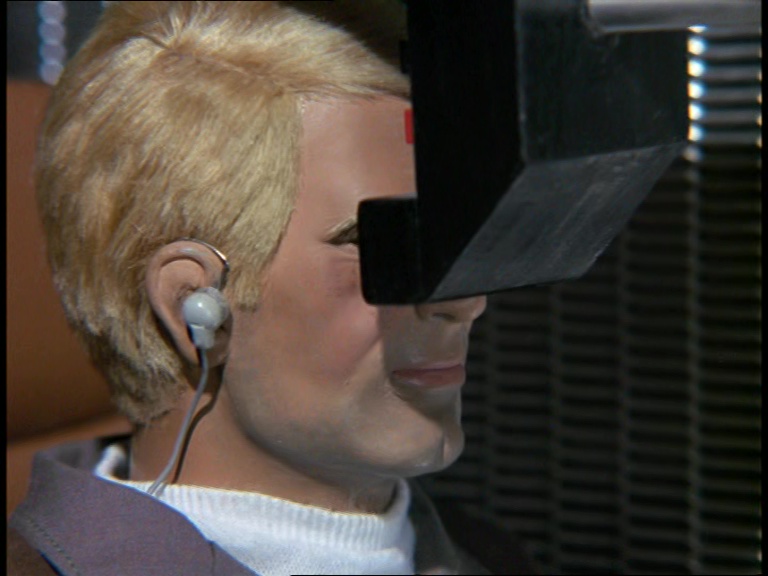
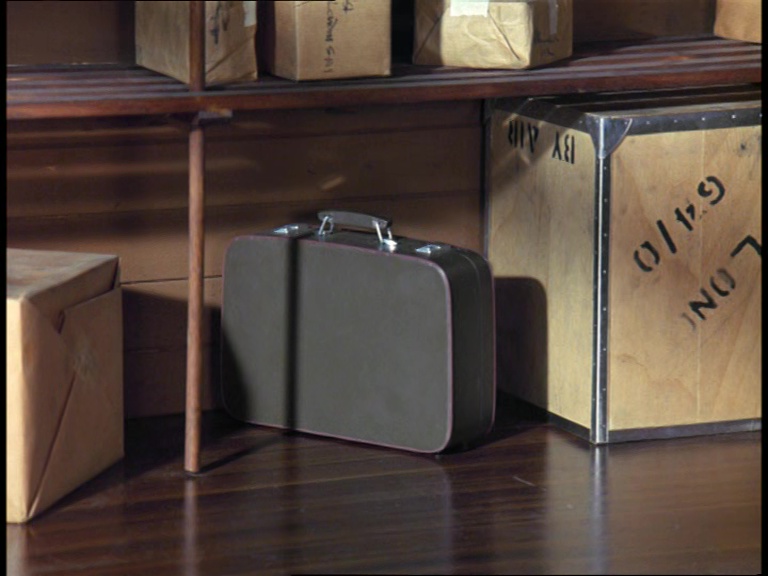
Finally, Matthew has a part to play in all this since he’s hidden away aboard the train without the criminals’ knowledge. What manner of daring exploit can we expect from our man in a suitcase, I wonder?
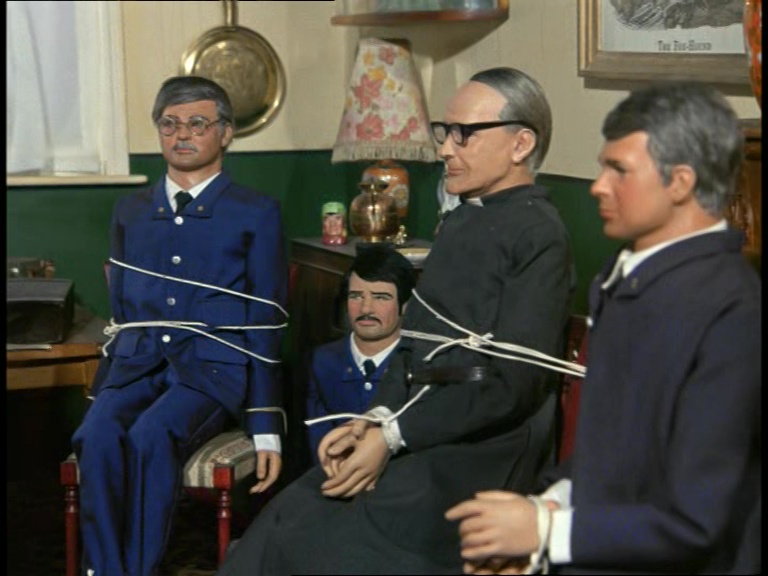
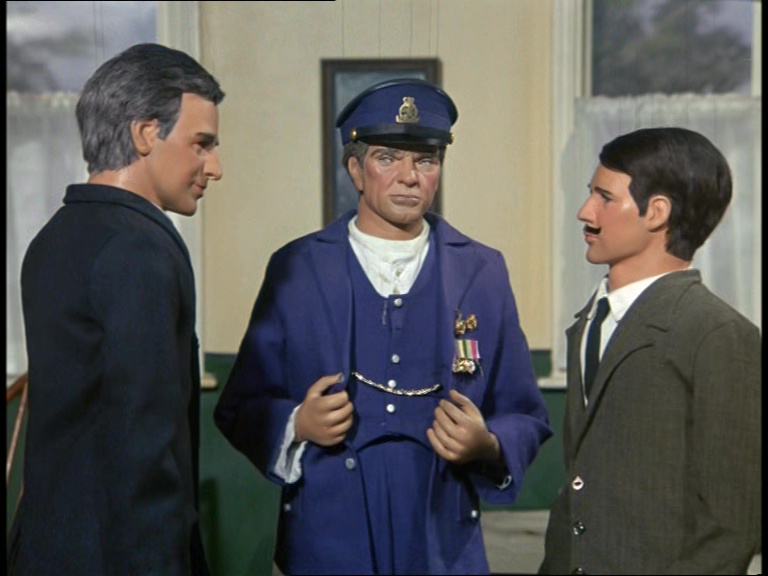
It turns out that Hobson is prepared to be a bit of a hard nut and work for the bad guys… albeit without a clue what’s really going on. Curiously, they’ve decided to remove the gag from the driver’s mouth… and they haven’t tied him to a chair either… he must have said something complementary about Calow’s moustache.
We learn that the truck picking up the money is five minutes away… which frankly just reeks of poor planning on Reed and Calow’s behalf. Surely it should have been ready and waiting when the train arrived?
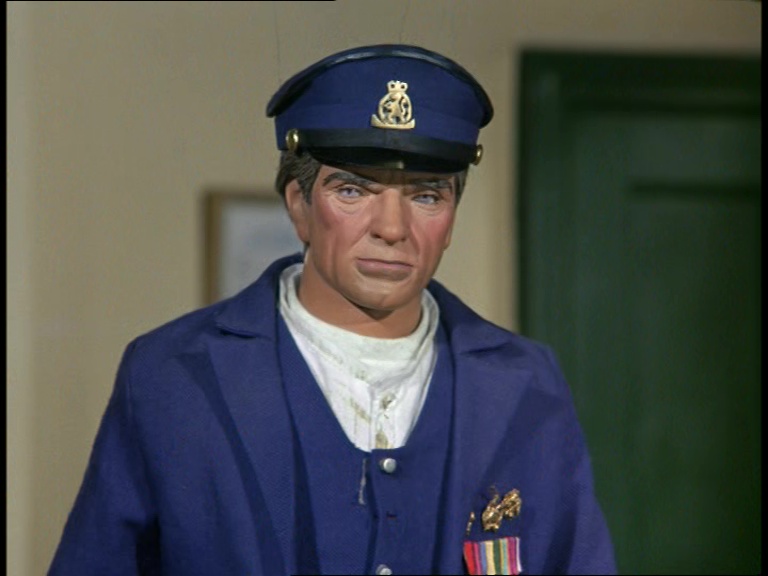
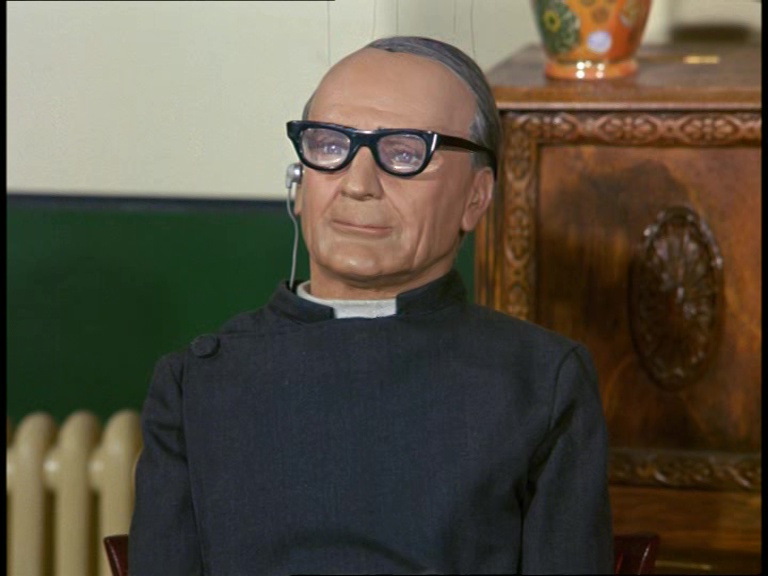
Once the baddies have left the room, Father Unwin attempts to appeal to Hobson’s better nature. Poor Albert seems to be under the impression that it’s Unwin and the other British Rail staff who have done something wrong. We also learn that he’s been working on the railway for 55 years… I can barely hold down a job for 55 minutes so that’s pretty impressive.
“I have a note in my pocket if you will care to take a look at it,” is another classic from Father Unwin’s book of chat-up lines.
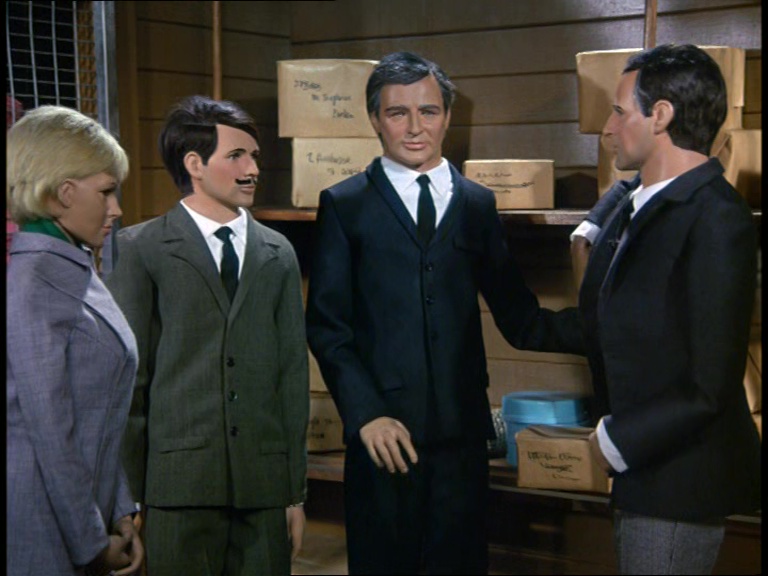
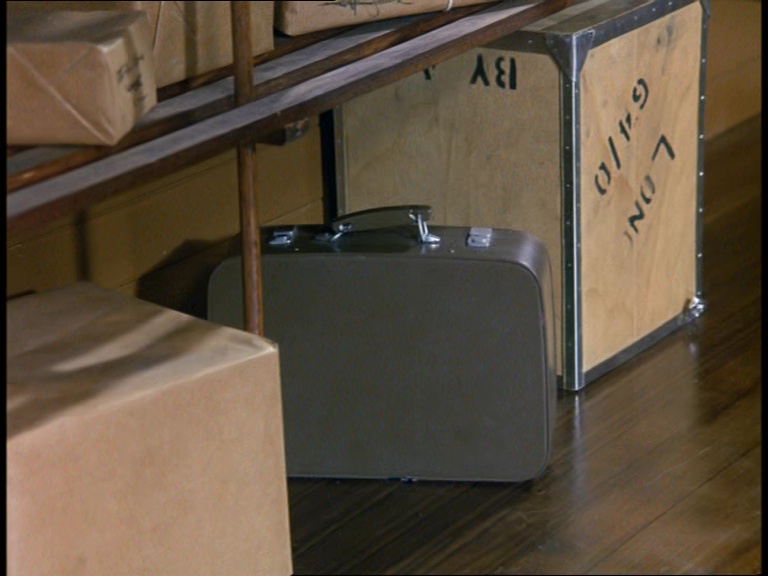
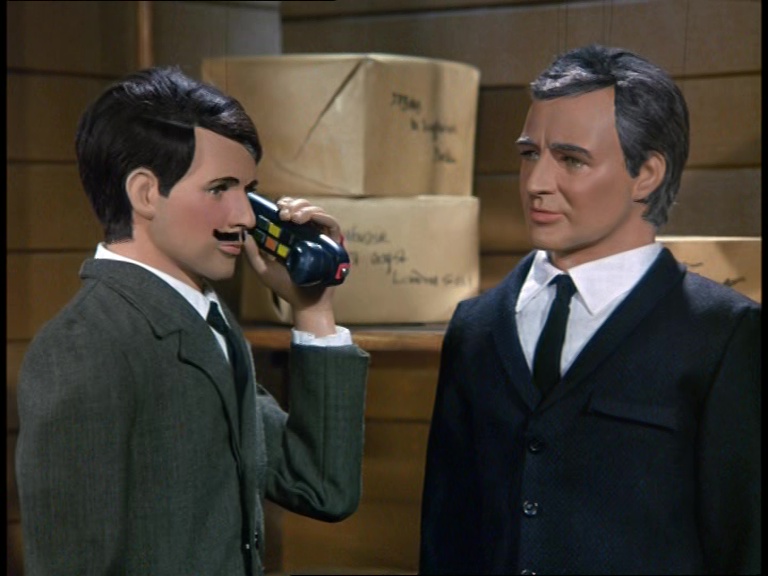
The gang have all reunited. Jackie, Calow, Reed, and Mason stand around in the carriage like lemons waiting for the truck to arrive… a truck for transporting six mail bags full of paper bank notes… hmmm… could have probably slung those in the back of the Ford Cortina I reckon. This is where the change in the script from gold bullion to used bank notes starts to cause problems. The operation of transporting the money doesn’t need to be nearly as complicated as they’re making it because they’re not dealing with anything that big or heavy. Still, at least it gives Matthew time to listen in to their plans…
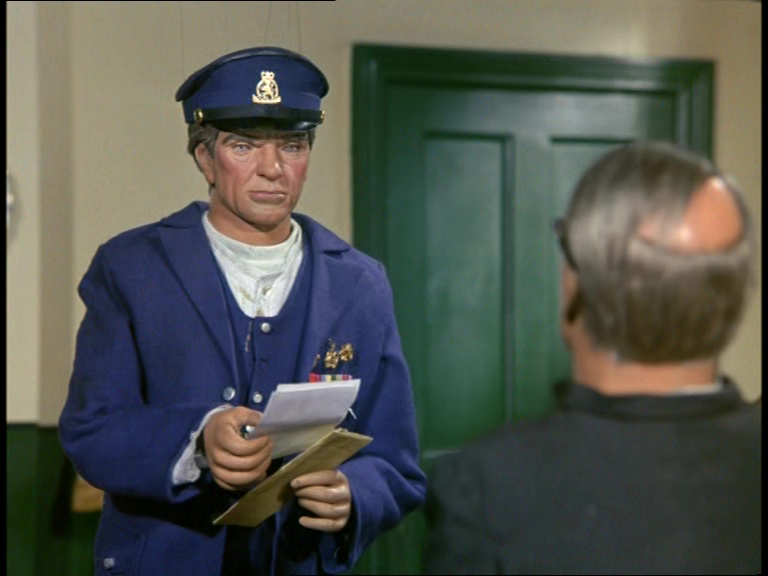
Hobson has completed his rummage through Father Unwin’s clothes and isn’t disappointed by what he finds in there. The note from the PM is enough to make Albert switch sides and start assisting the vicar with his mission to prevent the robbery.
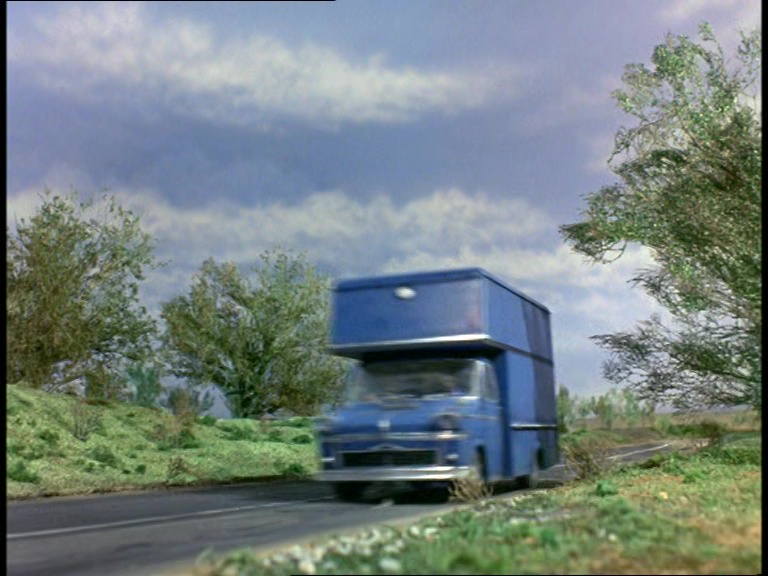
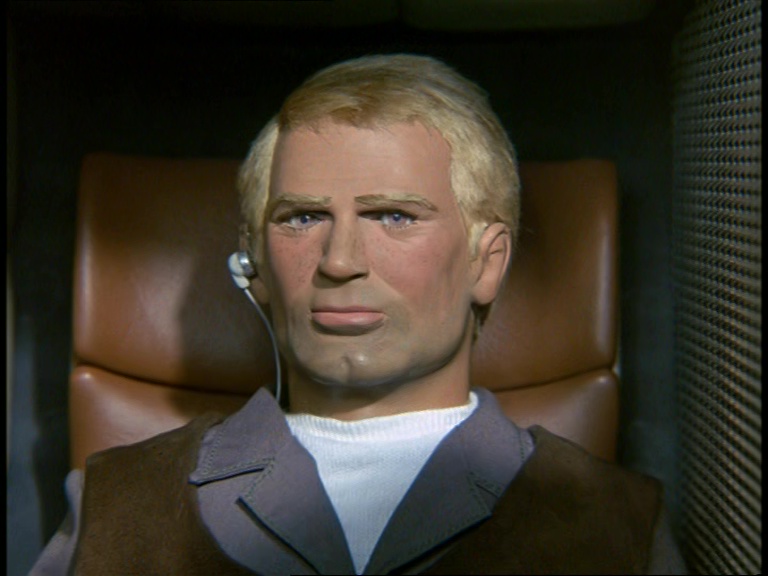
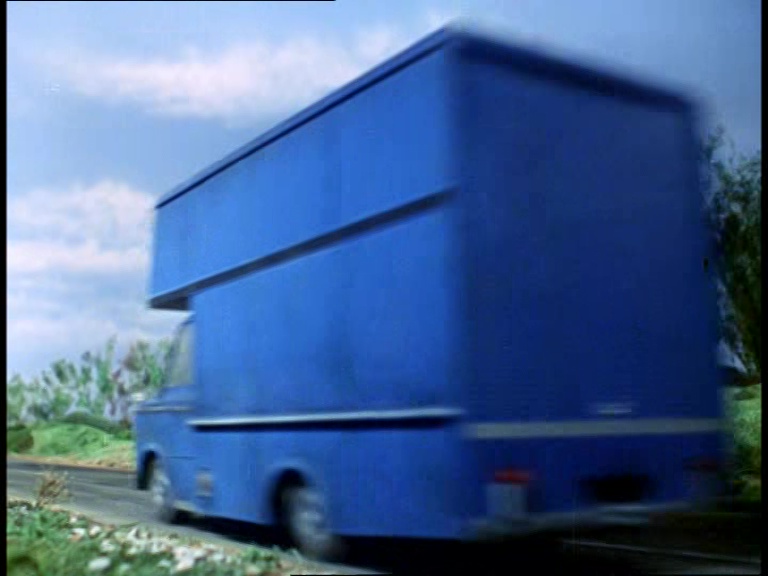
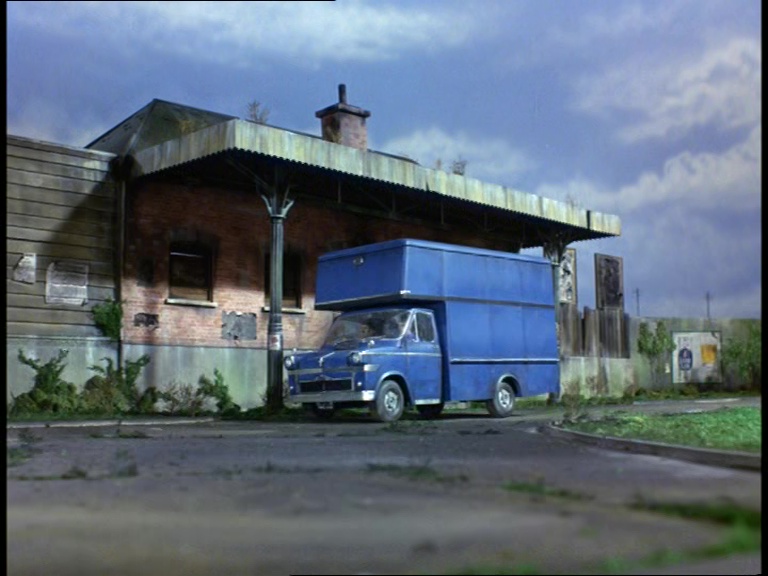
Unusually, the very ordinary-looking truck has been filmed by the effects unit rather than on location – likely because of the upcoming scene involving it and the train. It’s a beautiful little model, highlighting the model makers’ talents in areas other than futuristic craft. The design appears to be loosely based on a a Ford Transit van.
Matthew quickly informs Father Unwin that the rest of the gang are on their way. Frankly, if they’re all as dull as Reed and Calow I don’t think they’ll be much of a problem. Yeah, it’s probably worth mentioning that I don’t think much of this week’s villains. They’re all a bit too boring and ordinary. None of them possess much charisma, or mischievousness, or even a personality of any kind. They’re just there to move the plot forward without any outward motives towards malice.
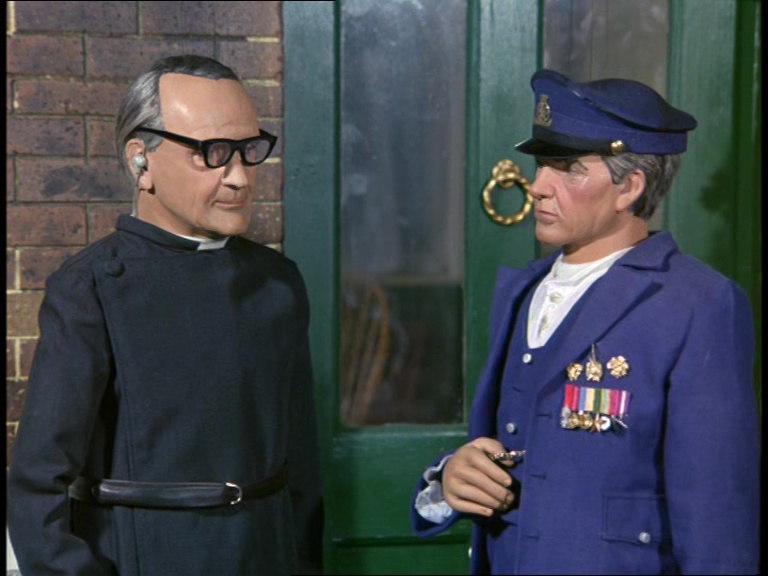
Meanwhile, Hobson makes the absolutely ridiculous claim that he’ll be able to drive the train. Even if you’ve never seen this episode before, I don’t think you need me to tell you how that’s going to go.
And pardon me for being rude but why the heck does Albert wear military medals on his British Rail uniform? He claims to have worked on the railway for 55 years having “never missed a day,” which, assuming the present year is 1968 as per the tax disc from the beginning of the episode, would put the year he started working on the railways as 1913… the year before the Great War started. So either he’s lying about his uninterrupted railway career or he’s lying about his years of military service that he would have had to have to earn so many medals. Either way, I’m not happy.
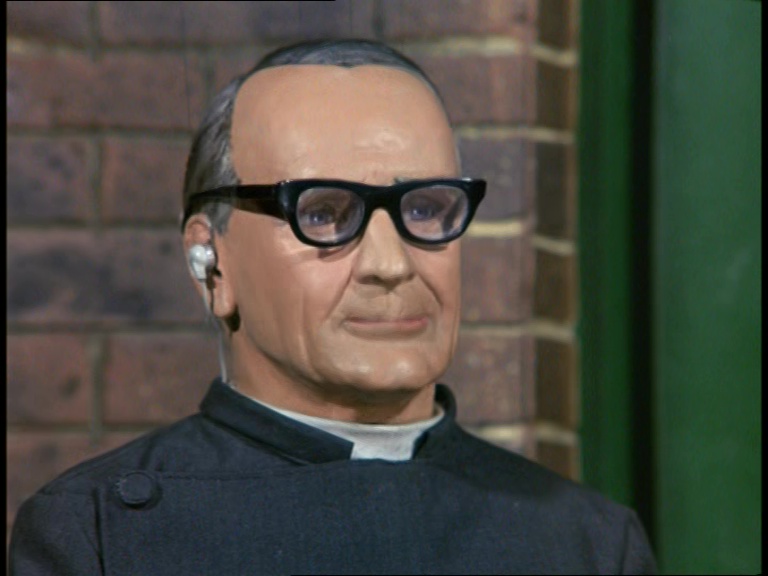
Meanwhile, Unwin asks Matthew to cause a diversion. I wonder what he’ll do! Something very devious and clever, no doubt…
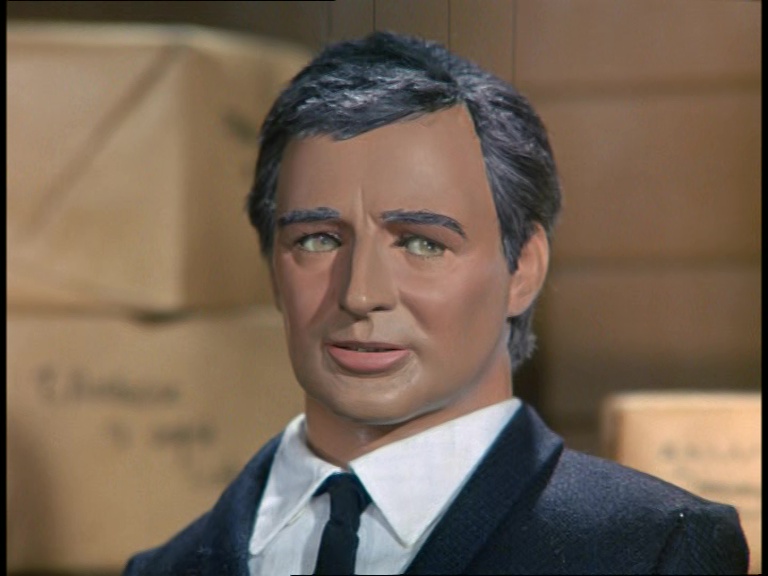
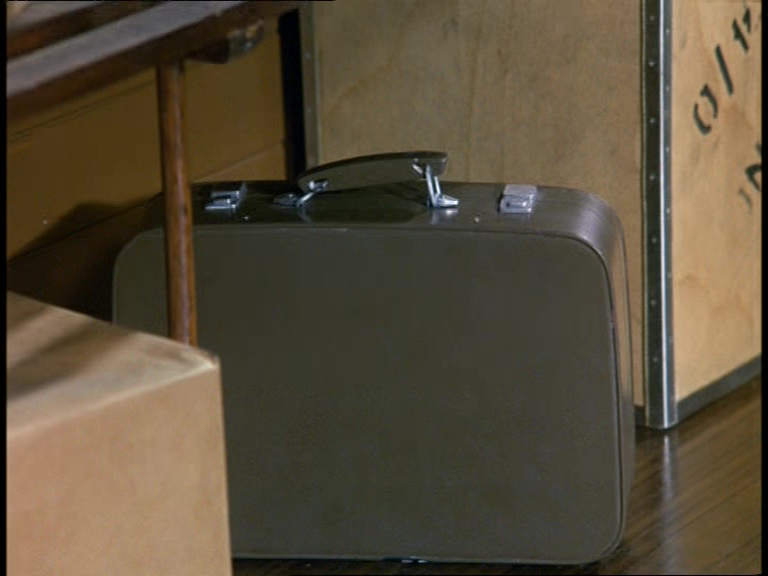
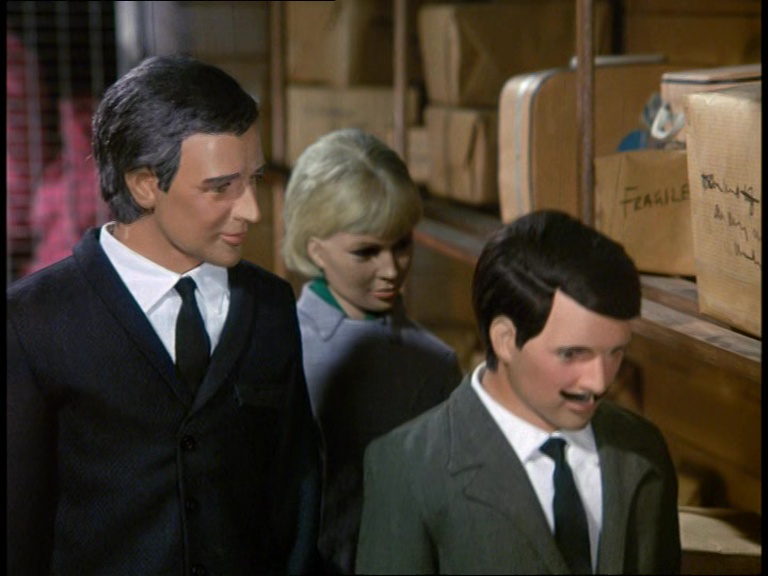
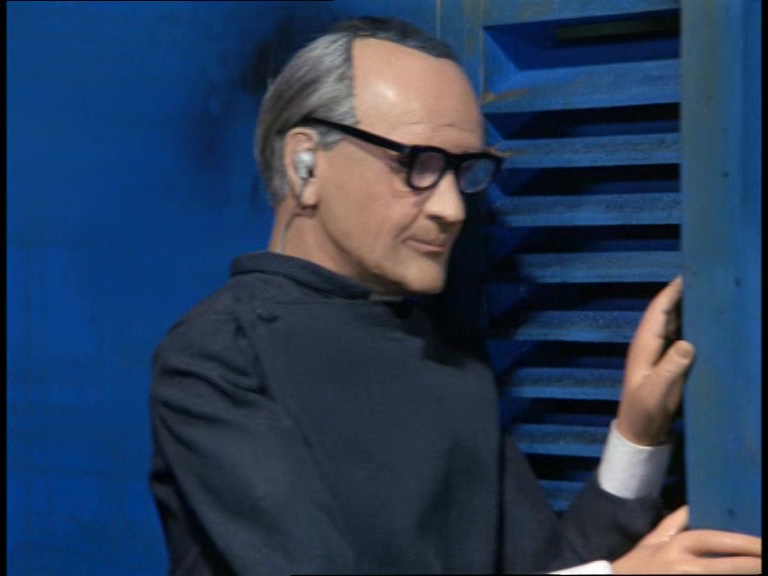
Huh… well I guess saying Reed’s name over and over and over again in a weird voice is something of a diversion. I was expecting something a bit more dramatic but I guess Matthew need not exert himself just to distract this bunch of morons. Unwin slams the door shut and that’s that taken care of.
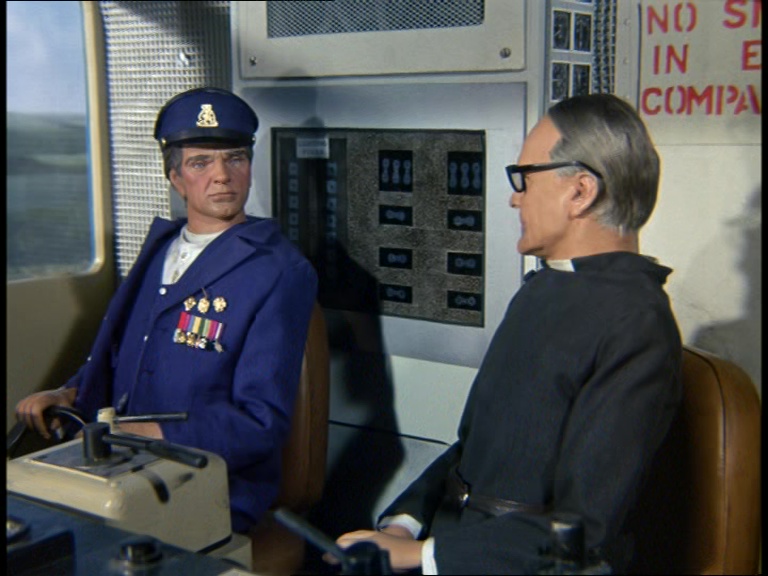
Meanwhile, Hobson has made himself comfortable in the cab and Father Unwin decides that they should make a getaway in the train before the rest of the gang shows up. Yes, okay, that will make the episode more exciting, but actually it probably would have been much more sensible for the Bishop to send all his agents stationed at the various checkpoints along the line over to Buffler’s Halt as soon as he heard they were heading onto the disused line. Then Unwin and Matthew could have had some backup to deal with the handful of crooks in that truck and all would have been well.
Instead, the train pulls away from the station just as the truck arrives. The locomotive starts to make its way back down the line for what I’m sure will be a very safe and uneventful journey…
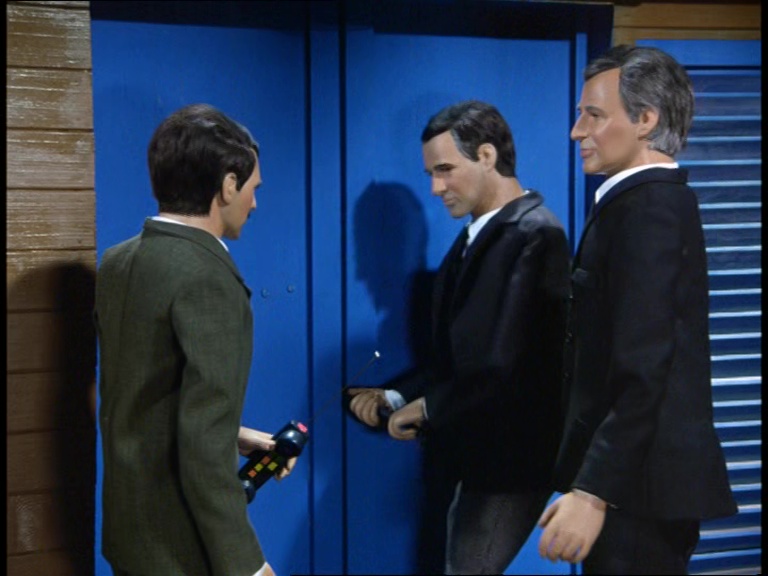
Tough guy Mason can’t get the door open while Reed and Calow watch uselessly. Jackie has probably been sent to make the tea or something because she isn’t seen or heard from again for the rest of the episode.
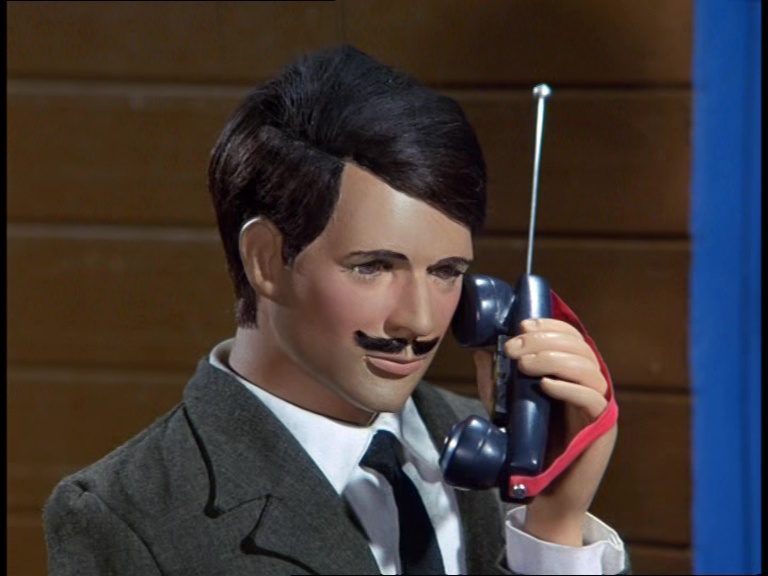
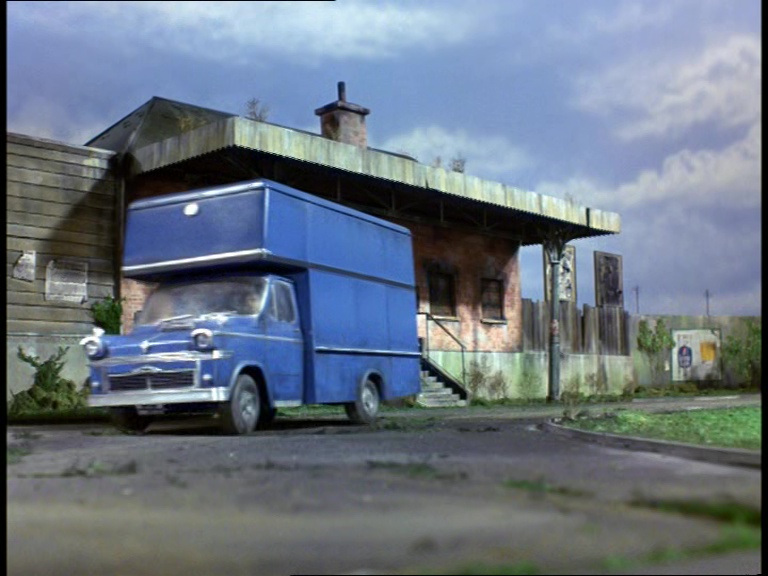
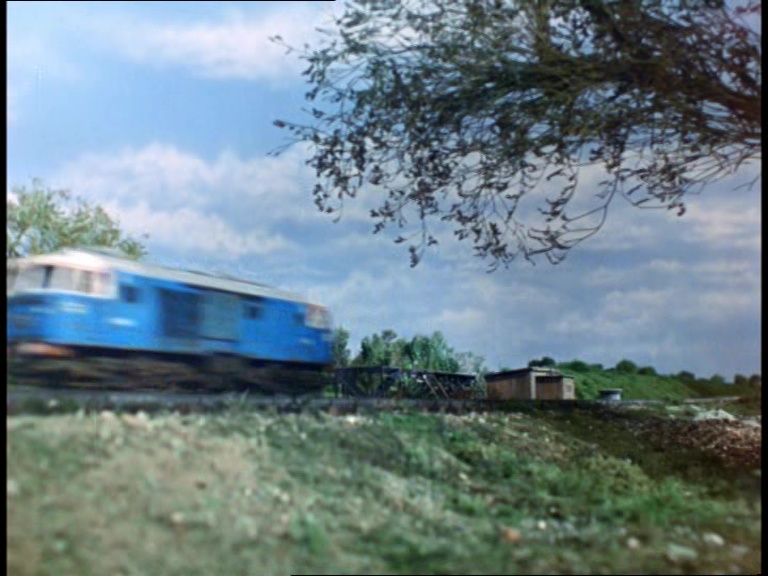
Calow has a radio with him which is jolly helpful. He orders for the truck to intercept the train at the level crossing… which just sounds like an accident waiting to happen. If he’s genuinely proposing that the truck stop on the level crossing and run the risk of the train smashing straight through it, then that getaway driver is an absolute moron for agreeing to go along with it.
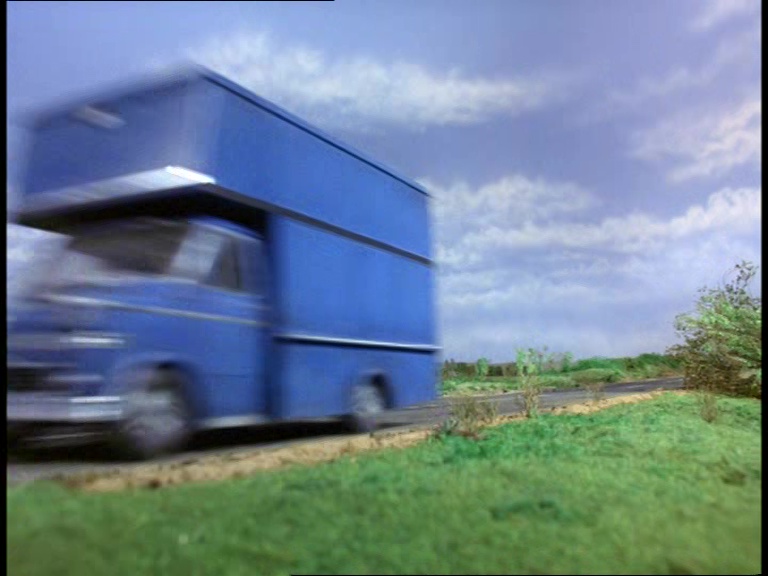
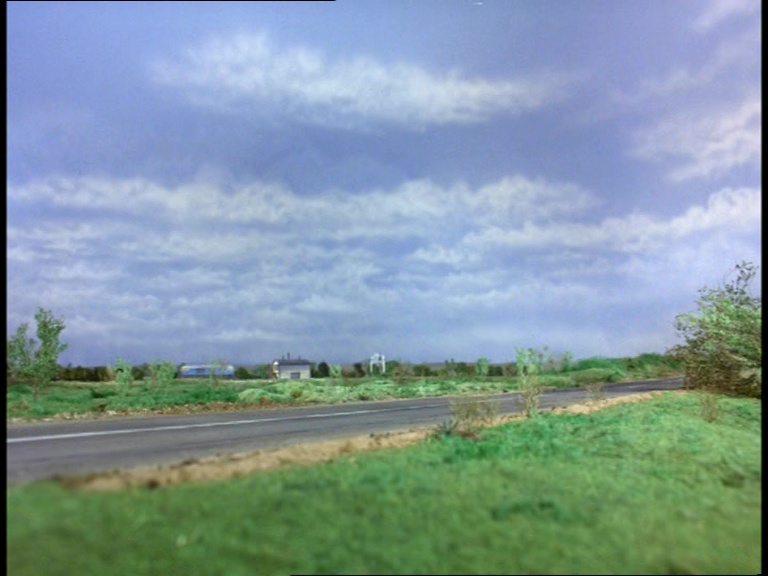
Barry Gray cranks up the tension with the music as the truck races along to meet the train. A slot in the model roadway guides the vehicle along in a semi-realistic fashion, while in the far distance a tiny little train whizzes past in the background to create a wonderful false perspective. I won’t deny a real van probably would have looked better for these driving shots, but it’s nice to see the effects unit getting their teeth into something.
A deleted line of dialogue from this sequence would have had Unwin say, “Excellent Albert. You’re driving like a veteran. (laughs) Oh dear, what have I said!?” … yeah I don’t get it either, but it sure makes Albert’s war veteran status even more contentious.
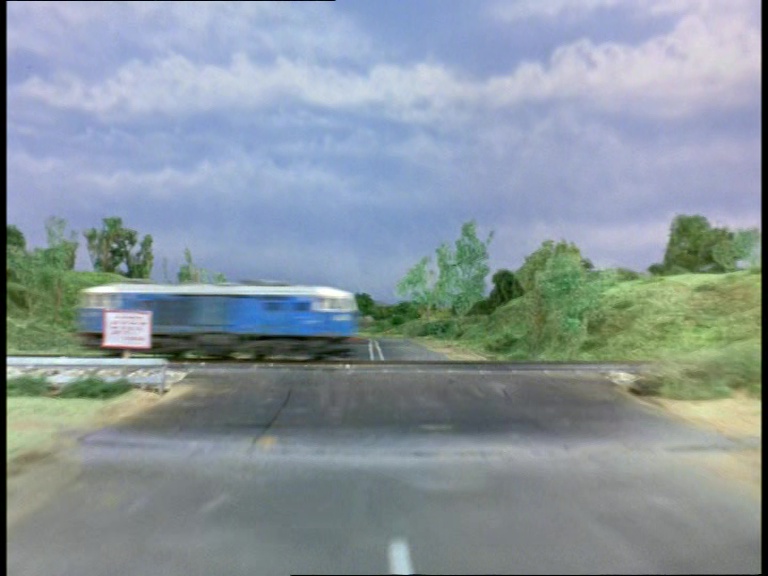
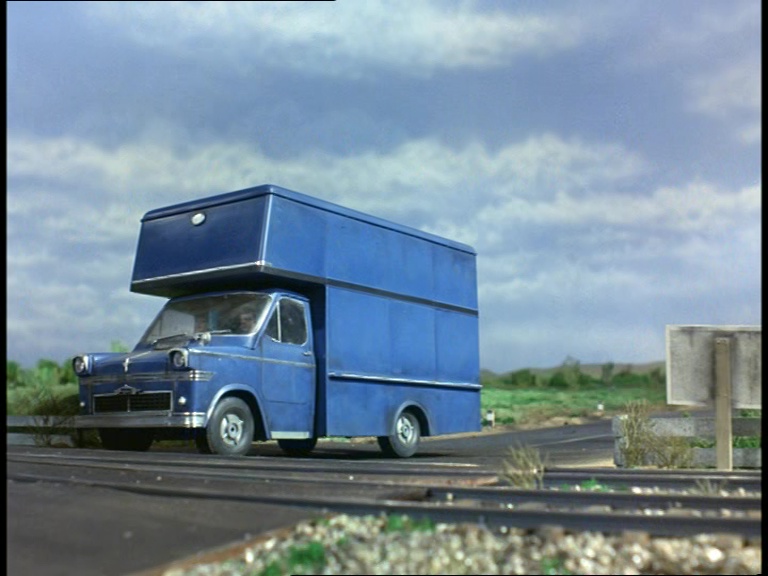
With only seconds sparing everyone from a horrific accident, the train shoots through the level crossing just before the truck reaches it… at which point the gang probably decided to call it a day, go home, maybe have a bath, and get an early night. They certainly don’t bother to catch up with their associates aboard the train again.
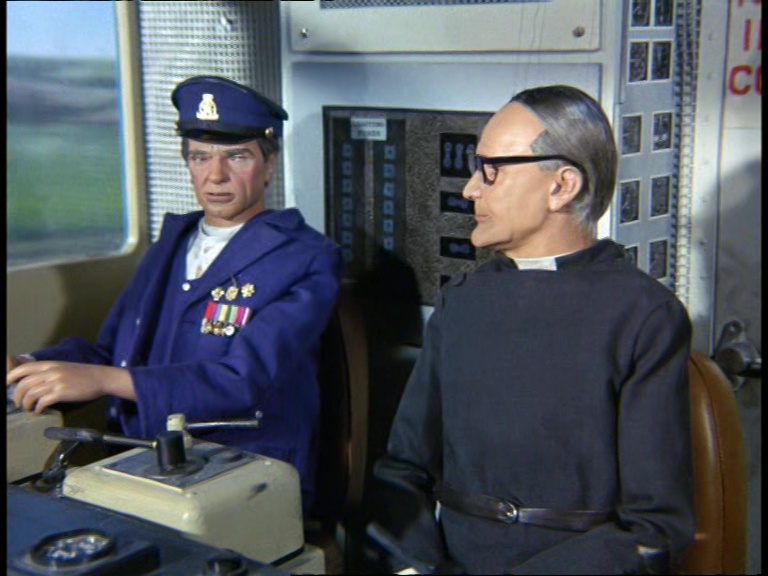
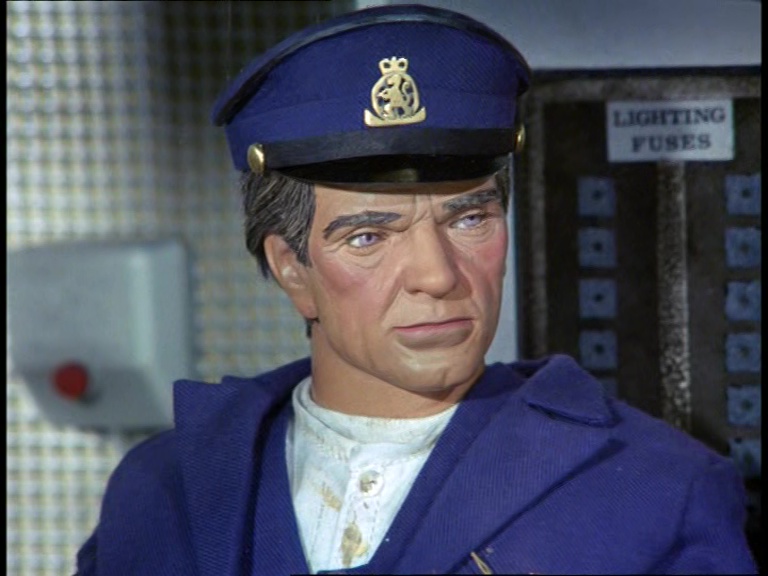
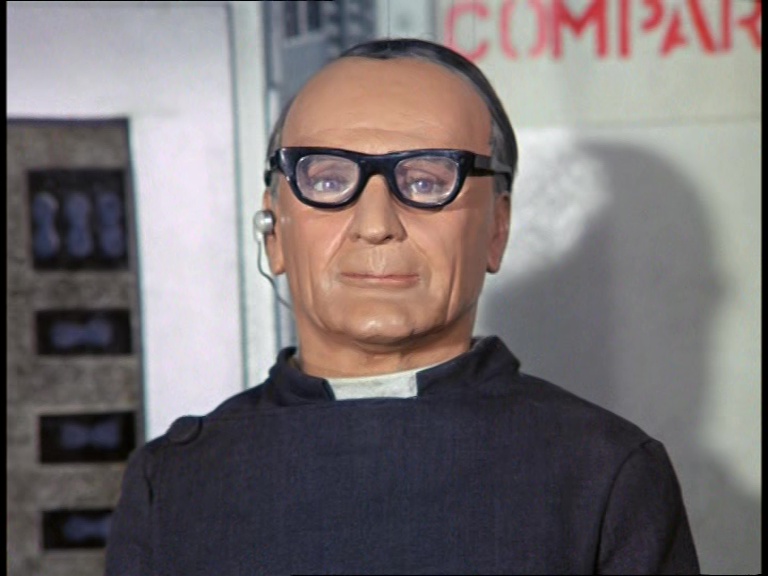
With the situation basically defused, it’s time for Hobson to slow the train down to a reasonable speed… except he doesn’t know how… because he’s the definition of chaotic good. Father Unwin now faces his worst nightmare… travelling at speeds in excess of 50 mph. I told you that earlier scene aboard Gabriel at the beginning of the episode wouldn’t be for nought.
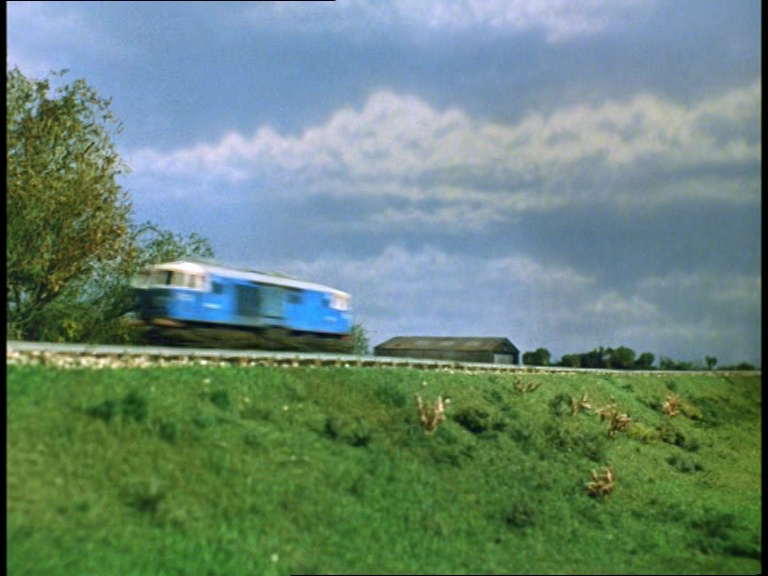

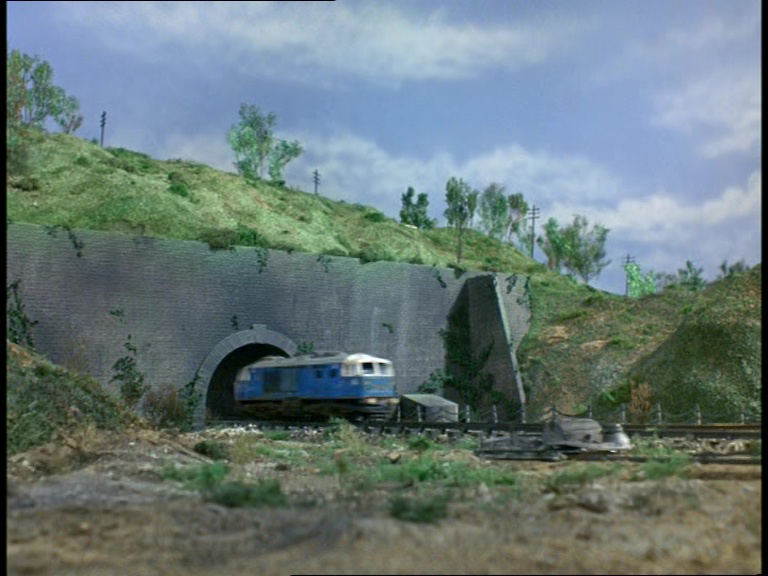
Barry Gray, being quite experienced with this sort of thing by now, knows exactly how to deliver a score for a runaway train sequence. See the Joe 90 episode Lone Handed 90, Thunderbirds‘ The Perils of Penelope, the Supercar episode The Runaway Train, or even Four Feather Falls‘ marvellous First Train Through episode for some earlier examples which feature similar musical motifs.
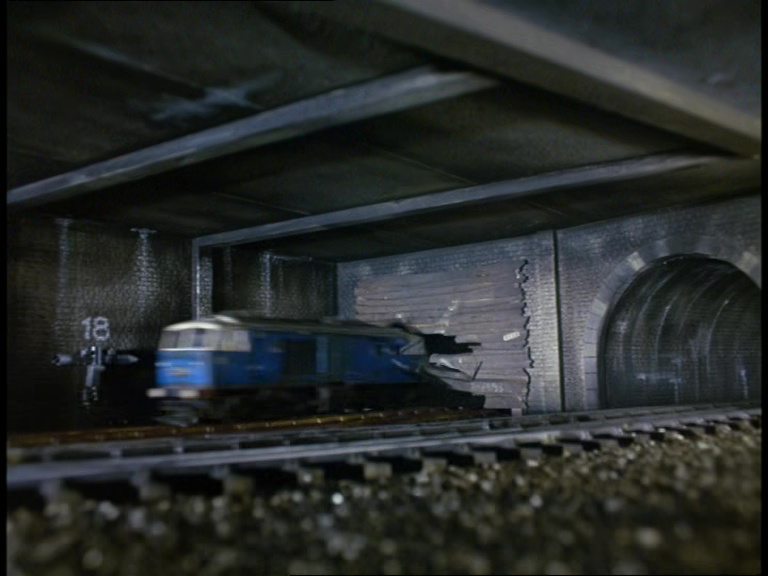
Finally all that business with the boards appearing and disappearing and what not makes sense… it was all for this exciting shot of the train crashing through at full whack.
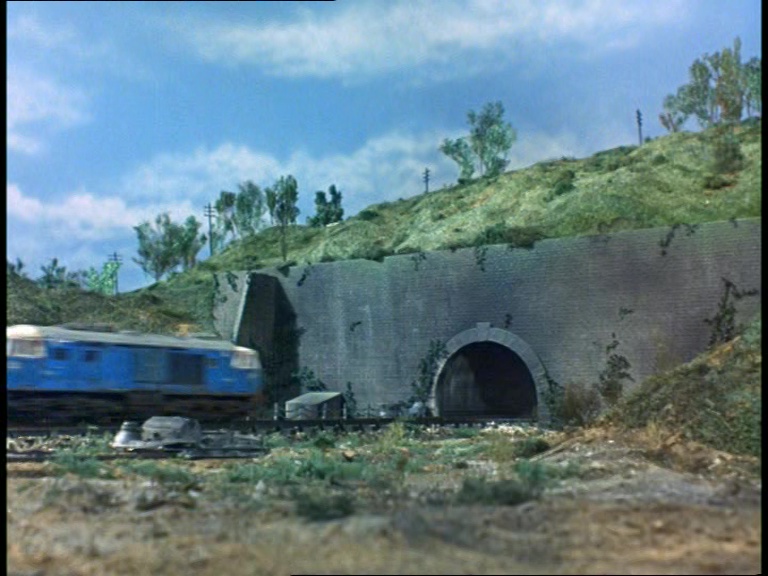
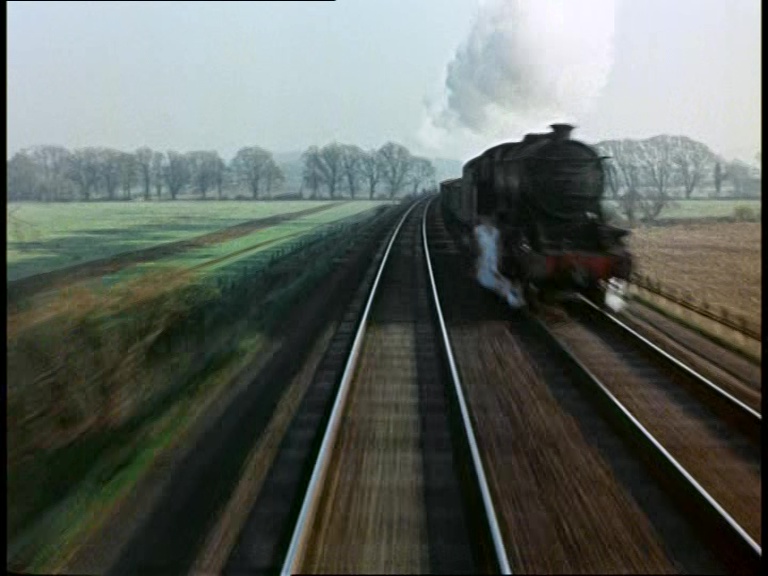
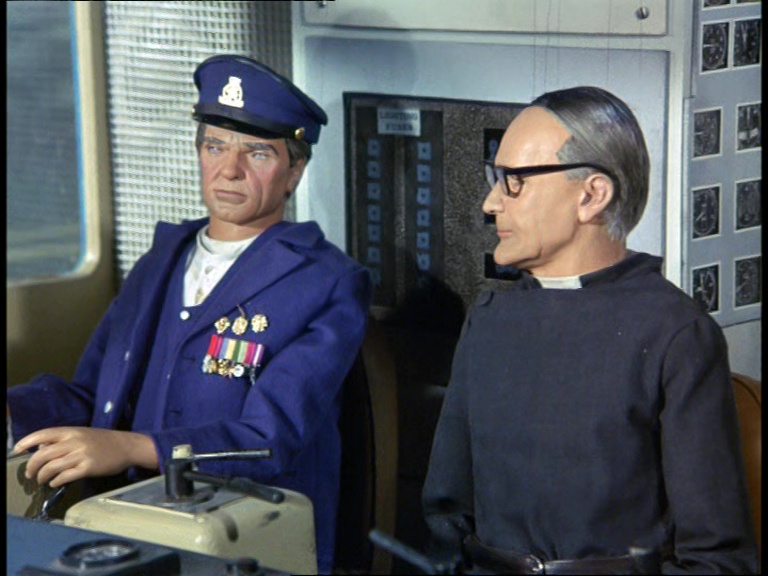
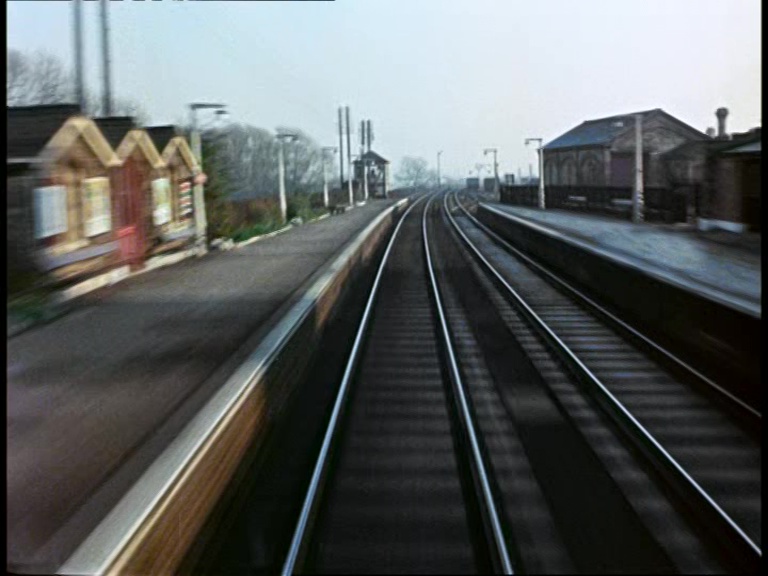
Hobson, being the absolute maniac that he is, can’t help but hide the fact he’s proud to be on the main line, getting ready to cause a major disaster at some unsuspecting London terminus. I can’t even with this guy.
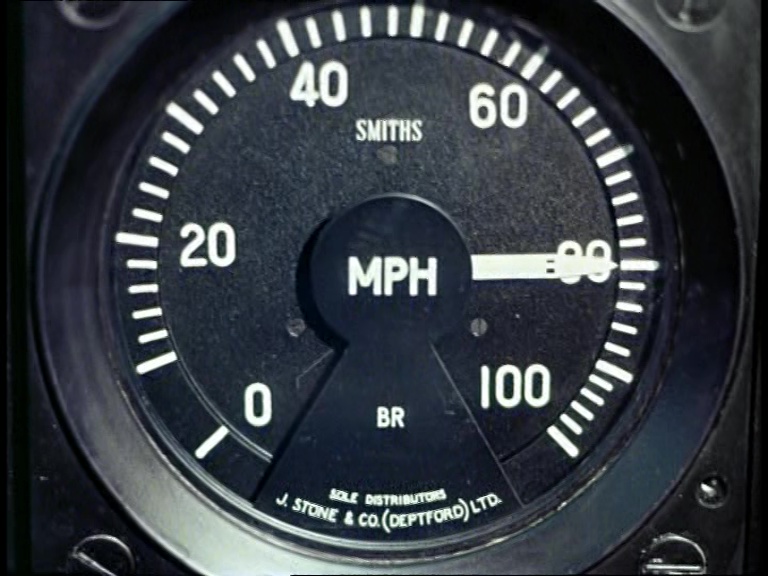
The switch between model trains and live-action trains is fairly acceptable, although the appearance of a steam train is something of a surprise for 1968 since they weren’t nearly so common by this time. Maybe this is stock footage filmed a few years prior. The speedometer shown in close-up was manufactured by J. Stone & Co. in Deptford and it is indeed from a rail locomotive since ‘BR’ stands for British Rail. As for the train station that we pass through, it would take a better man than me to identify it.
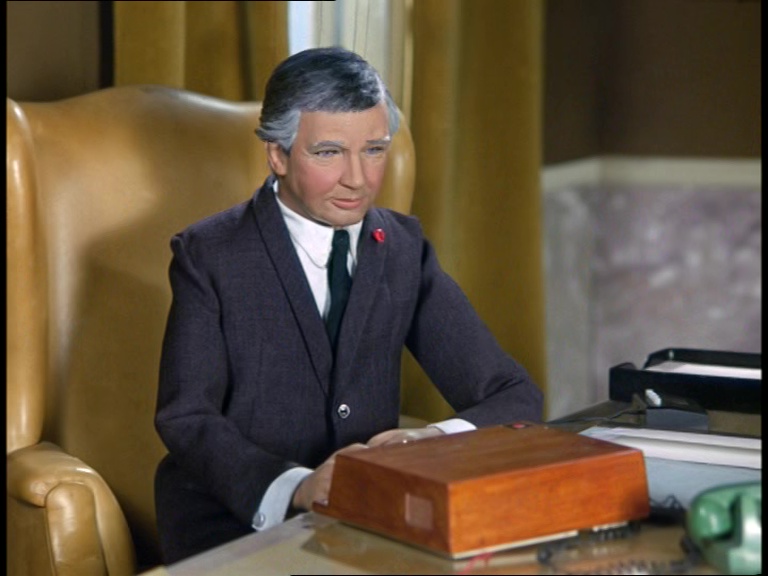
The Bishop’s offer to get the fuzz involved was actually scripted to appear much earlier in the sequence of events, when the train and the truck were heading towards the level crossing. Once the truck stopped on the level crossing, Barwick’s script suggested that police cars arrive. Instead, however, the line is just dropped in here and doesn’t really mean anything as a result.
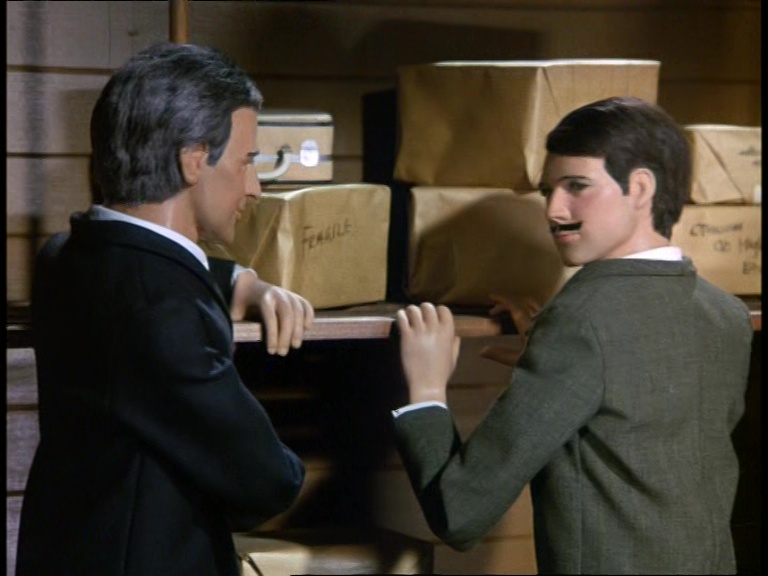
Meanwhile, the bad guys are having a bumpy ride and have basically lost all the potential they had of coming across as threatening. I actually feel sorry for them. It’s pretty clear who the real villain of the piece is…
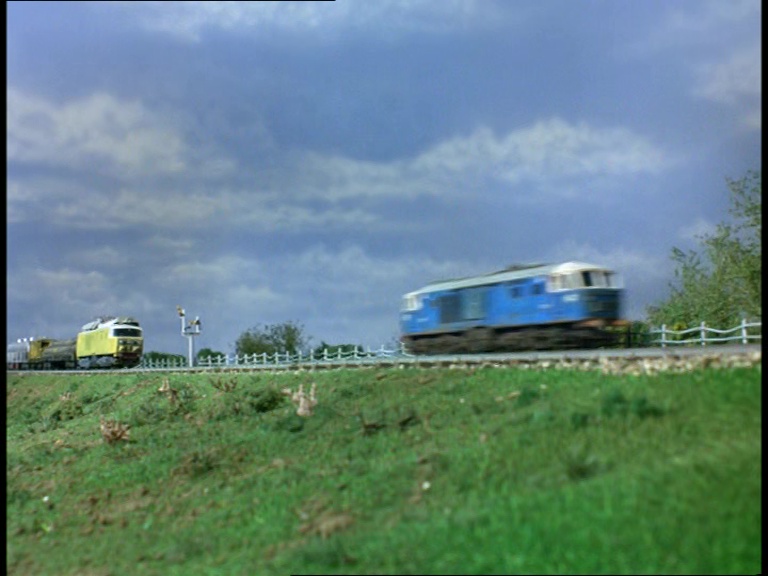
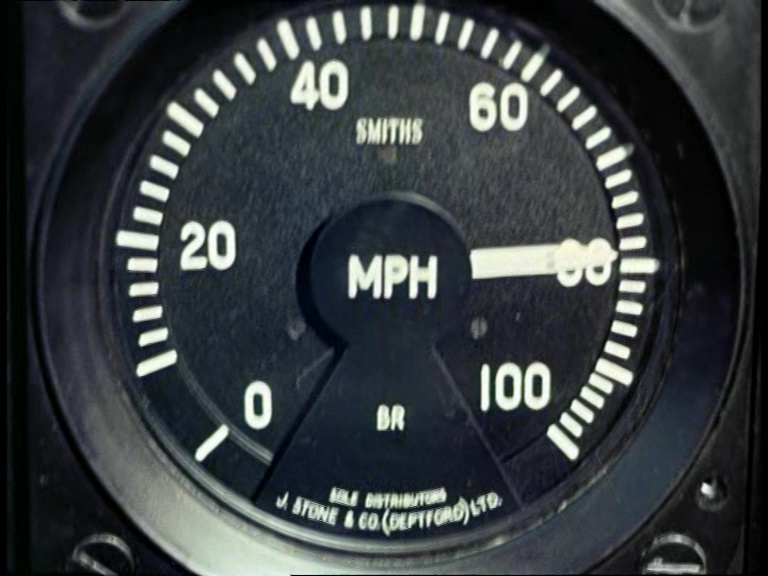
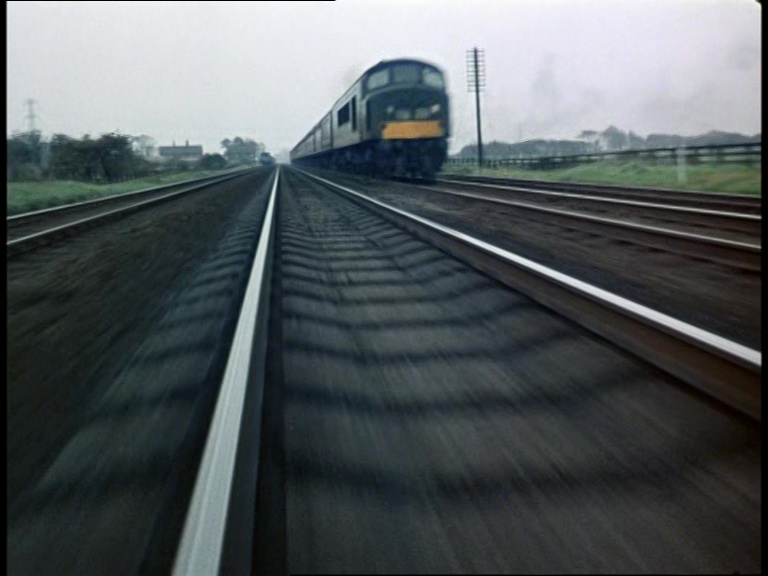
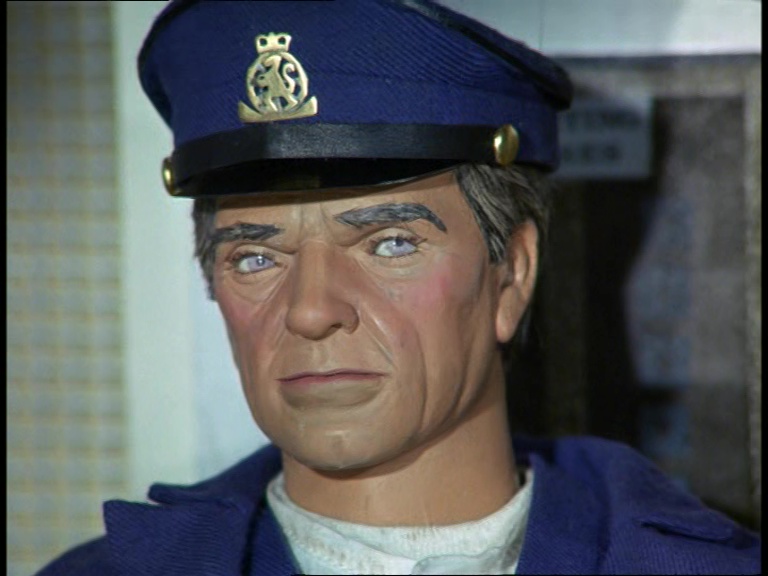
Hobson doesn’t even want to stop the train at this point. Look at the dead stare in his eyes. He has no intention of trying anything to slow down like, oh I don’t know, turning whichever knob he pulled in the first place the other way?!
Nope, instead the locomotive cruises along at 80 mph past a bright and sunny model shot of another Triang Big Big Trains model in yellow, and some more wintery-looking live-action footage of what I believe is a Class 45.
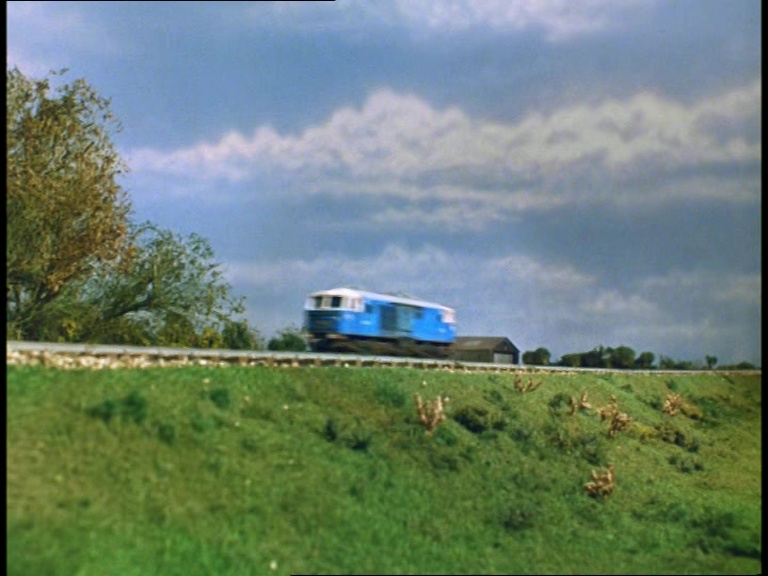
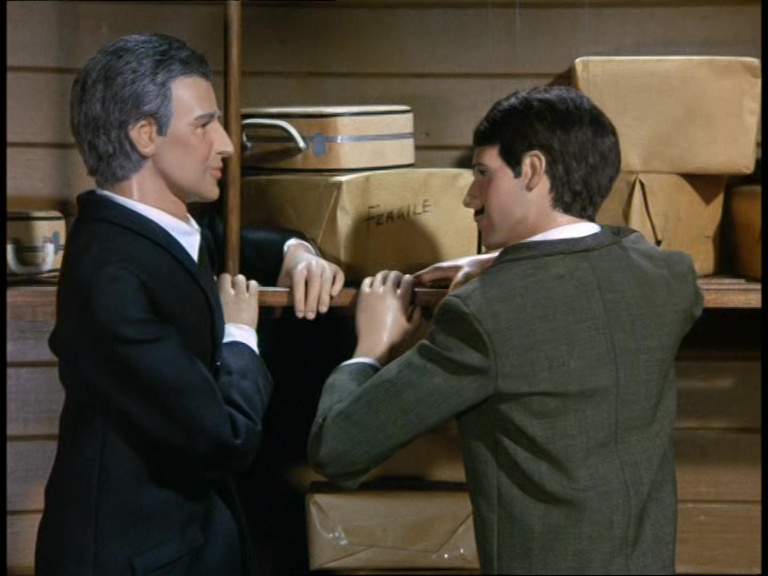
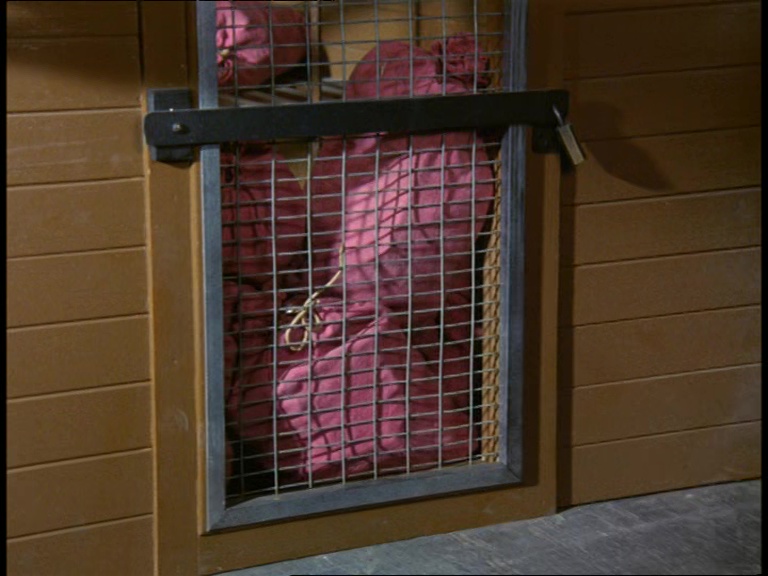
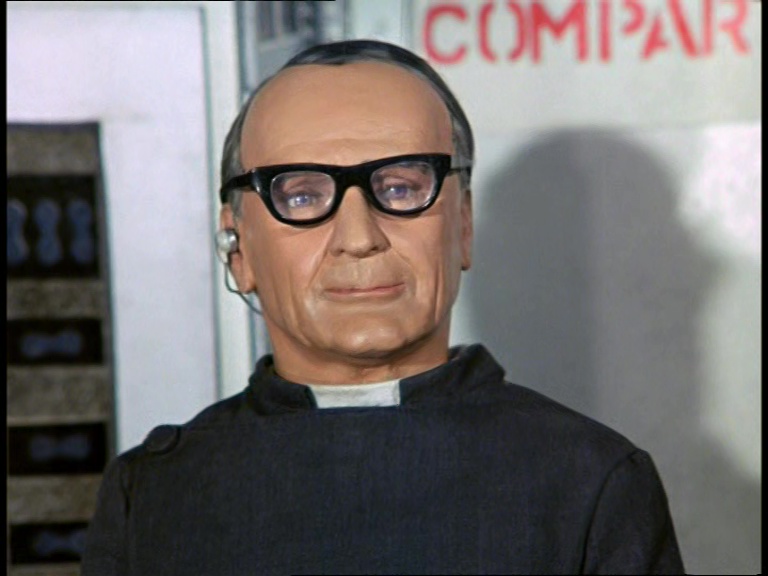
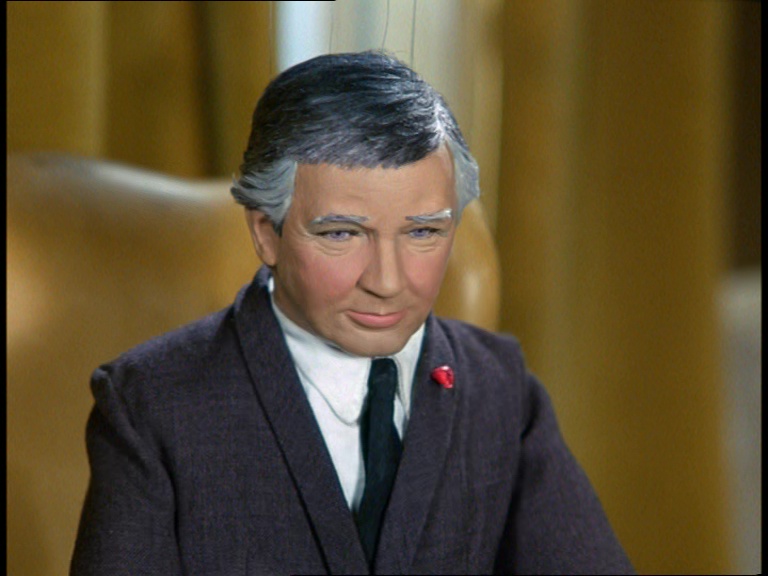
A shot of the train whizzing past an old barn is recycled from earlier, as if all these train model shots didn’t look similar enough already. Reed and Calow scream for help and for some reason cry about a million pounds… I mean, you’re standing right next to it chaps, you might still have a chance to pinch it and get away with it.
Unwin finally enlists the assistance of the Bishop to work out how the train can be stopped. For some reason, Unwin doesn’t have the confidence to just kick Hobson out of his seat and take over, or indeed do anything himself to try and figure out the problem. The script does feature a deleted line from Unwin saying, “I think I will try and locate the brake” while Hobson just stares ahead like a serial killer, but it was cut because, let’s be honest, any idiot could probably find a brake in a train cab.
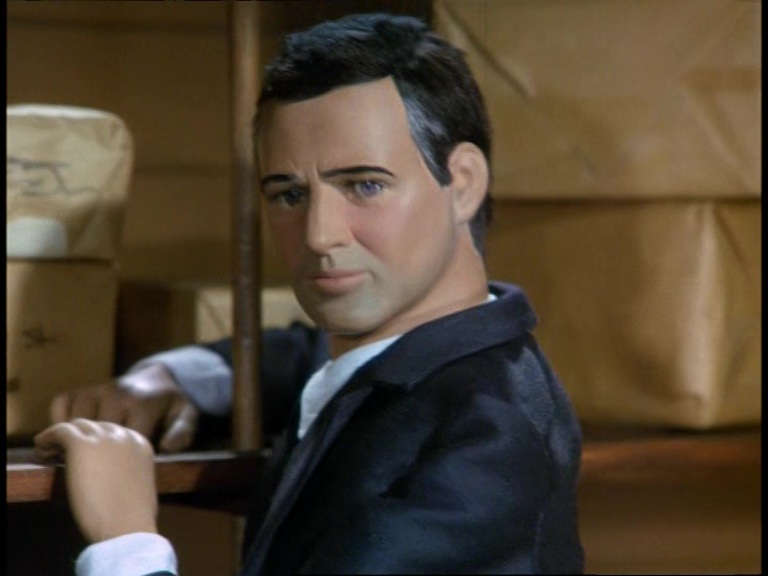
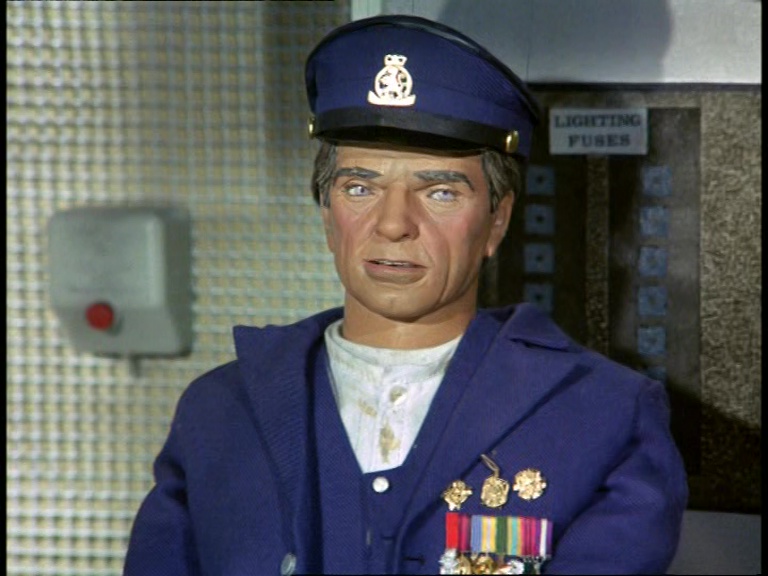
While everyone aboard continues to fear for their lives, Albert can’t help but brag about his newfound fondness for the main line… seriously, the man’s a psychopath. Just look at that suspicious stain down his shirt!
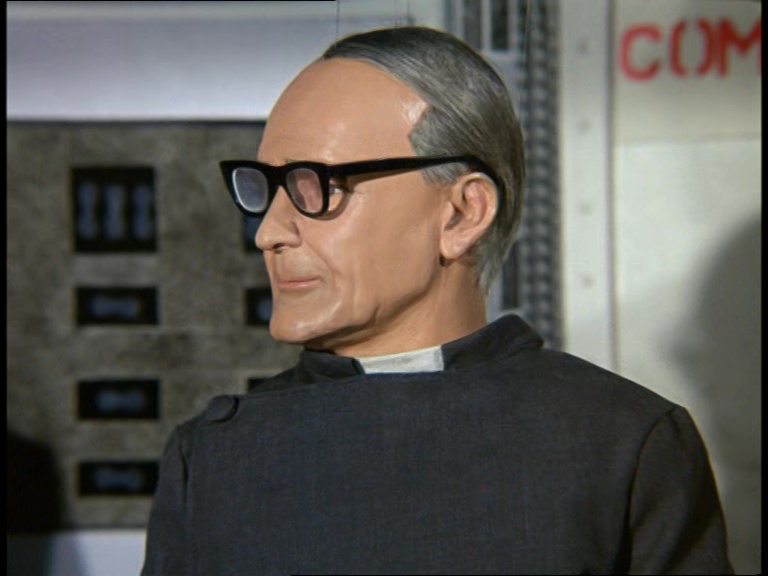
Unwin, who can usually see the good in all people, realises that Albert cannot be saved.
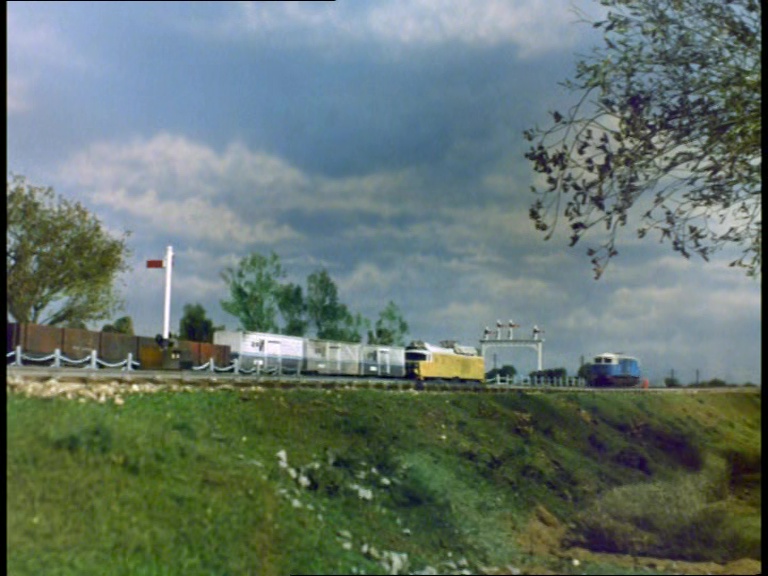
More trains. Honestly? I think I might have had enough of trains now.
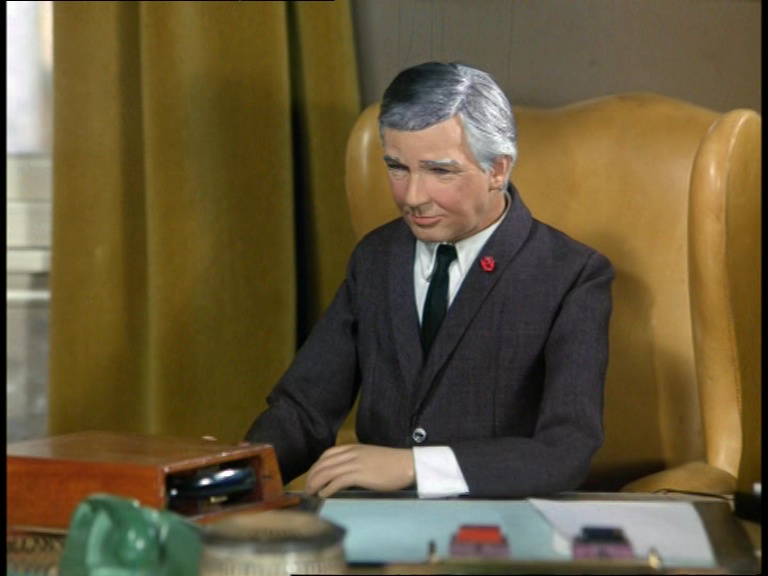
The Bishop’s either receiving some helpful information or he’s confirming his order for a new pair of disgusting yellow curtains.
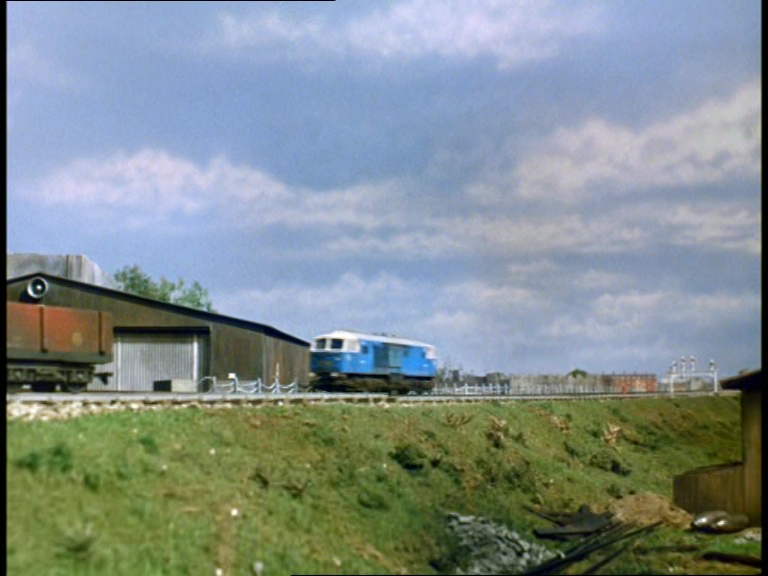
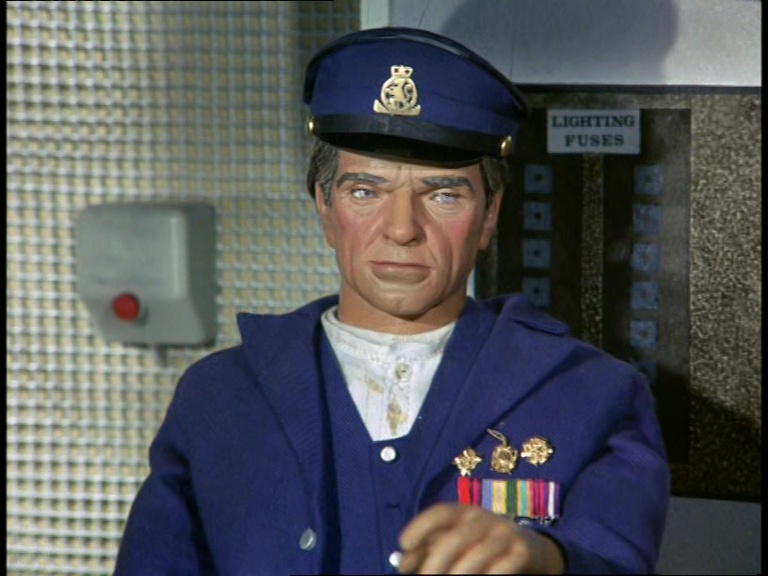
There once was a man named Hobson
Whose railway career was all done.
When driving the main line,
He was totally fine,
With crashing his train into London.
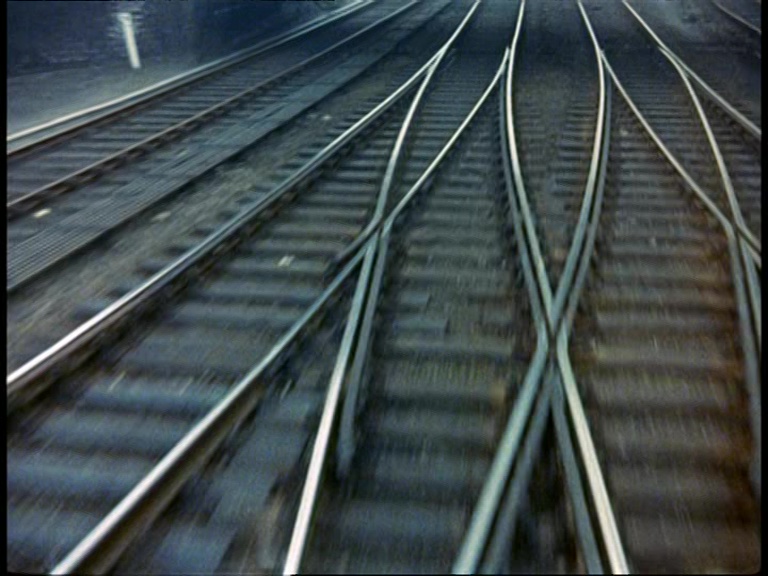
If you can identify this specific section of track, I actually think we could be friends.
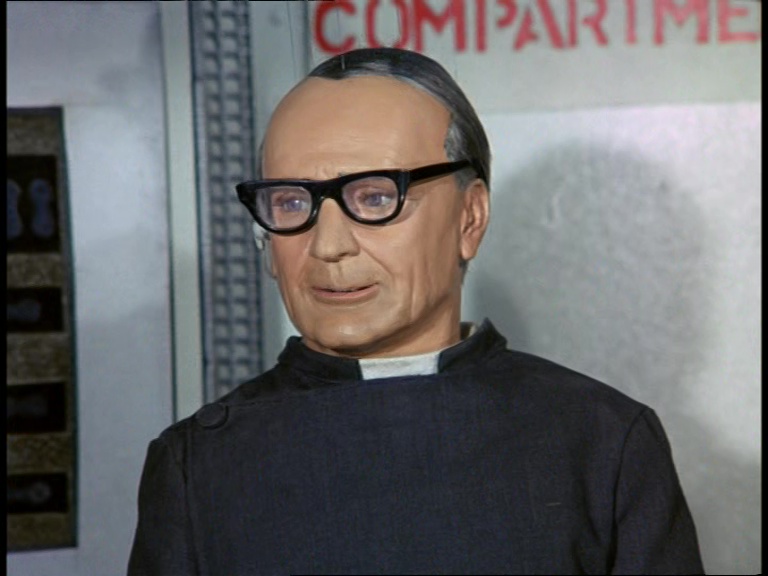
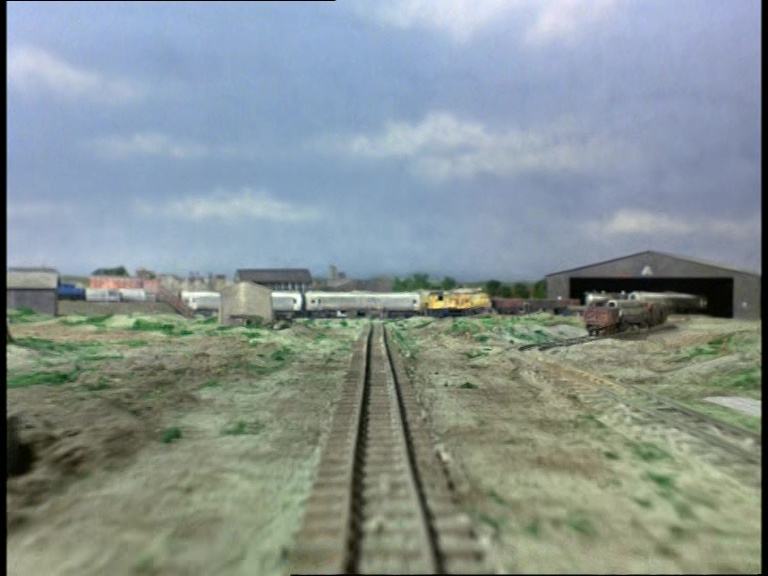
With confirmation from the Bishop at last, Unwin encourages Hobson to take his hands off the controls… something which probably should have been attempted earlier. The end of the line is approaching so all the previously seen train models have been gathered on the set to create a train yard for them to nearly crash into.
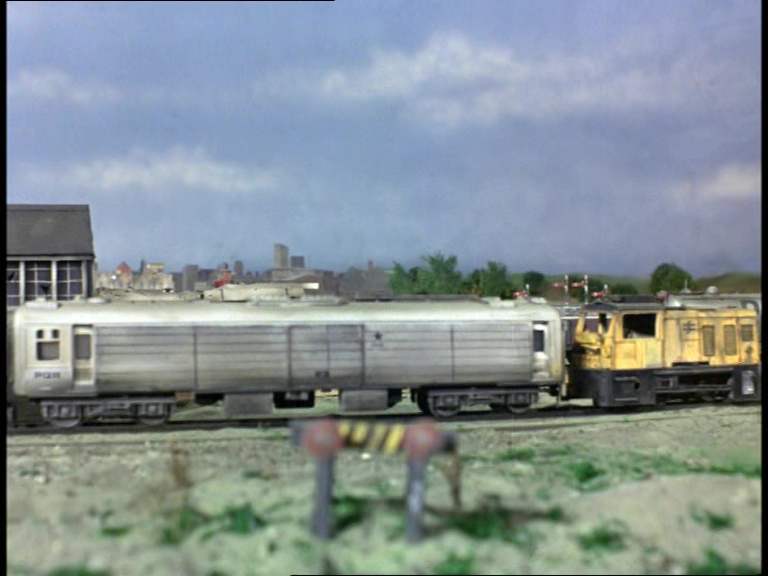
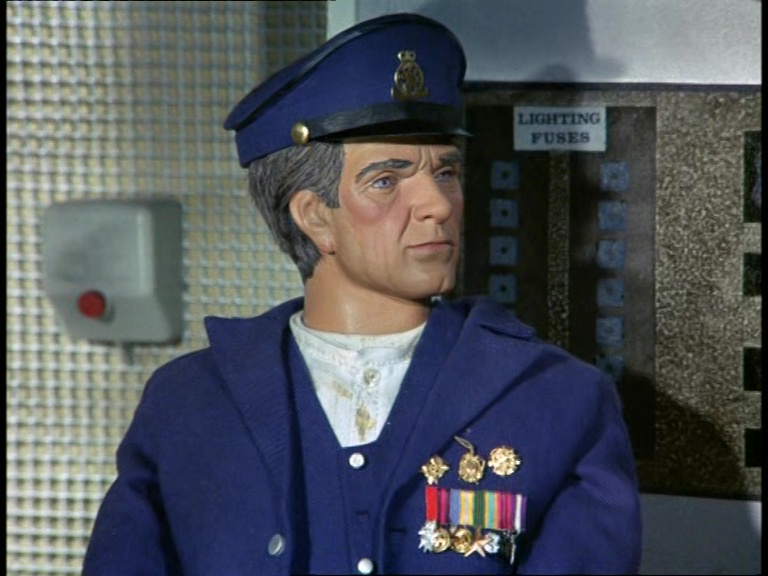
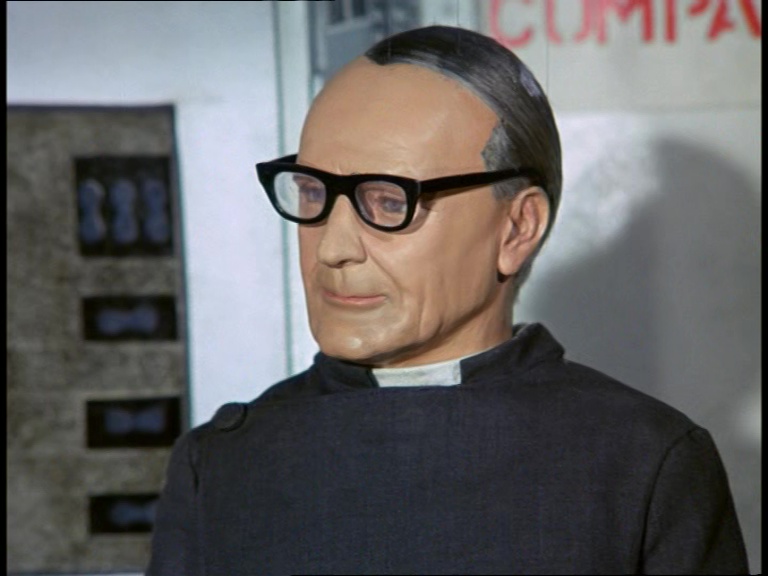
And that’s that. They stop at the end of the line just in time and Hobson looks at Unwin like a man who’s about to be committed to an institution. I love a happy ending.
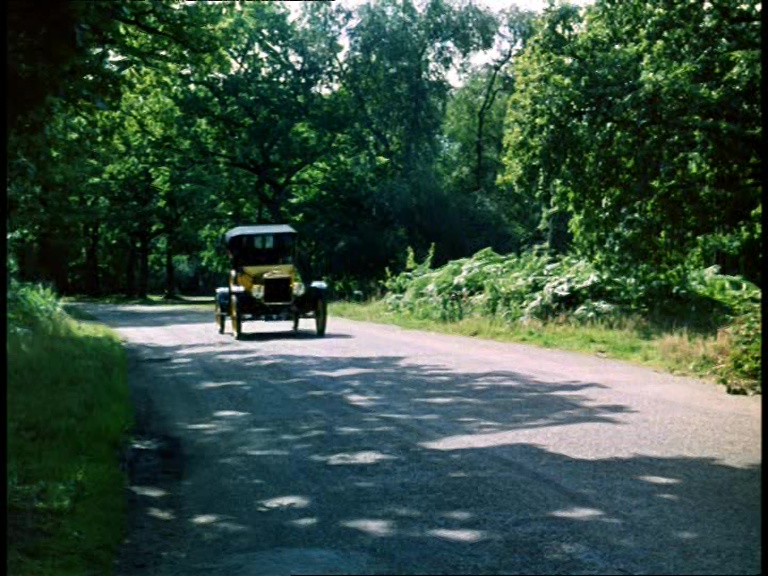
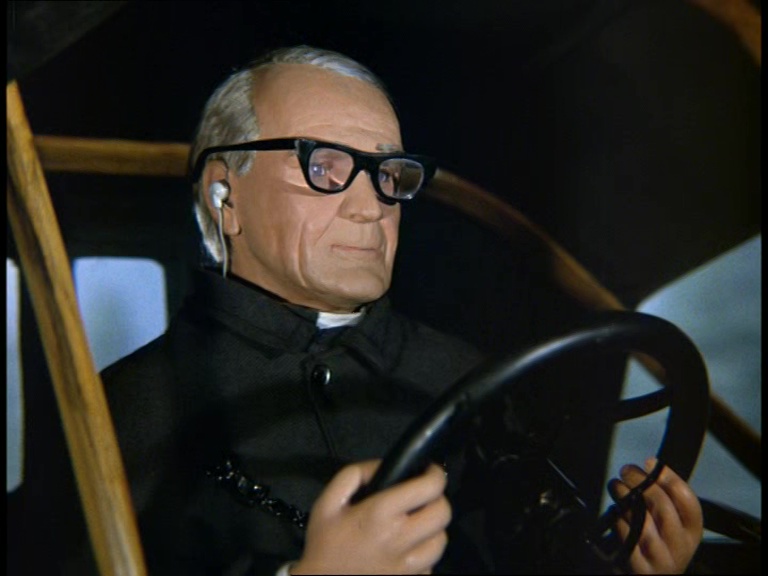
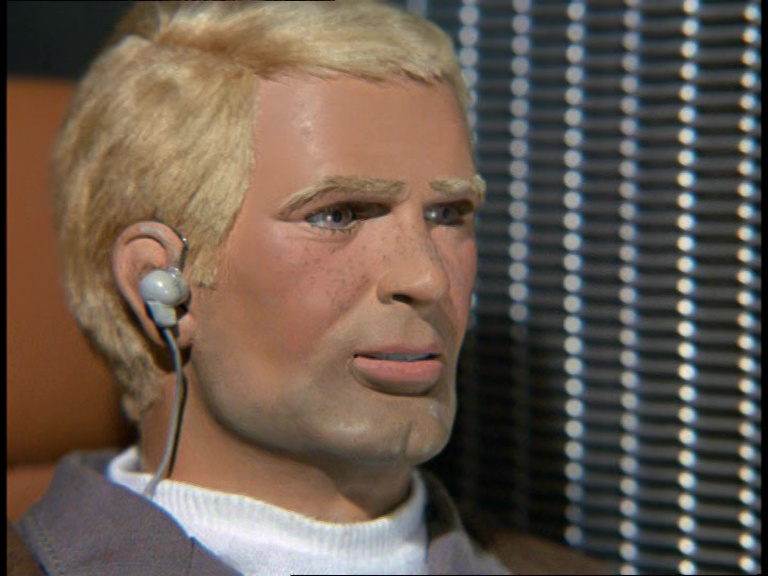
Time for a quick scene between Matthew and Unwin to tie everything up by concluding driving slowly is better than thundering down a railway line at high speed and stopping two inches form the end of the line… yes, I can totally believe Matthew pulled out a tape measure to check.
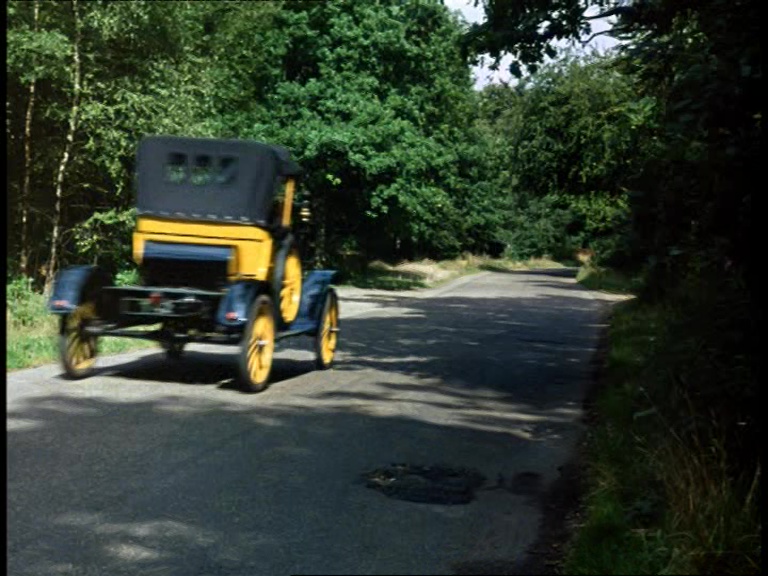
And so, the duo head for home. Presumably all the other loose ends like the arrest of the gang, Hobson’s sectioning, and whatever the heck happened to Jackie during that final sequence, have all been resolved off-screen.
It’s a bonkers episode with more holes than Hobson’s cardigan, but I love Last Train To Bufflers Halt. After all, it’s the one with the train! But it does have some faults. Matthew really needed more to do – he sits in the case and makes a weird noise, which isn’t really enough for the series’ main action hero. The bank notes really should have been gold bullion as the original script suggested because all the fuss with the train and the trucks and an enormous gang of criminals over six bags of paper money doesn’t quite add up. The model shots are good but far from perfect – the camerawork needed to be so much more dynamic to be engaging. This was likely the result of a lack of time or money to build more complex sets that could be filmed from different angles. That being said, I obviously adore the model train shots because they have that “toys come to life” aspect about them that the early Supermarionation series did so well.
The story itself holds together well enough and moves along at a great pace but, as with many Tony Barwick scripts, it holds up beautifully until you start to poke and prod it too hard. He really was a terrific writer partly because he was also a cheeky so-and-so who wrote absolute nonsense with admirable confidence and gusto so you can’t help but get swept along by it. Last Train To Bufflers Halt is also an example of the series becoming more confident with putting Father Unwin into the story as a central character, rather than a spectator orchestrating the operations. The results speak for themselves as the audience finds themselves at the forefront of the action as it unfolds.
Full steam ahead for some really weird stuff next week!
Next Time

References
Filmed In Supermarionation Stephen La Rivière
The statutes of the United Kingdom of Great Britain and Ireland [1807-1868/69]
The Reshaping of British Railways, Part I: Report
British Railways Board
The Big Big Train
Moonbase Central
Big Big Train
D L McCarthy
More from Security Hazard
The Secret Service – 4. To Catch A Spy
To be completely honest, To Catch A Spy has always struck me as a pretty standard-issue episode of The Secret Service. Not outstanding, not poor,…
Keep reading

Thunderbirds – 12. The Perils of Penelope
If there was ever a case for Lady Penelope being the real star of Thunderbirds, this episode would be exhibit A. The Tracys take a…
Keep reading

My Favourite Supercar Episodes
The simplicity of the format, the epicness of the theme song, and the charm of the show as a whole makes Supercar a firm favourite…
Keep reading
The Secret Service © ITV PLC/ ITC Entertainment Ltd
 Security Hazard
I’ve never been a terribly big fan of this episode, but it is a good one without a doubt.
I think the fact that the trains are less modern also help to remind you that this series is set in the 1960s.
LikeLike