
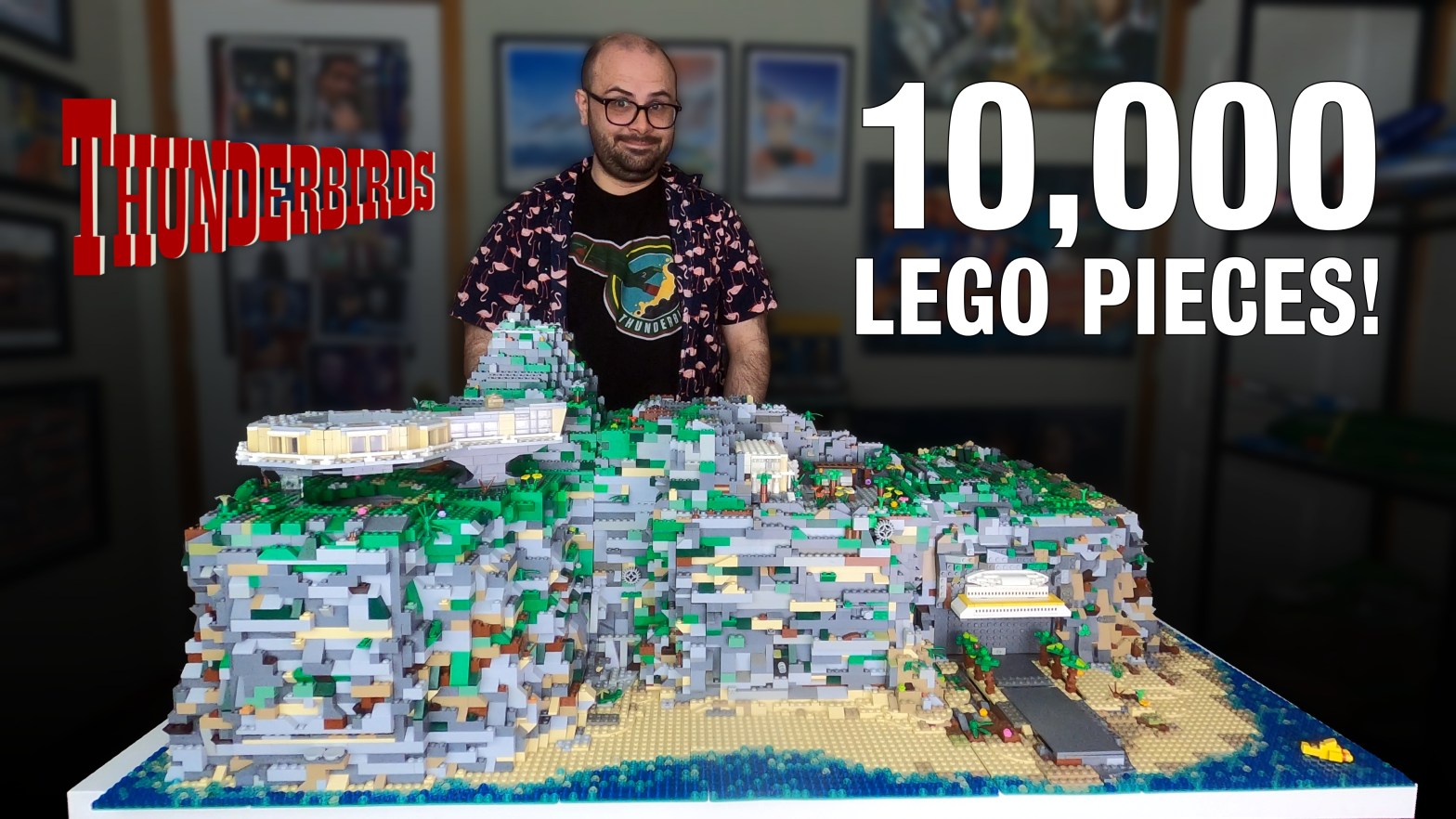
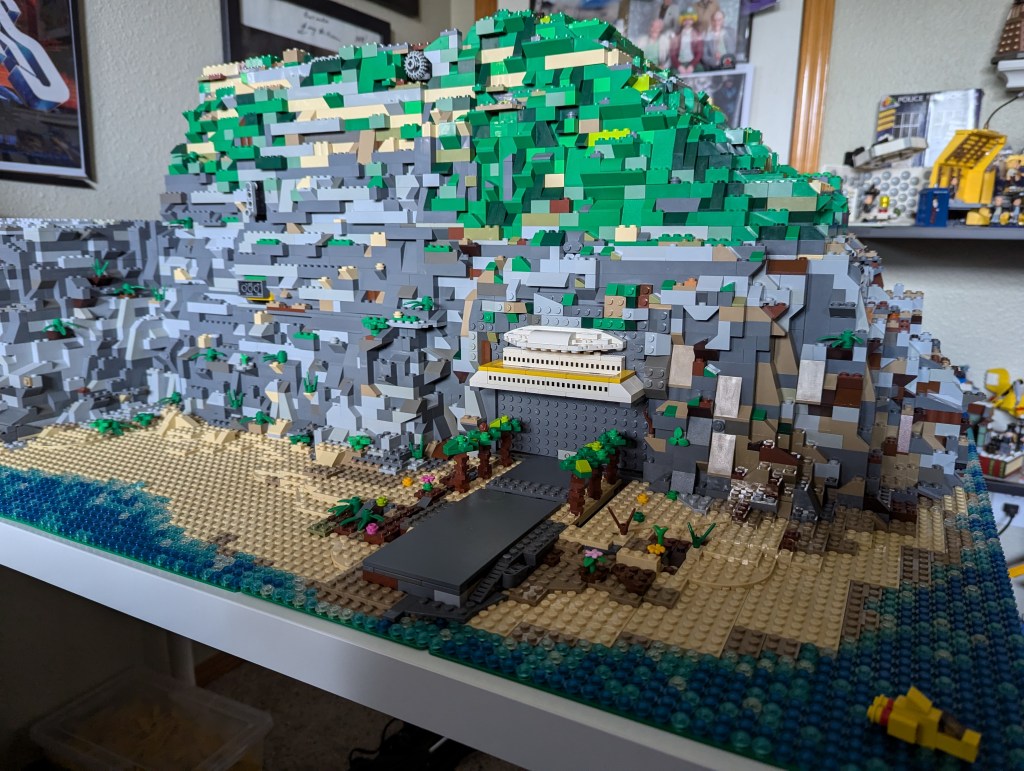
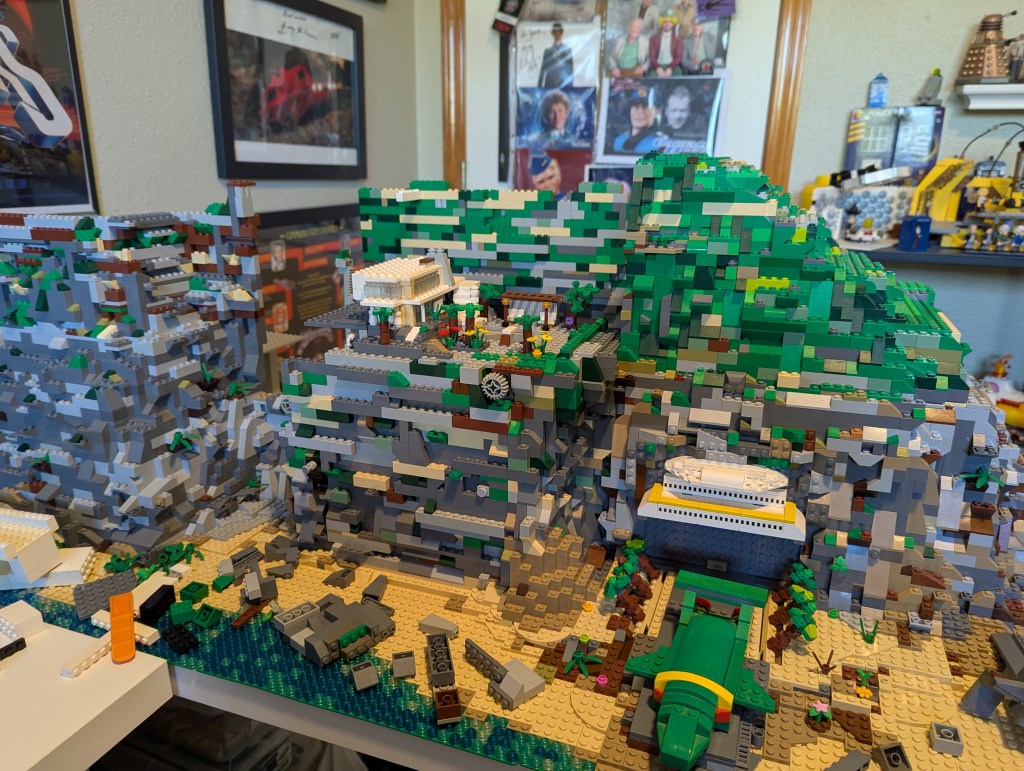
Weighing in at 15.6 kg and using approximately 10,000 LEGO bricks, this is the Tracy Island playset of my childhood dreams. It measures 115 cm long, 64 cm wide, and 44 cm high. This LEGO Tracy Island is based on the original Thunderbirds television series from 1965, and inspired by artwork from Graham Bleathman and Chris Thompson, as well as the legendary Tracy Island playsets created by Matchbox and Vivid Imaginations.
Watch the full tour video including secret interiors and easter eggs:
In this post, I’ll explain the things which mattered to me most while building this LEGO Tracy Island, and detail some of the challenges in bringing this massive project to life.
Modular Building
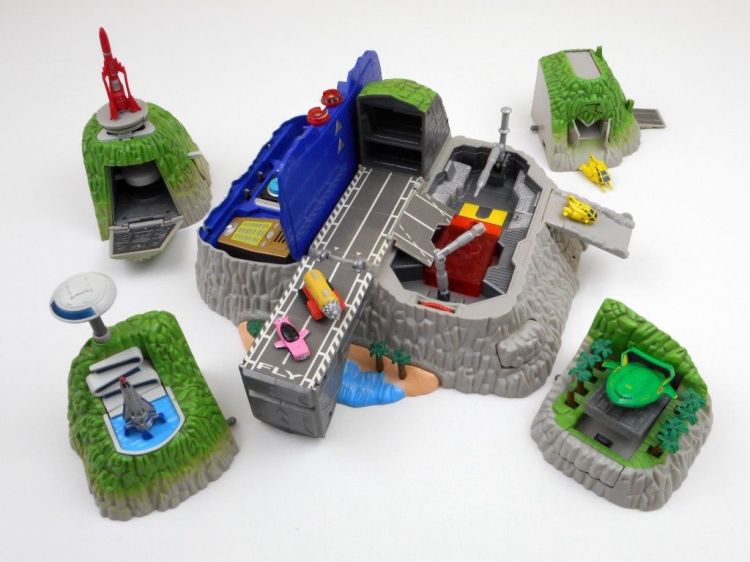
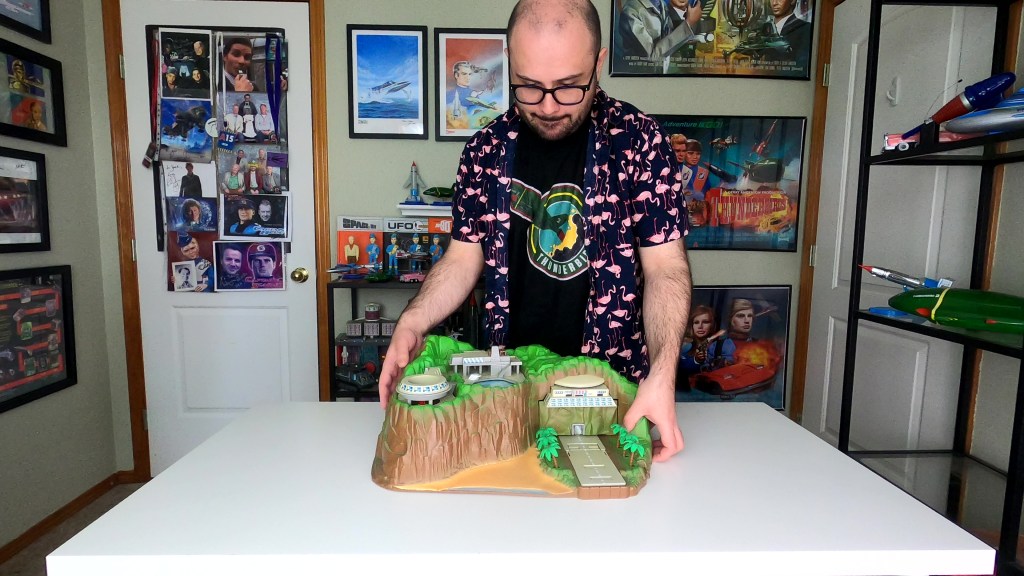
I knew I wanted my LEGO Tracy Island to be huge. I wanted it to cover an entire tabletop. But such a big lump of LEGO would inevitably become difficult to live with if it couldn’t be moved around easily. So, I decided very early on in the build that my Tracy Island would be modular and separate into multiple sections, taking inspiration from the toy of the 2004 movie Tracy Island.
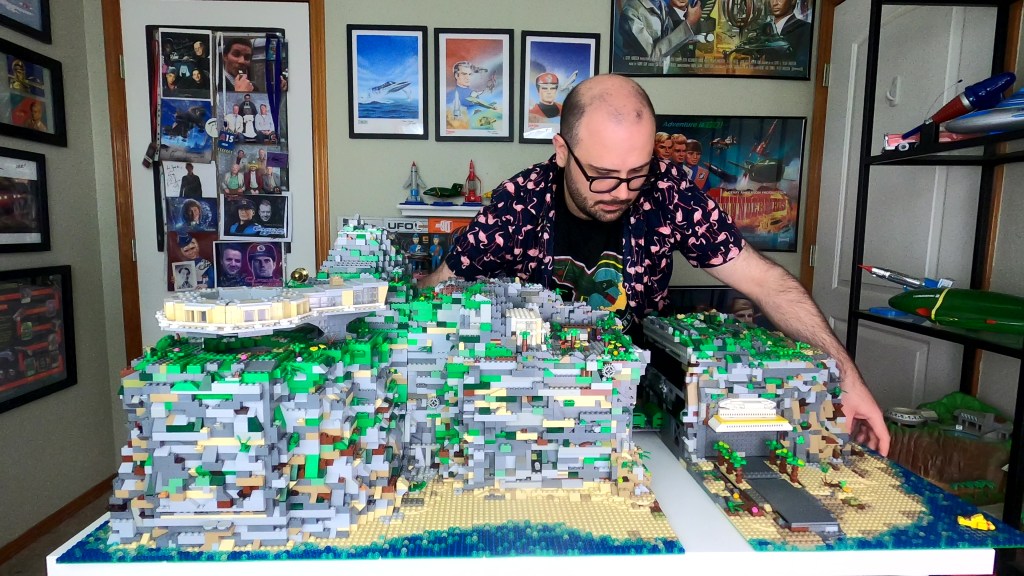
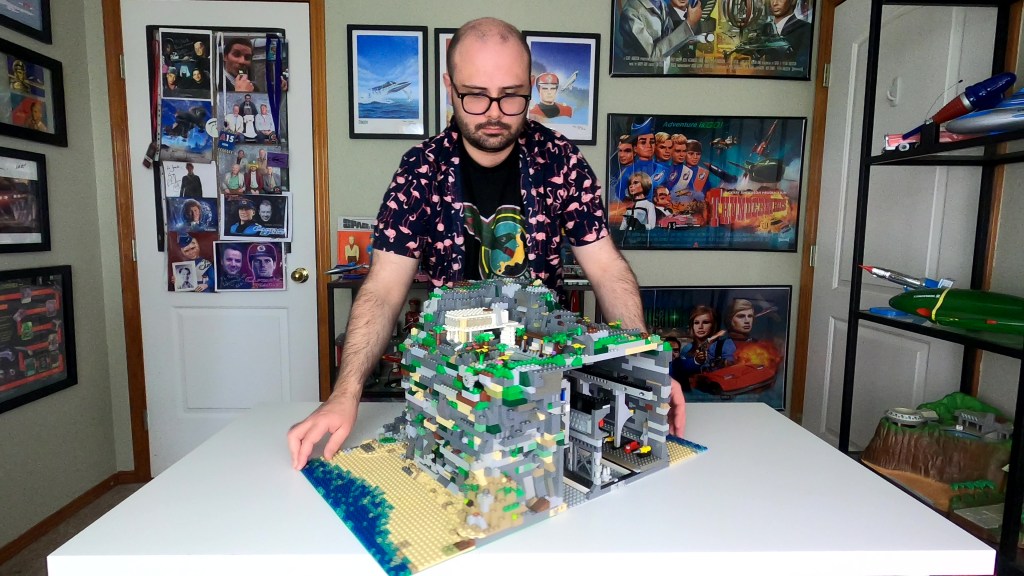
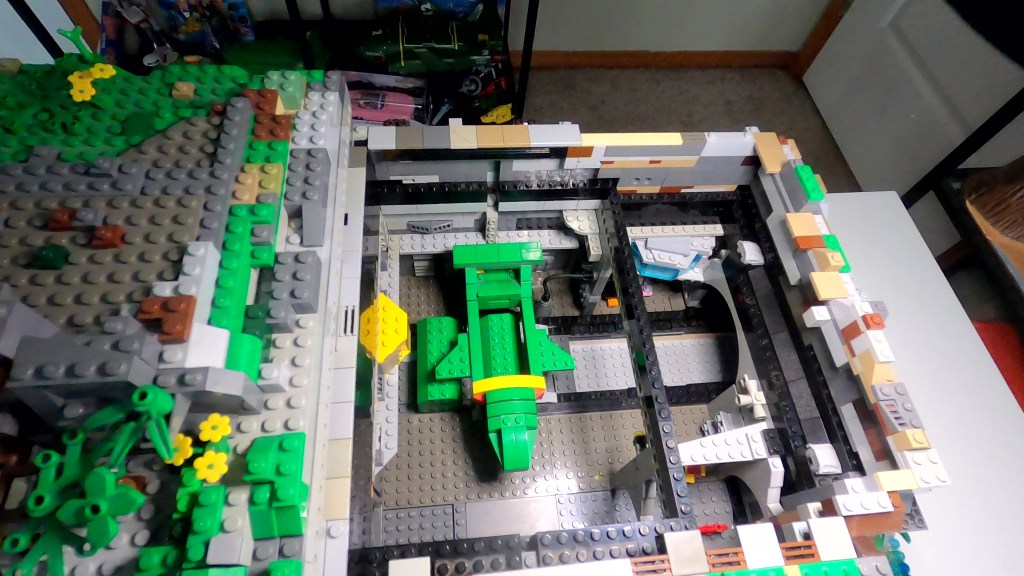
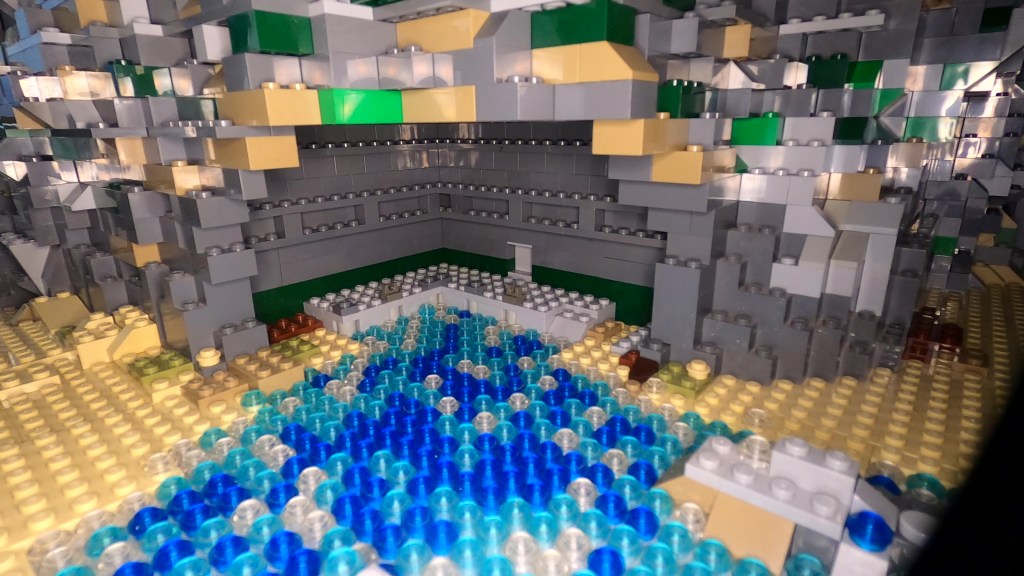
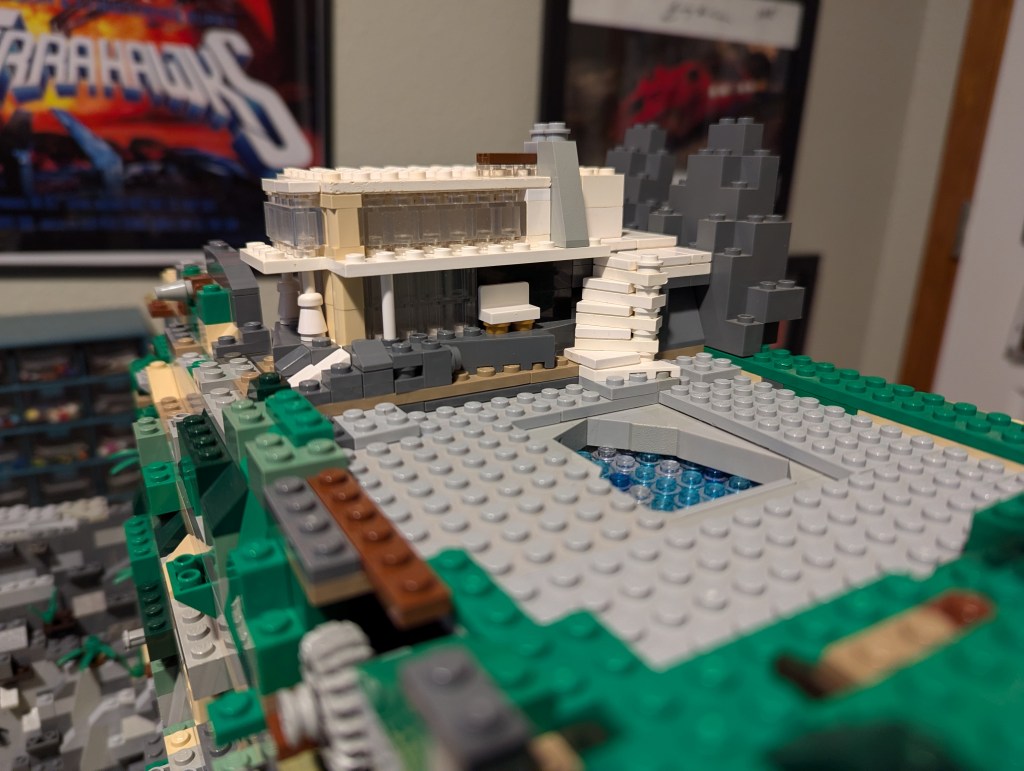
Each section of the island would be built separately and then lock together to form the whole landmass. This would not only make the build considerably more portable, but also allow for greater access to the island’s subterreanean areas. I divided the island into three sections. The east module includes Thunderbird 2’s hangar and runway. The central module houses Thunderbird 1’s hangar and launch bay, the villa and pool, the pod vehicle storage bay, and part of Thunderbird 3’s access tunnel. The western module hides Thunderbird 3’s silo and some additional facilities.
Fully enclosed
Official LEGO sets and official Tracy Island toys generally leave the interiors of their playsets exposed to the outside. This improves accessibility for children to play, but it does reduce realism. Fair enough when you’re dealing with a toy. But I wanted my Tracy Island to look like Tracy Island no matter what angle you viewed it from. I wasn’t keen on building something that could only be viewed properly from the front while the back was completely open and giving away the secrets of International Rescue.
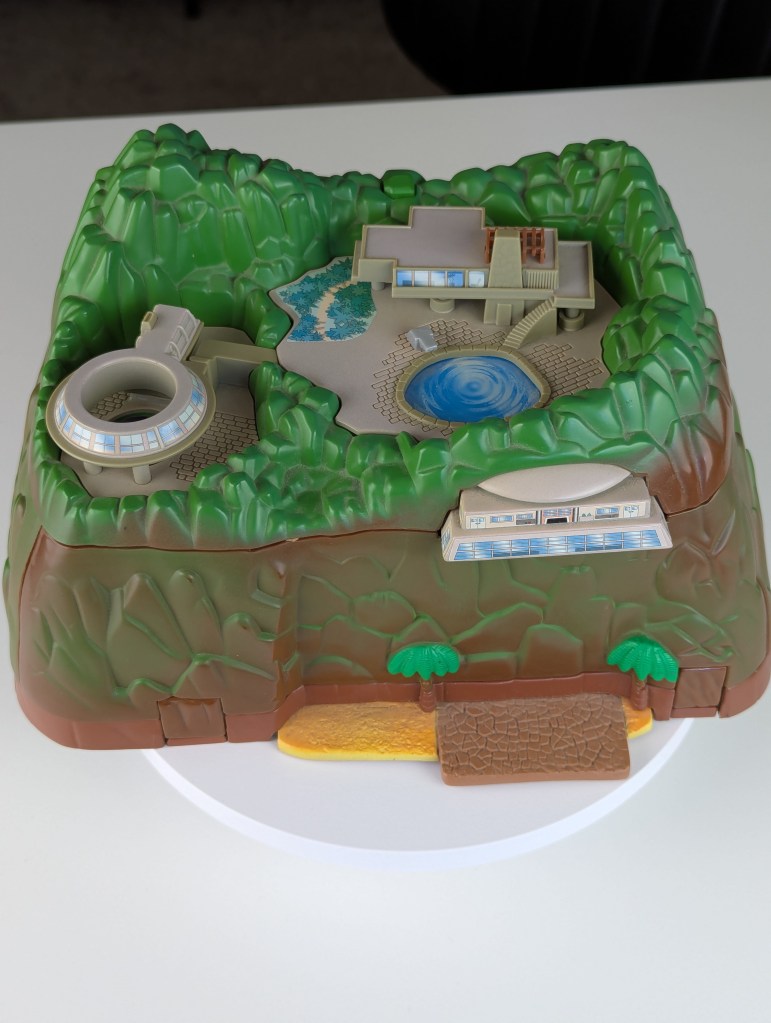
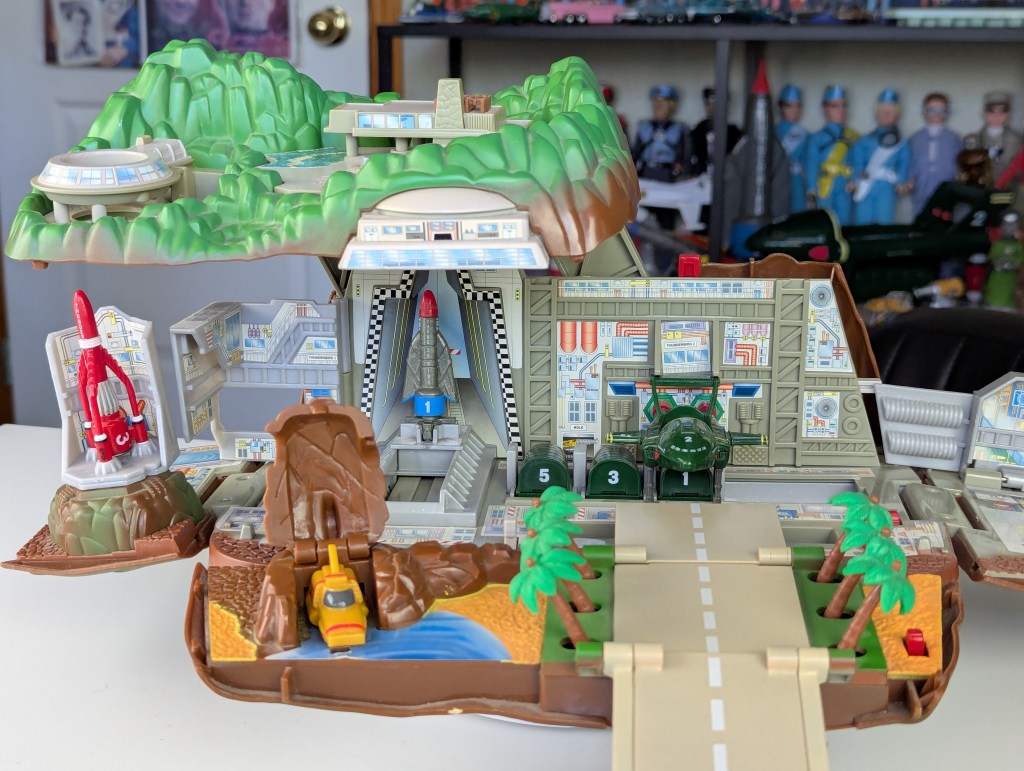
Like the PowerTech Tracy Island playset by Vivid Imaginations pictured above, I wanted the island’s exterior to appear totally innocent, with only hints to the impressive machinery hidden inside. Access to the interior needed to be subtle but with a toyetic quality that invites you to explore and open up the secret hatches and access panels.
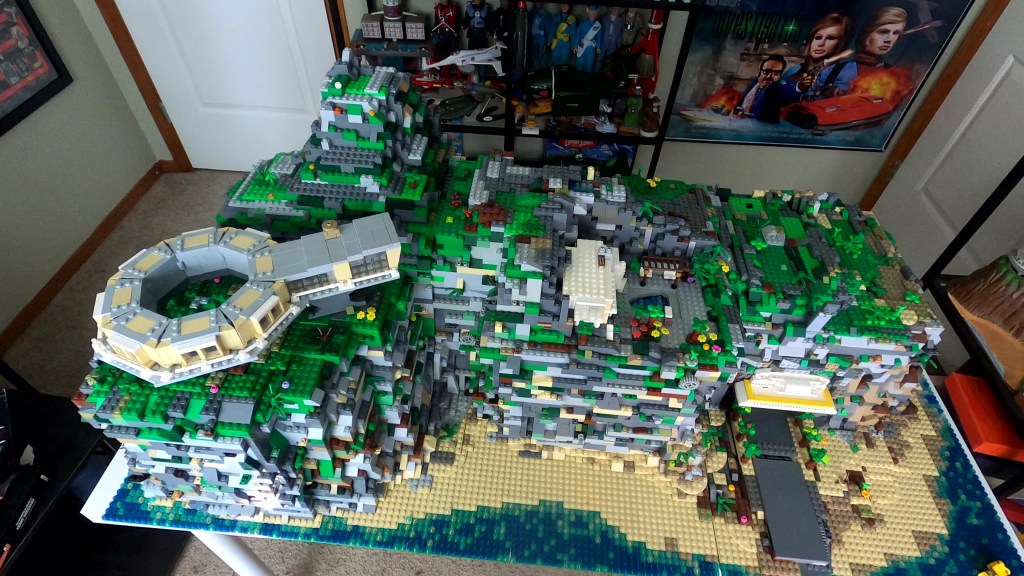
So, at first glance my LEGO Tracy Island looks like a big lump of rock, much like any other island. As you get closer you recognise the external installations like the swimming pool and the runway. Then you might notice a gear or a hinge or something that doesn’t quite belong. That’s the invitation to open up a secret hatch and take a look underneath the rocky cliffs at the wonderful machinery inside…
Detailed interiors
The PowerTech Tracy Island was the first toy to demonstrate how fun it is to play with the inside of International Rescue’s base as well as the outside. The hangars for the Thunderbird machines are some of the most important features of the island so it was essential to show them in all their glory on my LEGO build.
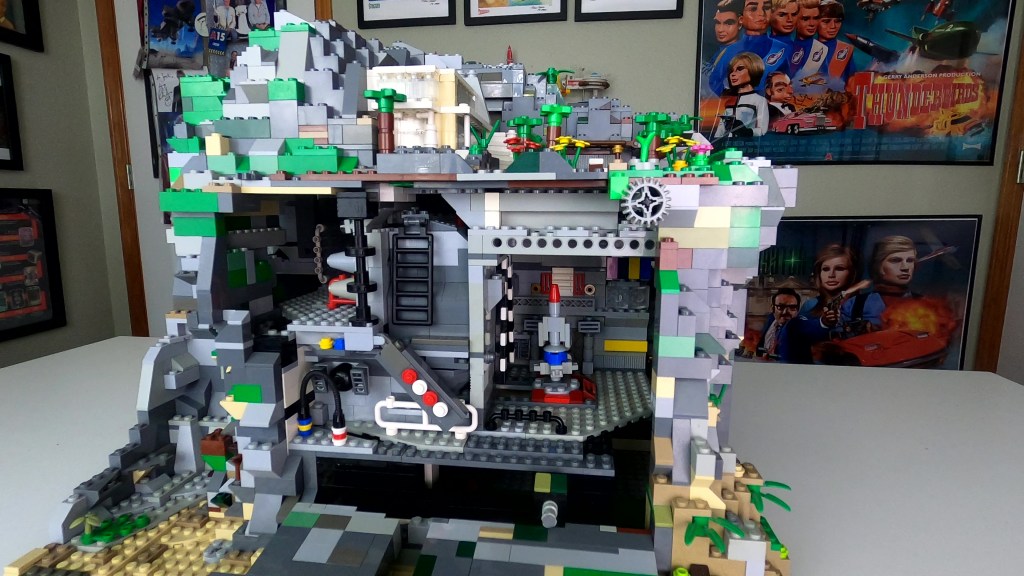
I studied shots of the underground facilities from the original series. I also attempted to adopt the rough layout of installations that was established in the 1968 Thunderbirds annual which has subsequently been echoed in Graham Bleathman’s work and beyond. The challenge was figuring out how to fit all that business into a tabletop LEGO model. I didn’t want to bury anything too deep underground so that it was inaccessible.
It was tough to find the balance between mapping the island out so that it was practical, accessible, and aesthetically accurate all at the same time. For example, I was at one stage faced with the prospect of stacking Thunderbird 1’s launch bay above Thunderbird 2’s pod vehicle storage area in order to have enough room for all the mechanical elements. But this would have effectively doubled the height of the entire island, and therefore nearly doubled the part count and driven up costs unnecessarily. So, I modified the footprint of the island found space for the Thunderbird 1 launch bay and the pod vehicle storage bay to sit side by side instead of on top of each other. My wallet was relieved that the island could now be half the height.
Scale
Figuring out the size of the island in relation to its various buildings and the International Rescue craft is a bit of a puzzle. Matchbox and Vivid Imaginations threw caution to the wind when designing their Tracy Island playsets and accompanying vehicles. They pretty much made Thunderbirds 1, 2, and 3 a similar size and gave their launch sites equal real estate on the island playset. Those playset designs are so iconic that it’s almost hard to accept that the Thunderbird machines are actually supposed to be very different sizes in-universe. Numerous books and guides over the years have specified that Thunderbird 1 is only 90 or 115 feet high (depending on source material), Thunderbird 2 jumps up to 250 feet in length, and is closely followed by Thunderbird 3 at 287 feet high. I decided to honour this scale very approximately.
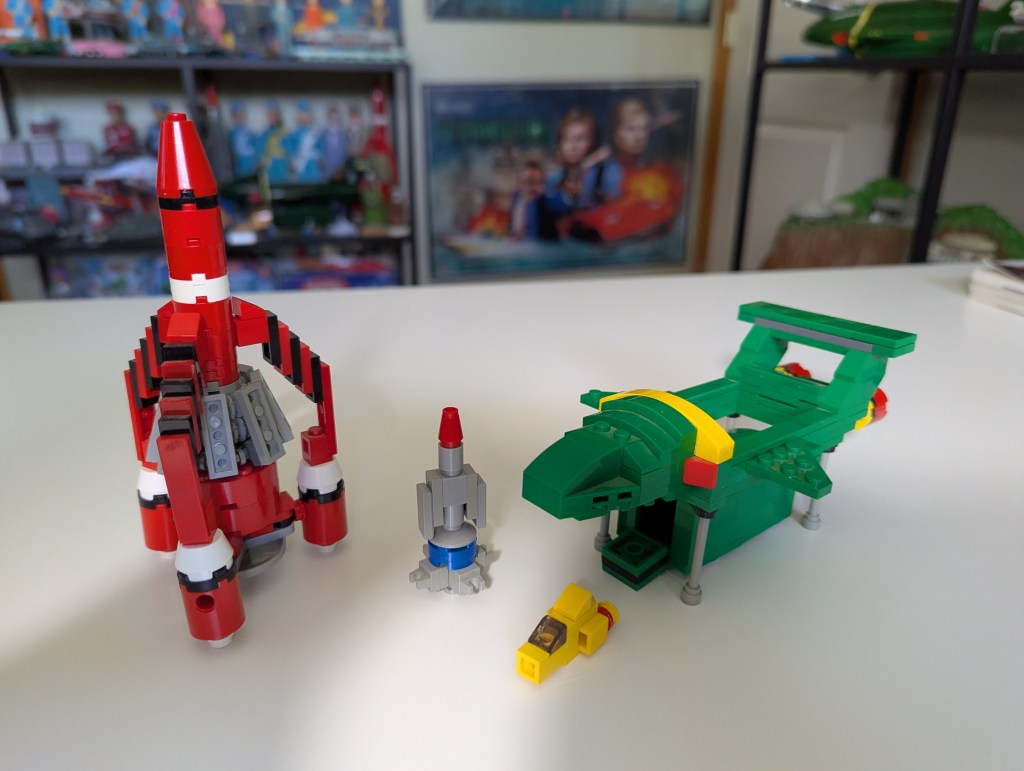
I made a LEGO Thunderbird 1 as teeny-tiny as possible, and then modified existing builds of Thunderbirds 2 and 3 which I originally created all the way back in 2014 and documented on the official Gerry Anderson blog. I was then able to build the hangars and exteriors to fit the craft. Adopting these vehicle sizes is probably what caused the shape and size of my LEGO Tracy Island to change so drastically compared to what is seen in the Matchbox and Vivid toys, and on-screen.
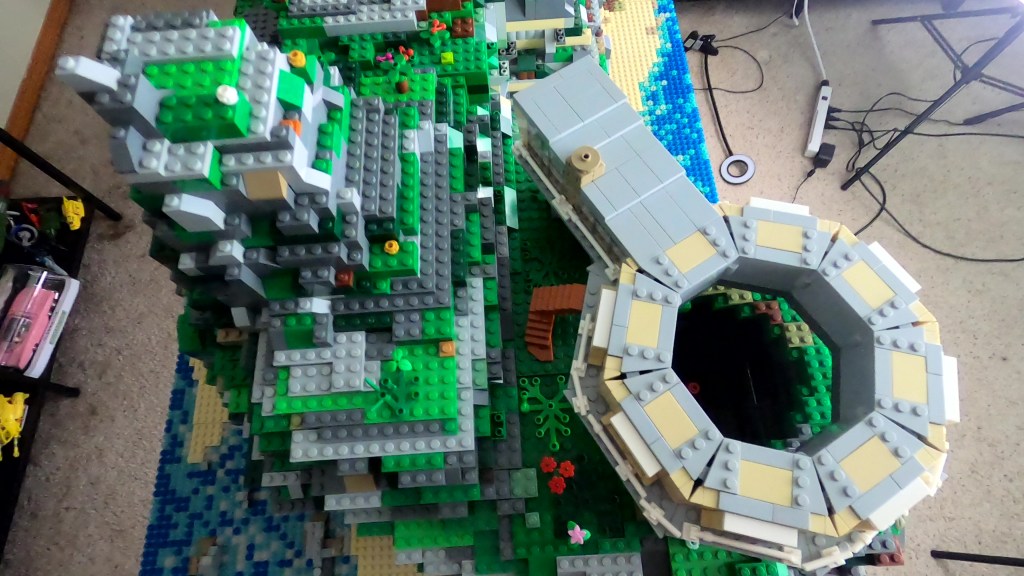
Adhering to this scale caused me one humungous problem. The round house that Thunderbird 3 launches through was an absolute headache to design. Even the original model makers working on Thunderbirds couldn’t figure out an appropriate size for the house in relation to Thunderbird 3. In between shooting the TV series and the feature films, the production team switched it from a one-storey building to a two-storey building – but even doubling the height of the building doesn’t square with the idea that Thunderbird 3 is closer to 20 stories tall.
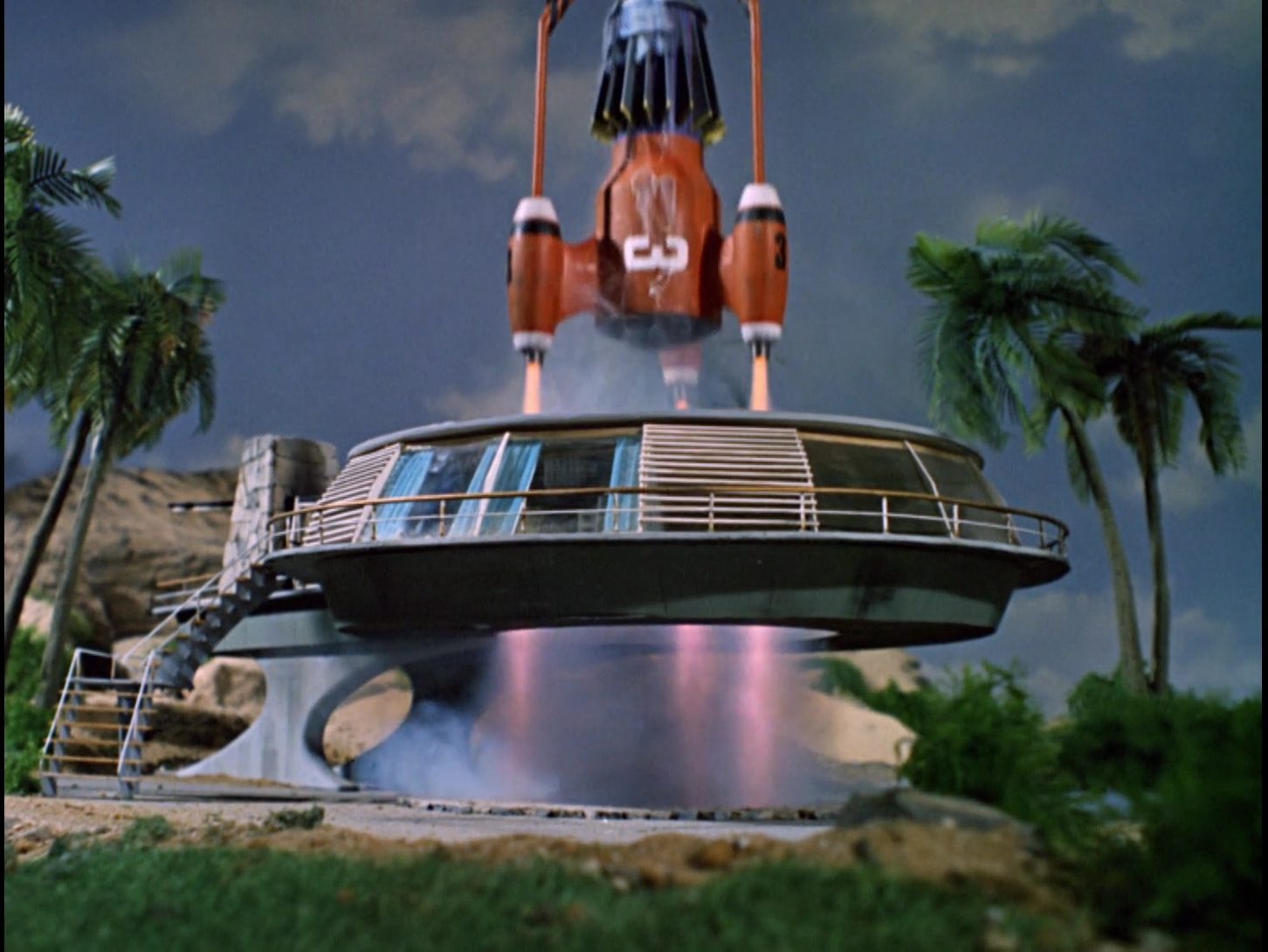
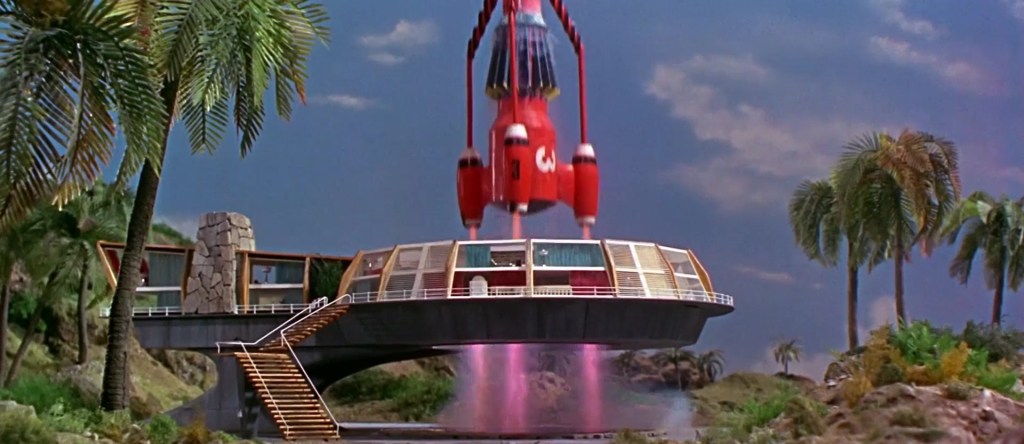
In order to create a hole in the house large enough for a LEGO Thunderbird 3 (and a human hand) to get through, the entire footprint of the round house suddenly needed to take up a massive area on the western module of the island. When one is so used to seeing the round house depicted as a modest accessory parked alongside the main villa in publicity photographs, illustrations, and toys, it was quite startling to realise just how gigantic the building needed to be in relation to everything else to fit the scale. So yes, I’m aware my round house looks enormous compared to everything else. The only way to compensate for that would be increasing the overall size of the MOC four or five times, and I’m afraid I don’t have a spare warehouse to store something like that.
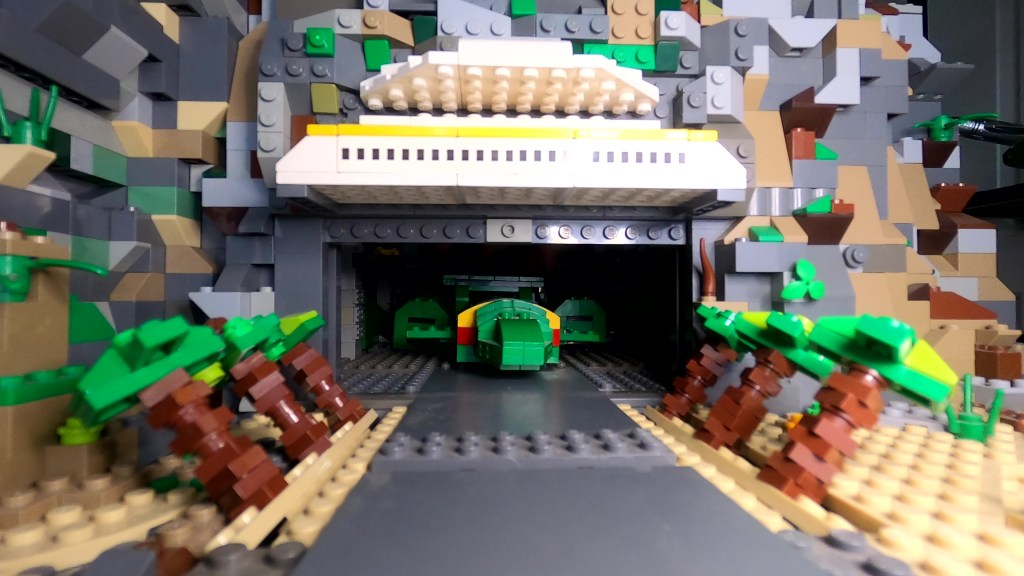
For similar reasons, I kept Thunderbird 2’s runway at a modest length, echoing more of the Matchbox playset than what’s actually depicted on-screen in episodes like Terror in New York City.
Mechanisms
Once again I felt it was essential to pay tribute to the PowerTech Tracy Island and make my LEGO version as hands-on and functional as possible. Incorporating electronics and motors was beyond my budget, so I opted for some good old-fashioned hand-cranked levers, pulleys, and gears to make my Tracy Island work like the real thing. I’m not an engineer and I’m a LEGO Technic novice at best. But I had a shopping list of features I wanted to include. I knew I wanted a working pod conveyor belt in Thunderbird 2’s hangar, plus an opening cliff door, folding palm trees and a ramp. These were relatively straightforward mechanisms to incorporate.
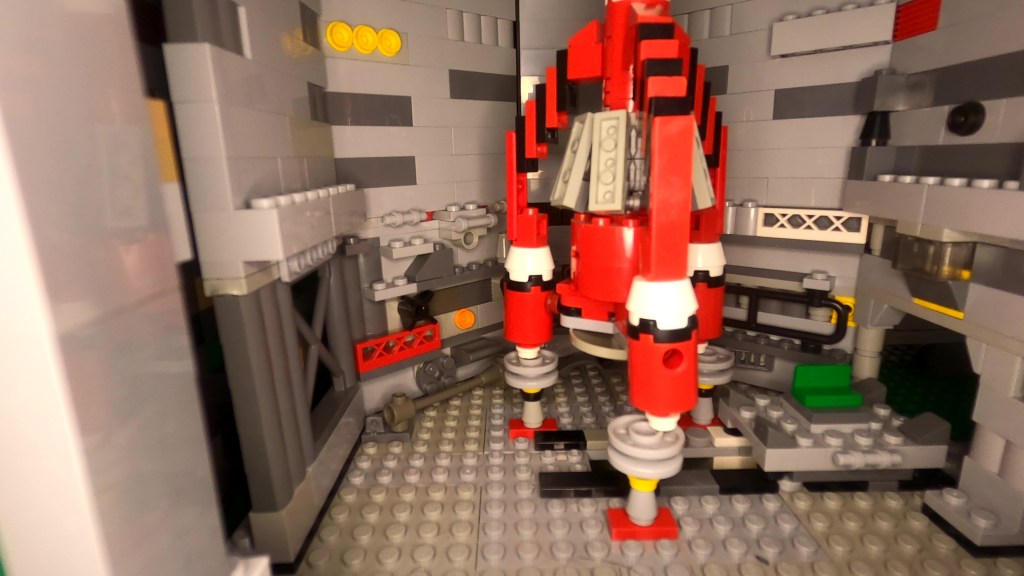
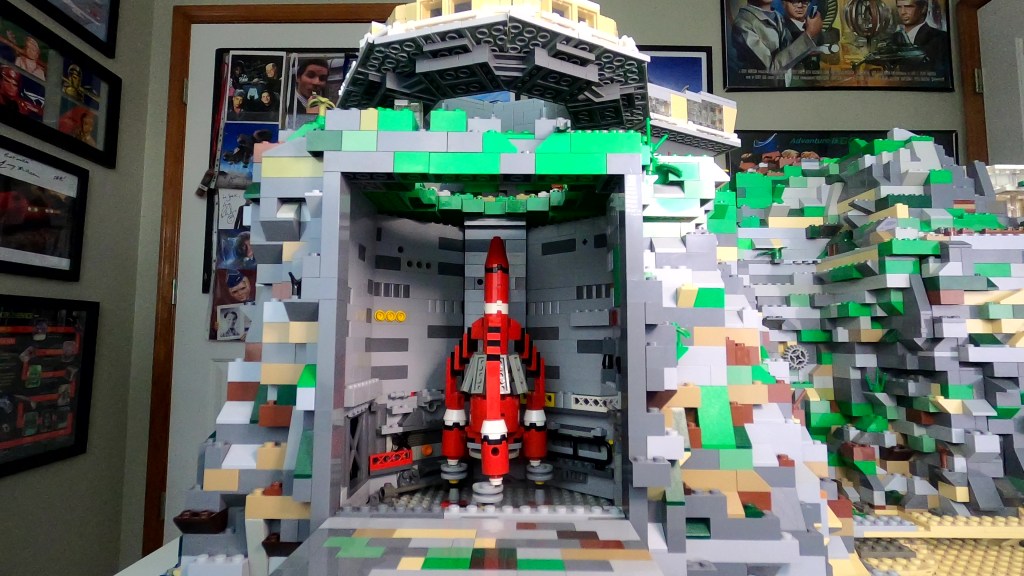
The challenge came when it was time to engineer Thunderbird 1’s launch sequence. A lot of geometrically complicated things happen as Thunderbird 1 moves down its rail from the hangar to the launch bay. While the trolley descends diagonally, the rocket itself remains upright. The trolley then levels out as it enters the launch bay. And, at some mysterious point on the descent, Thunderbird 1 also rotates 90 degrees on its platform to face the camera. I needed Thunderbird 1 to smoothly travel in the X and Y axis between its hangar and the launch bay, and have some means of rotating on the spot too. For a brainy engineer with access to exactly the right LEGO Technic parts, this might be a walk in the park. But boy did I struggle. This was probably the section of the build that went through the most revisions. Every time I had a mechanism that seemed to work I would revisit it a week later and find that Thunderbird 1 was getting stuck halfway down the tunnel or that sub-assemblies were suddenly out of alignment.
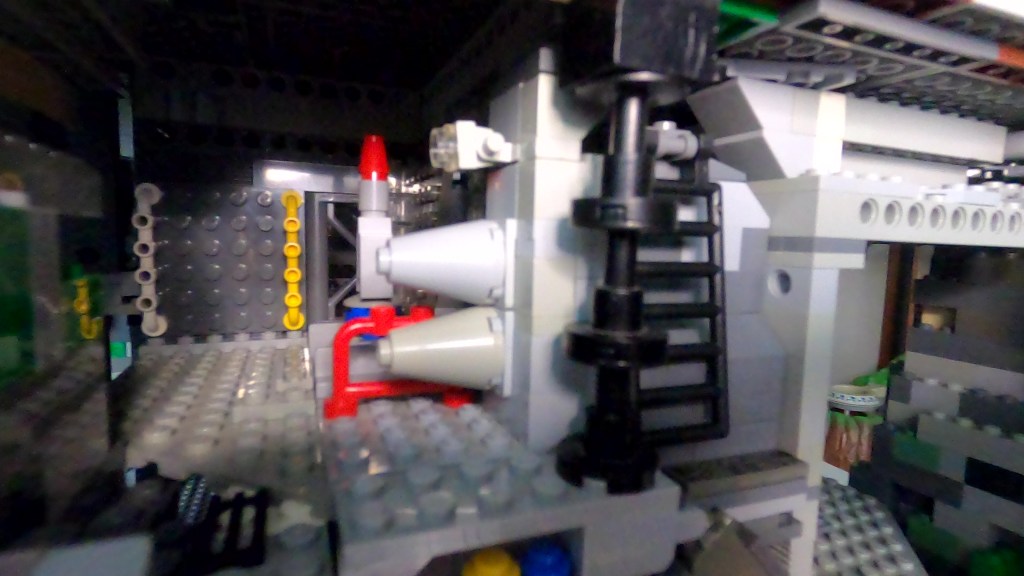
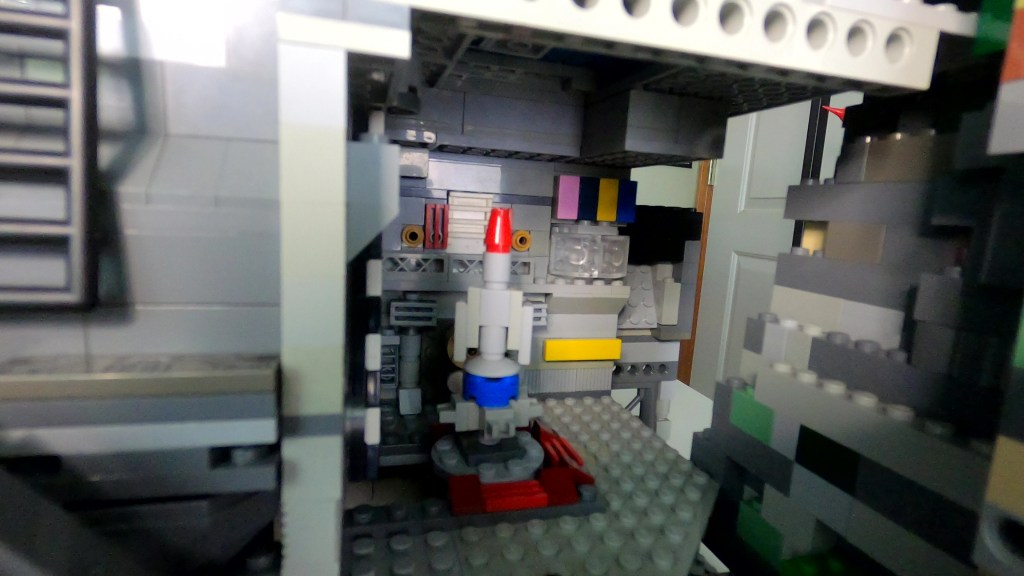
In the end… I cheated. But I cheated in a really clever way. I blocked off the diagonal tunnel so that it was no longer open to view from the front. This made Thunderbird 1’s descent into the launch bay invisible. I built a duplicate Thunderbird 1 that would sit at the top of the tunnel in the hangar. At the bottom, another Thunderbird 1 would pop out in the launch bay. The movements of the twin Thunderbird 1s were synchronised so that only one would ever be visible at a time. The illusion is pretty neat and feels reasonably in-keeping with the spirit of Thunderbirds. And I did manage to keep the spinning platform so that once Thunderbird 1 is in the launch bay you can either twist the rocket to face forward like we see in the iconic opening countdown, or off to the side as seen in the feature film, Thunderbirds Are Go.
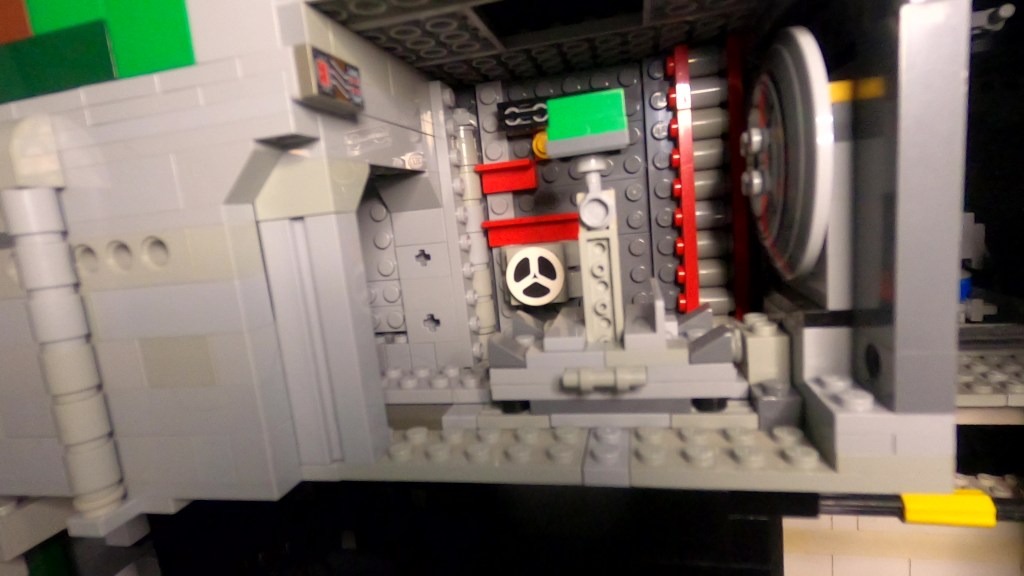
The lesser seen Thunderbird 3 launch sequence also presented some mechnical challenges. I wanted to depict the couch descending from the lounge and into the tunnel heading towards Thunderbird 3’s silo. As with Thunderbird 1, this effect also required an illusion using twin couches. Under the Tracy Villa in the central module I constructed a simple piston for the couch to rise up and down on, operated by a gear. When the piston was low enough, the couch was pushed off of the piston and rested on a trolley, which in turn could be pushed down a tunnel facade. Then, in the completely separate Thunderbird 3 silo in the western module, a long way from the villa, a duplicate couch trolley could be nudged in on a rail until it sat underneath Thunderbird 3 on its raised launch platforms, ready for boarding.
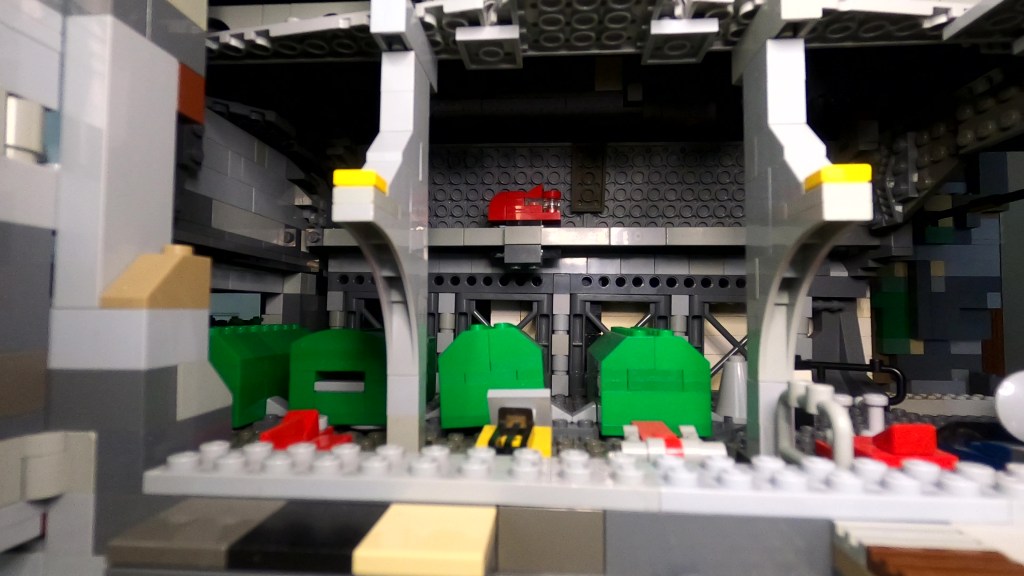
One more mechanical element of Tracy Island that I was eager to incorporate was the inspection monorail seen in the episode, Cry Wolf. It’s just one little monorail car that conducts passengers through a guided tour of Tracy Island’s underground installations. I knew that building the entire rail network in my LEGO version of the island would be impractical. But the pod vehicle storage bay felt like an appropriate place to offer a quick glimpse of the monorail car in operation. I simply hitched a tiny replica of the vehicle to an overhead rail and tethered it to a LEGO winch system. The string was hidden out of sight behind the rail and connected to a spool embedded in the rockface. The monorail car can simply be winched along a short section of track from one end of the pod vehicle storage bay to the other. That was probably most satisfying and niche part of the island to get working. But speaking of niche…
Easter Eggs
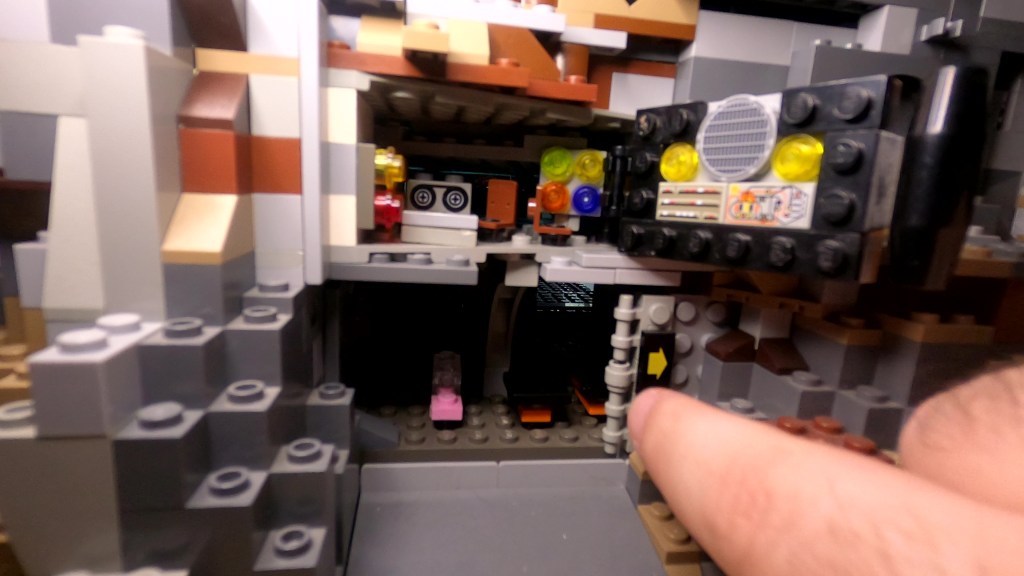
A huge LEGO replica of Tracy Island is crying out for some hidden bonuses that only the most dedicated Thunderbirds fans can spot. Never seen on-screen but depicted in cutaway artwork and the Matchbox playset, there is supposedly a cave on the north-west side of the island for boats to dock. I incorporated this detail partly to be nerdy and partly because there wasn’t much else going on behind Thunderbird 3’s silo in the western module. To that end, I also devised an underground maintenance and storage facility to fill a cavity between the dock and Thunderbird 3’s silo. I even filled it with some maintenance cranes and equipment of my own design.
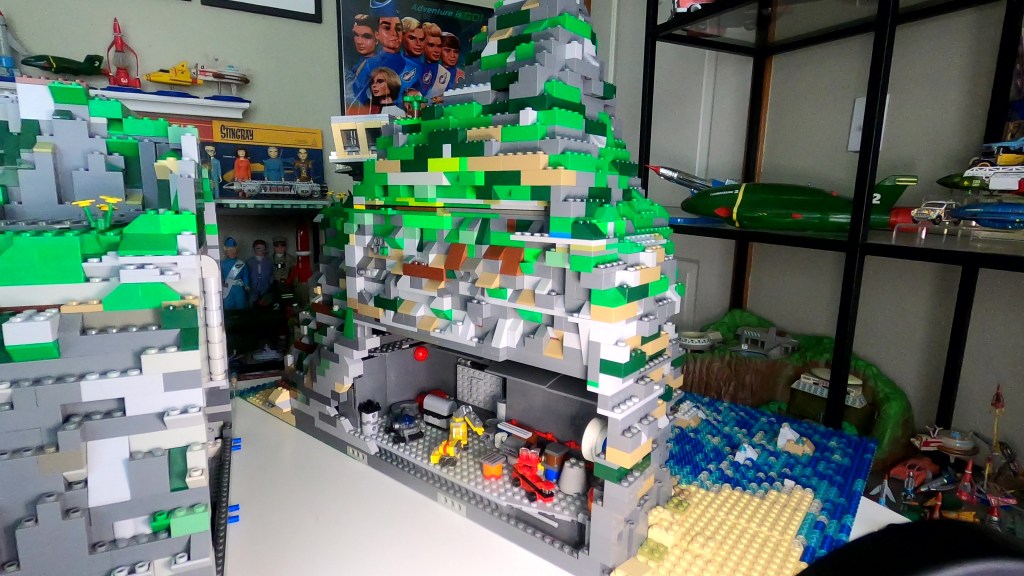
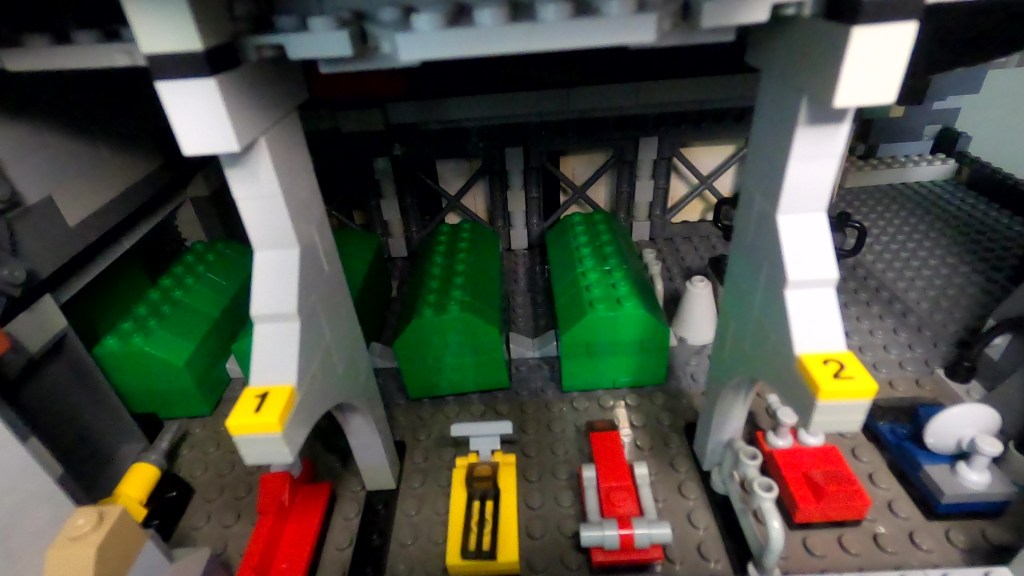
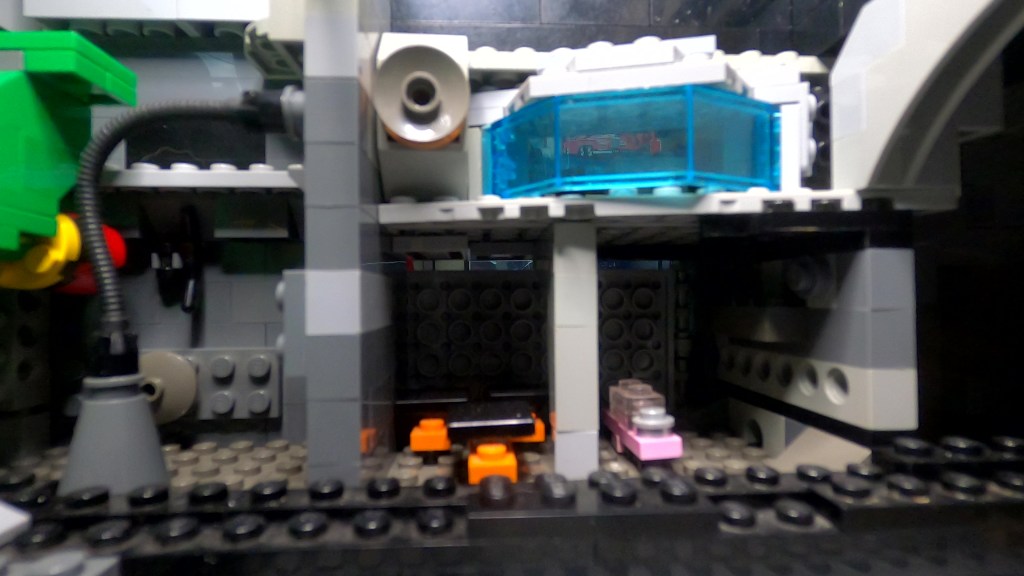
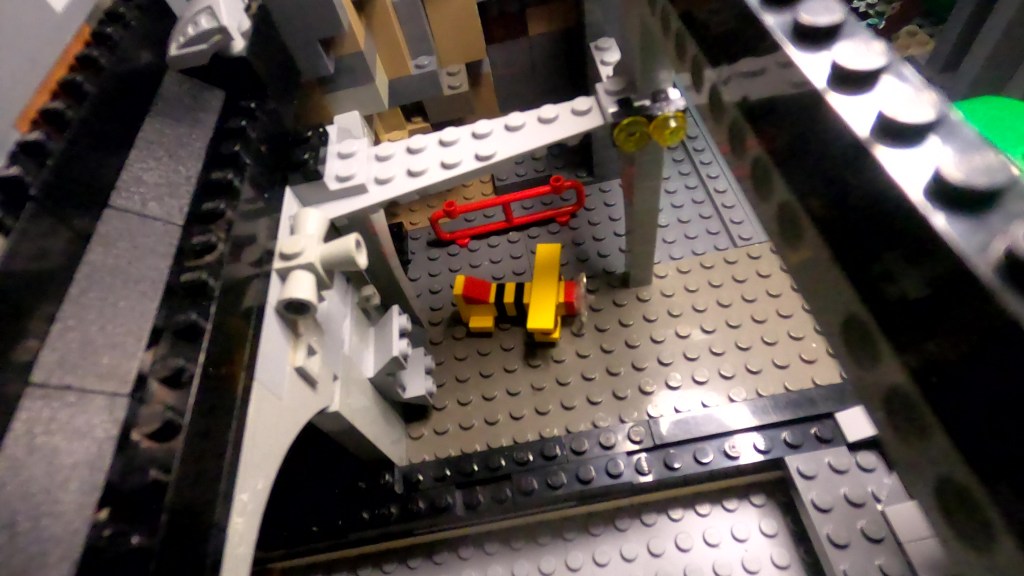
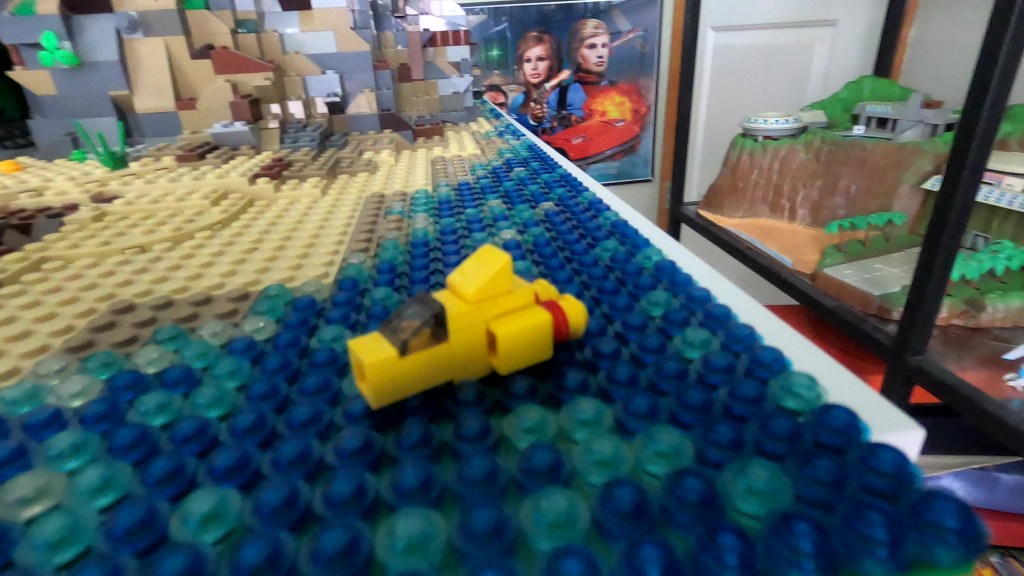
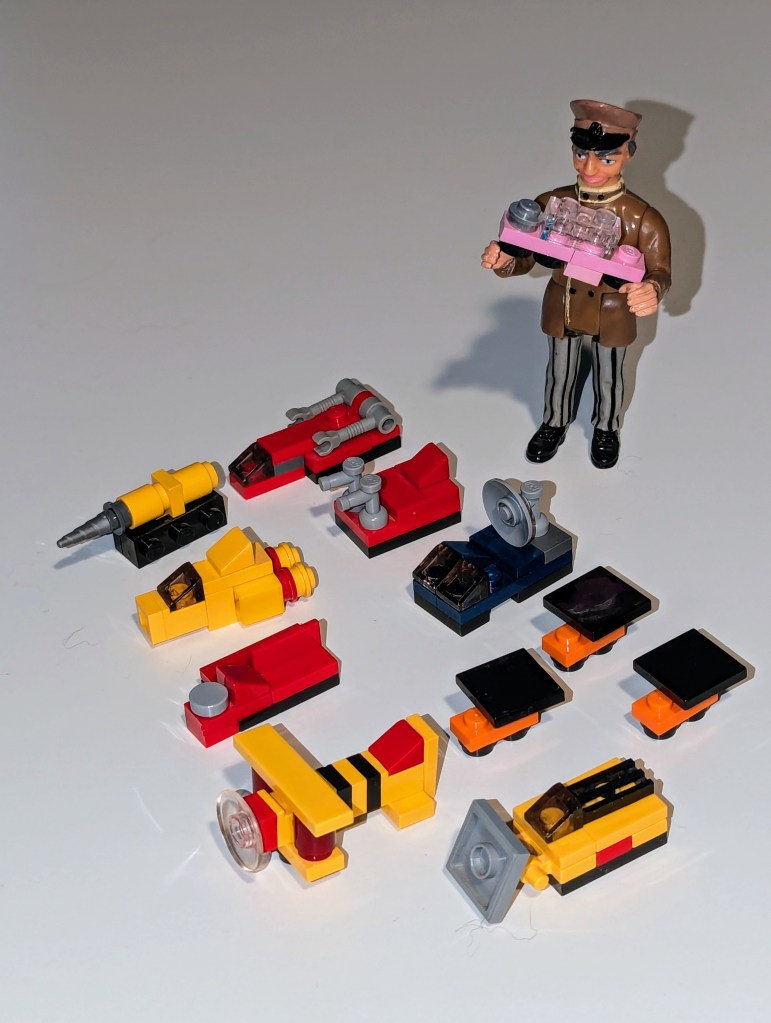
In the pod vehicle storage bay I parked a number of mini pod vehicles: the Mole, the Firefly, the Monobrake, the DOMO, a Recovery Vehicle, and the Transmitter Truck. In Thunderbird 2’s hangar you’ll also find FAB 1, three Elevator Cars, and the Thunderbird 6 Tiger Moth waiting for action. To make these details more accessible I decided to install a rear entrance in Thunderbird 2’s hangar, hidden away in the rocks. Above this sliding hatch is access to a mini version of Brains’ laboratory. This is a direct reference to the PowerTech Tracy Island which also features a version of Brains’ lab hidden off the side above some pod vehicle parking bays. Meanwhile, sailing out at sea on the corner of the diorama is Thunderbird 4.
The Design, Building, and Presentation Process
Very little of this project was planned ahead of time. I had a vision in my head and just started putting bricks on top of bricks until it was done. Digital design work was reserved exclusively for the round house because I knew such complex architecture would require specific LEGO parts. The rest of the island was designed through trial and error. I tried to work from my existing parts inventory, and when that well dried up I would order certain pieces in bulk in totally guesstimated quantities. Based on the weight of the finished build alone I have calculated that there must be around 10,000 pieces of LEGO in there. It sounds about right, but I honestly have no way of knowing the exact part count for sure. As for instructions so you at home can build your own… nah, even I don’t know for sure how this thing was put together.
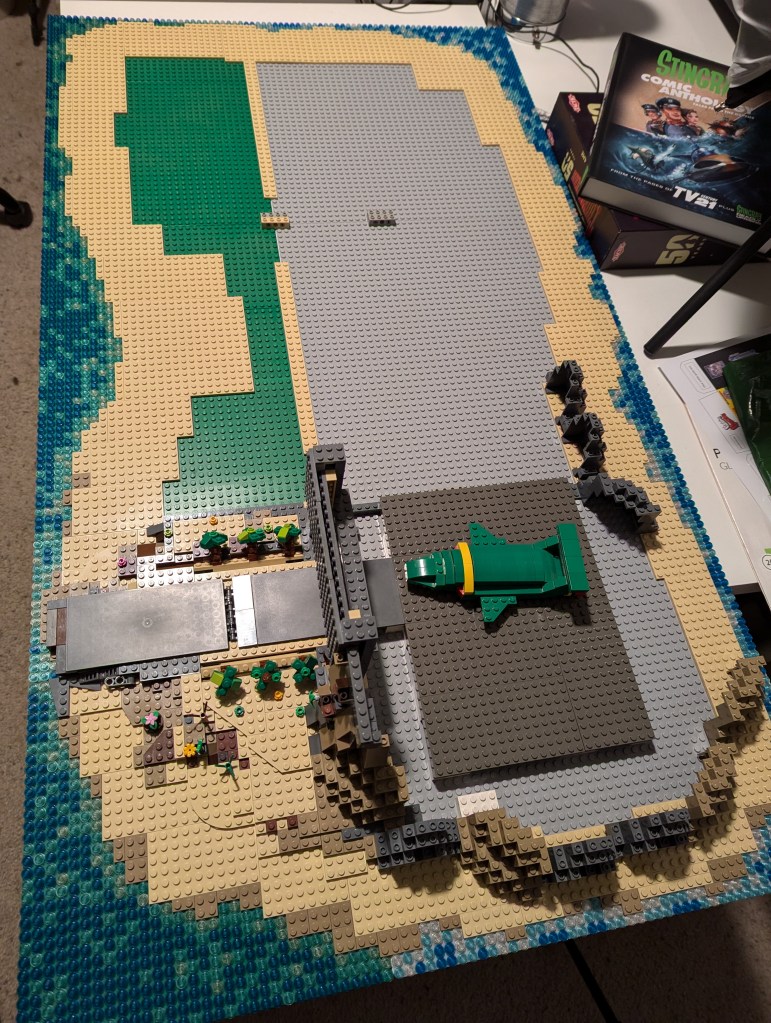
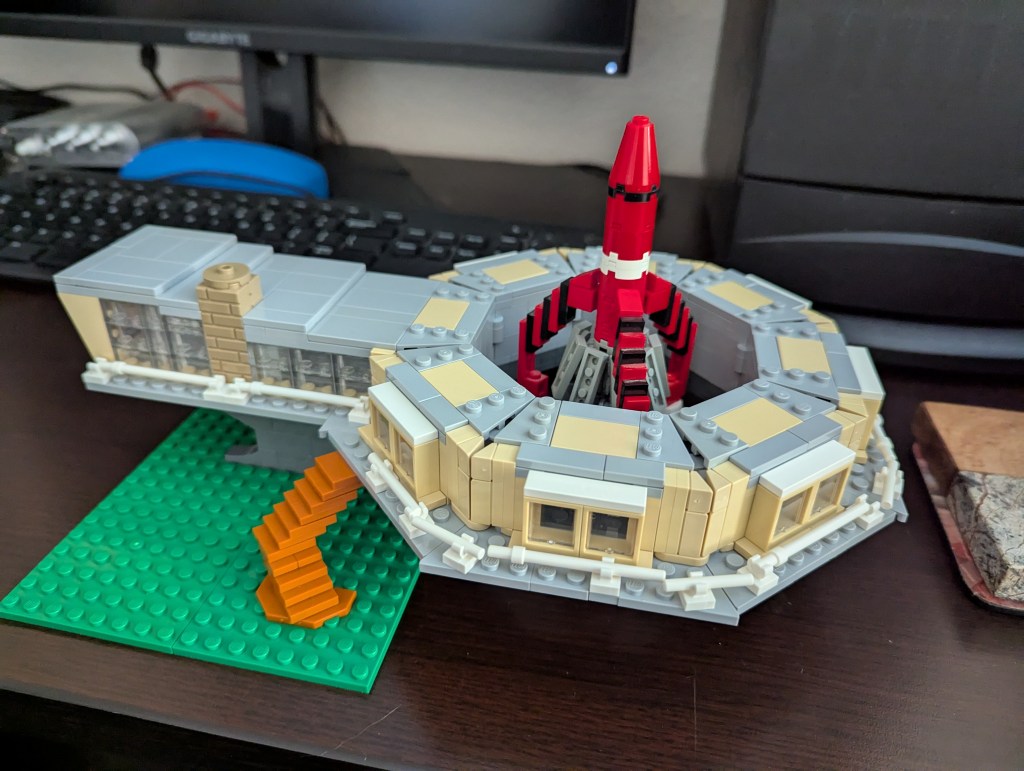
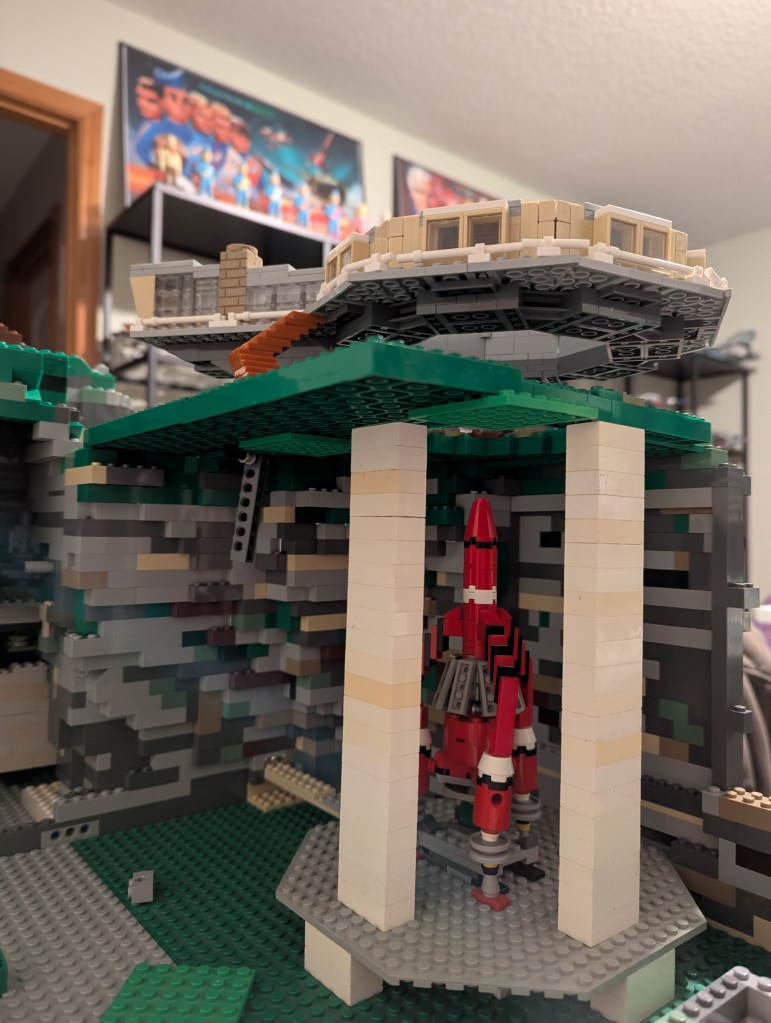
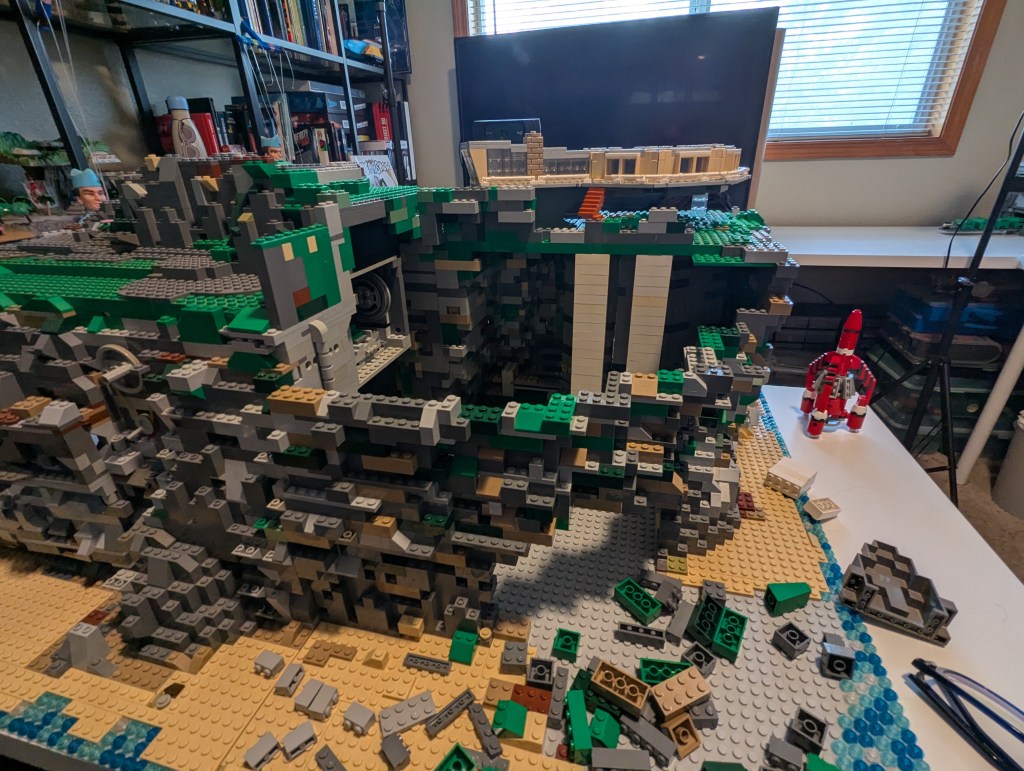
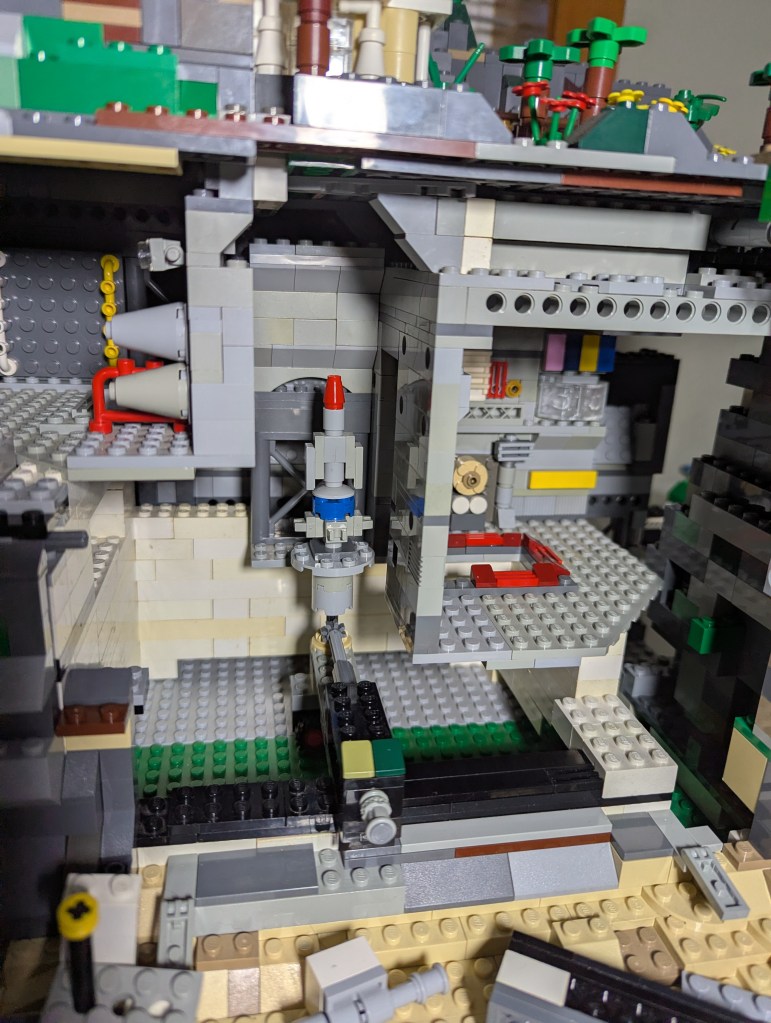
From start to end, the project took about 18 months. Large portions of that time were spent figuring out how to proceed to the next stage, redesigning stuff that didn’t work, or waiting for my birthday to come around so I could beg my wife for more parts. And actually, a chunk of that time has also been spent trying to work out how to present the finished project on camera. Figuring out how the heck to show off this LEGO Tracy Island has been a challenge in itself. I didn’t really build it to be camera-friendly. Some of the interior areas are dark and accessible to eyes and hands rather than cameras and lights. I didn’t put too much pressure on myself to photograph and document the build process because I wanted to just enjoy my LEGO-building hobby and see where it took me.
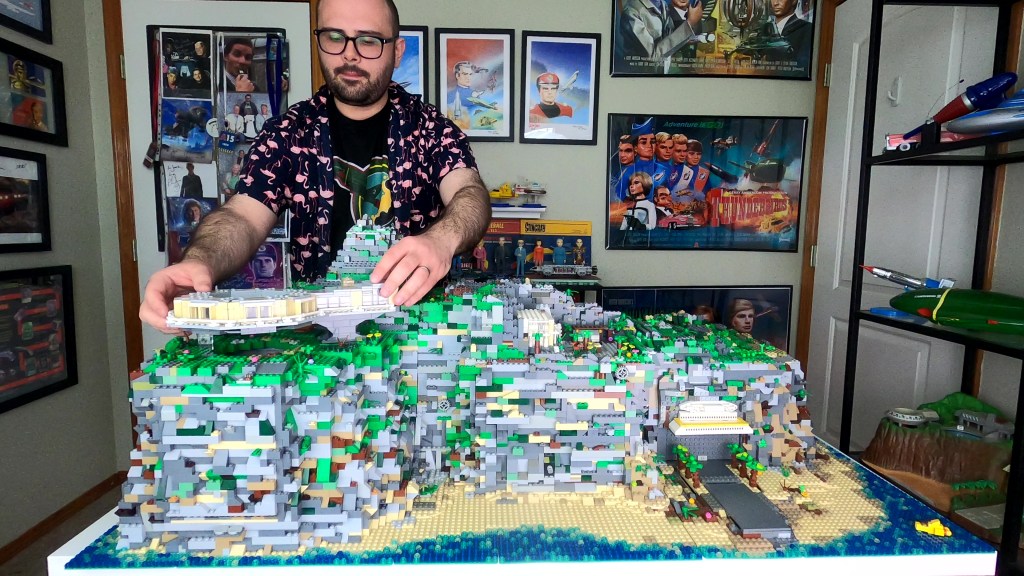
This LEGO Tracy Island is a real, tangible, tactile, hand-designed expression of what my Thunderbirds and LEGO enthusiasm mean to me. It’s big – obnoxiously big in a brilliant way. It’s intricate and detailed. It’s imperfect. It’s a joy to get your hands on and play with. All of these qualities scream LEGO and Thunderbirds to me. How thrilling to express that and share it with like-minded enthusiasts.
I have to say some enormous thank yous to Andrew Clements and Ben Wolf Page for cheering me on through the ups and downs of this project. My family have also been hugely supportive as more and more boxes of LEGO have arrived and been quickly transformed into cliffs and rocket silos. And, of course, the Security Hazard Patreon supporters have contributed to making this project a reality – sorry that I kept teasing you all with this for so long. I hope it was worth the wait.
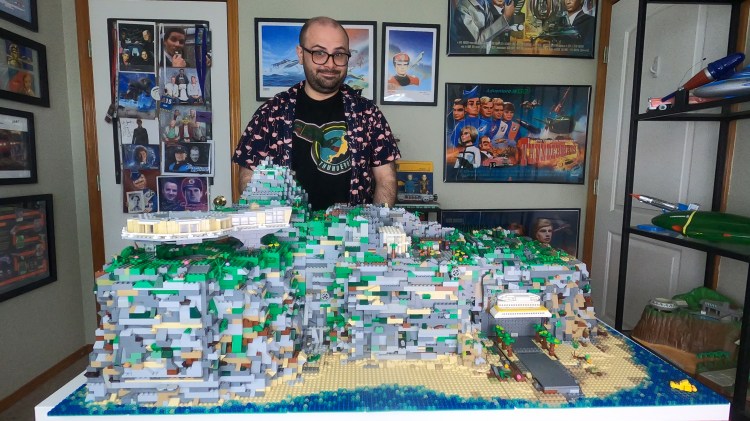
They say no man is an island, but if I was an island I think it would definitely be an enormous Thunderbirds island made of LEGO.
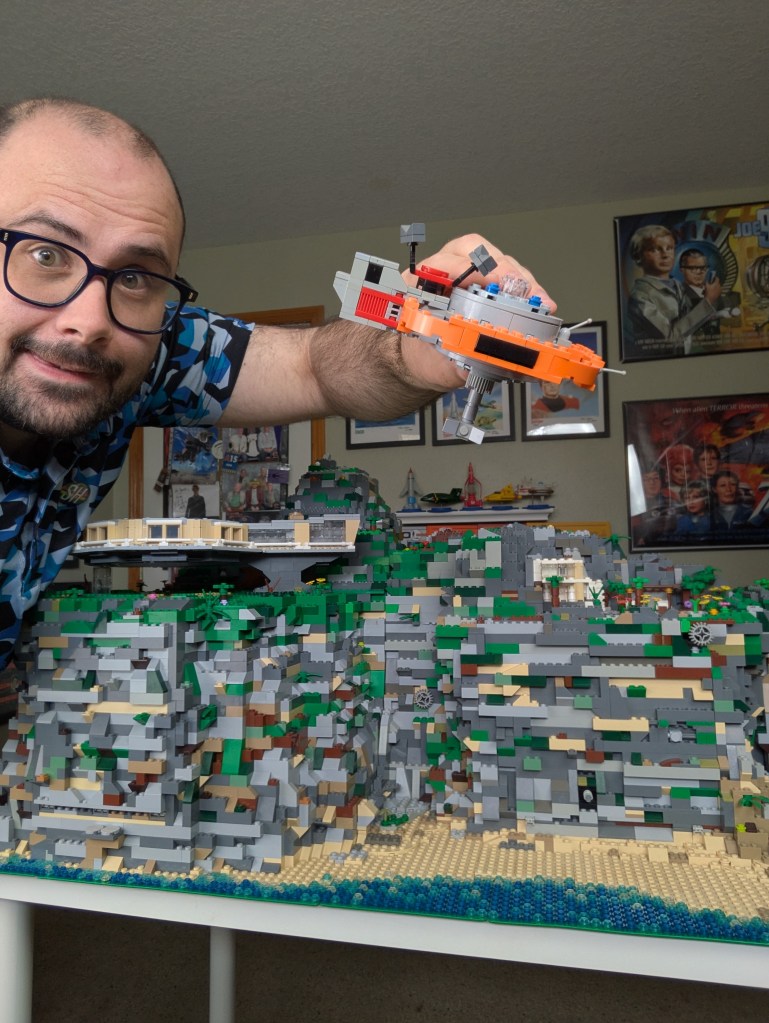
P.S. Here’s Thunderbird 5, floating in orbit far too high above Tracy Island to be seen…


Absolutely marvellous!!
LikeLike
This is absolutely incredible! However, there’s just one issue… where’s Thunderbird 5?
LikeLike